Surprise Billing Arbitration Outcomes and IDR Ruling Patterns for Practices
High-volume filers and private equity dominance tilt IDR outcomes far from independent practices.

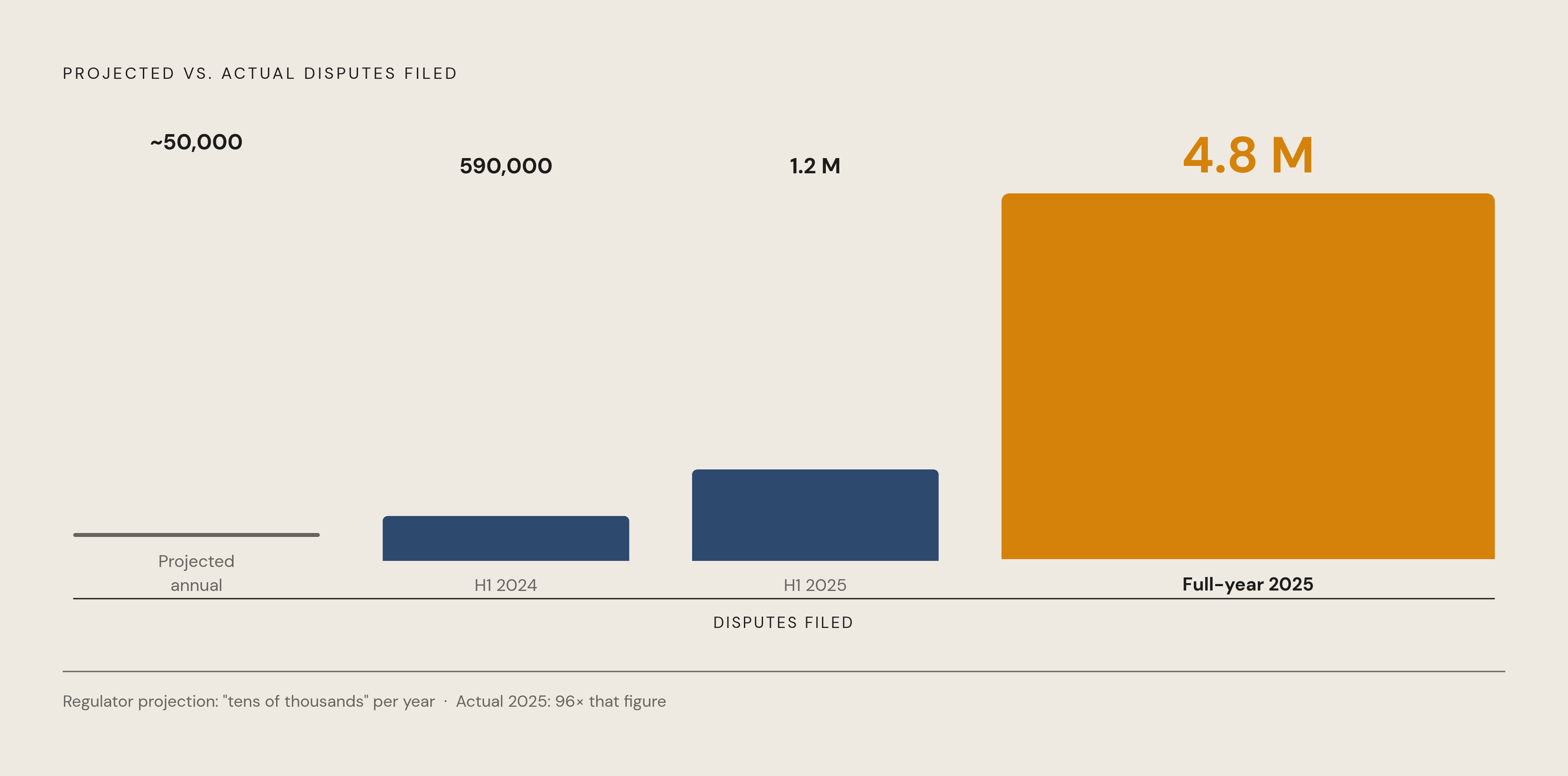
Congress built the independent dispute resolution process to settle out-of-network payment disagreements between insurers and providers after it passed the No Surprises Act in December 2020. The design was modest by intention. Federal regulators projected only tens of thousands of standard disputes a year, according to Georgetown University's Center on Health Insurance Reforms in a study published in Health Affairs. That projection has almost no relationship to what the system now processes. CMS data show that 1.2 million new disputes were filed in the first six months of 2025 alone, more than double the roughly 590,000 filed over the same period in 2024. That volume pushed total disputes submitted from 2022 through June 2025 into the millions.
The second half of 2025 did not slow down. CMS's own supplemental background for the year states that disputing parties initiated 1,372,563 disputes between July 1 and December 31, 2025, bringing the full-year total to 4.8 million cases. The process itself has not changed: both the insurer and the provider submit what each believes is a fair payment amount, and a certified third-party arbiter picks one of the two offers in full, with no splitting the difference. That binary, winner-take-all structure means the entire outcome rides on the quality and completeness of what each side files, which has become a serious barrier in a system now moving several million cases a year. A process sized for tens of thousands of annual disputes and now handling millions does not run the same way at both scales, and the volume alone has changed who can realistically compete in it. Filing at this scale takes staff, data infrastructure, and legal capacity that most independent and small-group practices do not carry in-house, and that resource gap is the starting point for understanding everything that follows about who wins and who doesn't.
Why providers win as often as they do
Providers won the large majority of IDR disputes resolved in the first half of 2025, the highest win rate recorded since the process began and a continuation of an upward trend running back several years, based on CMS data analyzed by Georgetown CHIR. Taken at face value, that number suggests arbitration is simply favorable terrain for providers. The reality underneath it is narrower. A small number of large, private-equity-backed organizations file an outsized share of all disputes and win at rates that have little to do with how the typical independent practice would fare on its own.
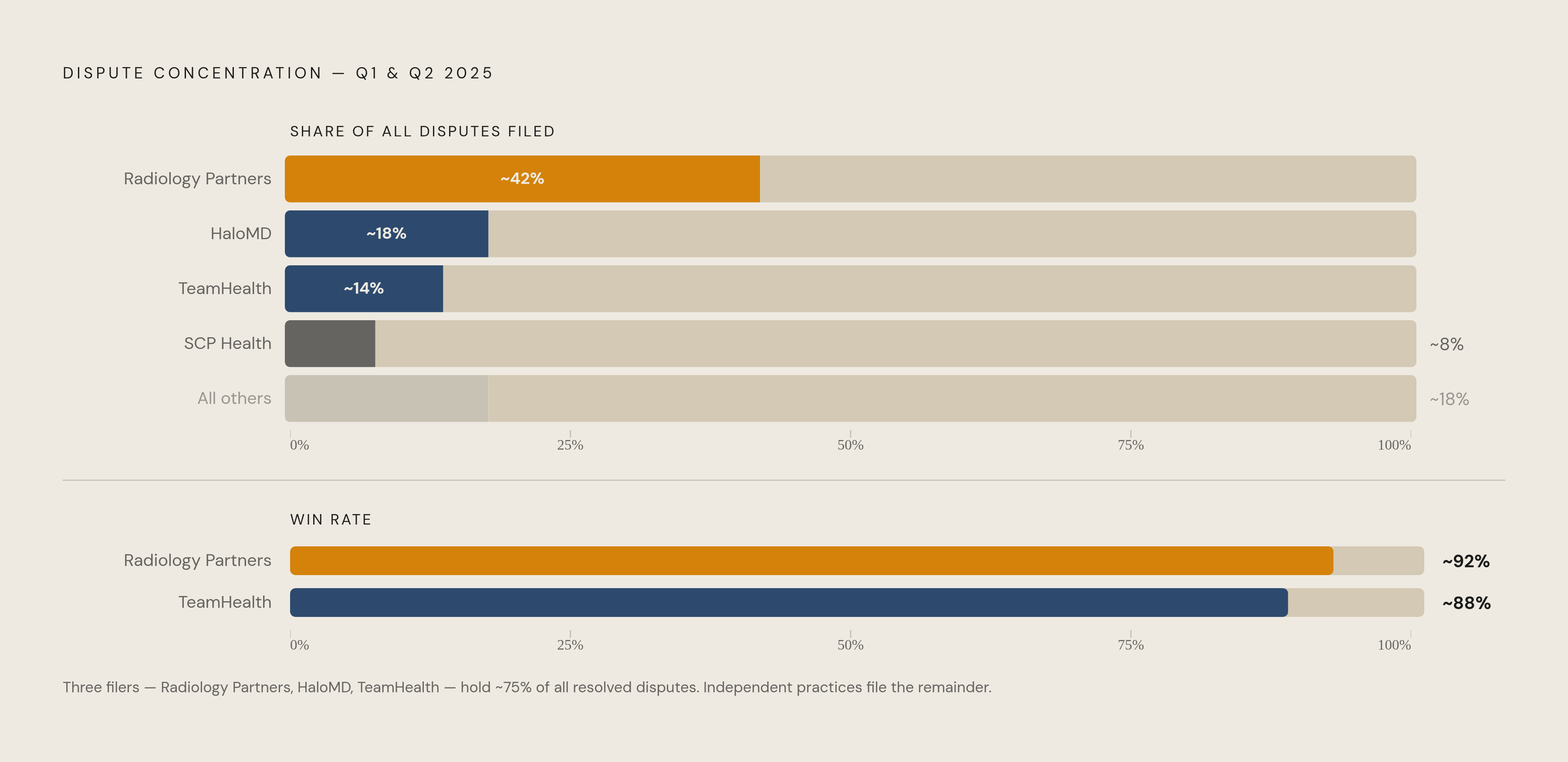
Radiology Partners prevailed in more than nine out of ten of its disputes in both the first and second quarters of 2025. Team Health won at a comparably dominant rate across both quarters. Those are not outlier results from a handful of cases. Georgetown's Health Affairs study found that three organizations, Radiology Partners, HaloMD, and TeamHealth, together account for nearly three-quarters of all resolved disputes, with each holding a substantial share on its own. HaloMD, a billing and arbitration intermediary built to represent providers in IDR rather than a treating provider, saw its growth tell its own story: it went from a negligible share of disputes in 2023 to a substantial portion of the entire system by 2025, a trajectory built around filing volume at scale. If Team Health, Radiology Partners, and SCP Health are added to HaloMD, those four initiating parties accounted for more than half of every dispute filed in the first two quarters of 2025.
That concentration matters because it explains a gap that would otherwise look contradictory. Peer-reviewed research in Health Affairs Scholar found that private-equity-backed emergency physician groups won only 39% of their disputes, a figure far below the headline provider win rate reported industry-wide. Large organizations filing thousands of disputes a year have built systems, staff, and legal processes purpose-built for IDR, while a single-location or small-group practice filing its first dispute competes in the same arena with none of that apparatus behind it, and that infrastructure gap, not the merits of any individual claim, explains the difference in outcomes.
The incentive structure inside arbitration itself compounds the imbalance. Arbitrators set their own fees within ranges predetermined by CMS, and the losing party pays. Georgetown CHIR notes that IDR entities are paid on a per-dispute basis and are not paid for disputes they find ineligible, giving arbiters a financial incentive to rule on the merits and issue a payment determination and collect the fee. That incentive rewards whichever party shows up with a complete, well-documented submission, which is precisely the advantage that high-volume filers have built into their operations and that most independent practices have not.
Provider awards and the specialties that gain the most
Winning a dispute is worth a specific amount, and the amount depends heavily on specialty. When providers prevail, the awarded payment routinely and substantially exceeds what an in-network rate would have paid for the same service, though how much it exceeds that rate varies widely across specialties. Georgetown's Health Affairs study found the median 2025 award for emergency medicine claims came in at a multiple of the qualifying payment amount, the benchmark insurers use to represent a typical in-network rate. Separate peer-reviewed research published in PMC found that emergency medicine decisions averaged 2.65 times the relevant QPA, a figure consistent with the broader pattern Georgetown documented.
Neurology and plastic surgery show an even sharper trend. Median awards in both specialties roughly doubled between 2023 and 2025, landing at many multiples of the QPA by the latter year, Georgetown found in the same study. CMS's own supplemental data for the second half of 2025 back up how often this happens broadly: the prevailing offer exceeded the QPA in approximately 87% of payment determinations made during that period. The specialties with the largest awards also happen to be the specialties where the large, PE-backed groups named earlier have the deepest and most established presence, which is not a coincidence so much as a reflection of where those organizations have concentrated their filing operations.
The QPA benchmark that anchors all of these awards is now facing a legal challenge that could reshape the numbers going forward. In August 2026, the full Fifth Circuit ruled that the government's method for calculating the QPA was partly unlawful, siding with the Texas Medical Association on two of the three issues it raised. If that ruling stands and reshapes how QPAs are calculated, arbitration awards tied to that benchmark could move higher heading into 2027. Practices evaluating whether to file a dispute now or wait face a developing legal matter rather than a settled rule that has already changed how awards are calculated. Practices weighing the timing of a dispute should treat it as a factor to watch, with no guarantee yet locked in.
Eligibility gatekeeping is now the primary barrier practices face
High provider win rates and large awards describe only the disputes that reach a merits decision. A growing share of disputes never gets that far, and eligibility challenges, not losses on the merits, have become the primary way practices lose in IDR. A practice that cannot clear the eligibility threshold loses the arbitration outright and still has to absorb the administrative costs of having filed it.
Plans challenged 40 percent of cases as ineligible for the federal IDR process in the first half of 2025, Georgetown CHIR found. CMS data show that share kept climbing through the second half of the year, a consistent upward trend. The incentive problem described earlier works against practices here too: because arbitrators are not paid for disputes they rule ineligible, Georgetown CHIR notes they have a financial reason to deem disputes eligible and proceed to a payment determination rather than dismiss them, which means some disputes that should have been screened out on eligibility grounds are reaching merits review anyway. Both the Trump administration's 2026 rule and insurer lobbying groups are now targeting that exact failure point.
State-level data shows what happens when eligibility gets enforced the way it is supposed to be. Providers prevailed in a large majority of federal IDR disputes in 2024, but in fewer than half of disputes resolved through Virginia's state-level IDR system, which applies explicit eligibility guardrails and state guidance before a case proceeds, Georgetown CHIR found. That gap functions as a working model of what stricter eligibility enforcement does to provider win rates once it is actually applied.
The backlog adds another layer of cost. Georgetown CHIR found that despite IDR entities closing more disputes than were newly filed during the first half of 2025, hundreds of thousands of disputes remained outstanding as of late June 2025, and two-thirds of determinations took longer than the 30-day period the process requires. IDR administrative fees collected in the first half of 2025 alone came close to matching the total fees collected across all of 2022 through 2024 combined, Georgetown CHIR found. A practice that pays those fees and then gets dismissed on an eligibility challenge recovers none of it. Eligibility has become a contested front of its own inside the arbitration process, one that now determines more outcomes than the merits review it is supposed to precede.
What the 2026 IDR reform rule changes for practices
The eligibility bottleneck and the administrative cost burden it creates are what the federal government's 2026 IDR reform rule was written to address. The Departments of Health and Human Services, Labor, and Treasury, along with the Office of Personnel Management, finalized the rule on May 28, 2026. It modestly favors practices that come prepared, though it leaves unresolved several of the broader structural questions insurers have continued pressing Congress to fix. The Blue Cross Blue Shield Association called the rule meaningful progress while still pushing for further action on what it described as the flood of ineligible claims entering arbitration and awards that often far exceed what providers typically receive for a service, and insurers have continued lobbying Congress on No Surprises Act reform even after the rule's release.
One of the rule's concrete changes requires insurers to use standardized claim codes when communicating with providers about out-of-network disputes. That gives providers a clearer, earlier way to assess whether a claim actually qualifies for IDR before they commit the time and the filing fee to submitting it, addressing part of the eligibility confusion that has been driving so many disputes into merits review when they should never have gotten there.
The rule also sets a five-day window for parties to submit additional information once the certified IDR entity requests it, specified in CMS's fact sheet as five business days. For a practice preparing to file, that window is tight enough that eligibility documentation needs to be assembled and ready before submission, not pulled together after a challenge arrives. A practice that waits until an insurer disputes eligibility to start gathering the records that prove a claim qualifies is already behind the clock the rule has set. Given how much of the current system turns on eligibility rather than the merits of the underlying claim, that single procedural detail may matter more to a small or mid-size practice's odds of success than anything in the award data itself.