Aetna Prior Authorization List Expansions by Specialty
Aetna's staggered PA updates across five systems create mid-cycle surprises for every specialty.

Aetna runs three separate prior authorization systems, split by benefit type and service line, and a request that lands in the wrong one does not get rerouted. It just sits there until it becomes a denial. Every specialty section below is really a variation on the same warning: know which door to knock on, because Aetna's own staff will not walk you over to the other two.
Aetna runs three separate prior authorization systems, and a request routed to the wrong one does not get redirected, it generates a denial. CVS Caremark handles pharmacy and specialty drugs; EviCore handles high-cost specialty services including advanced imaging, cardiology, and musculoskeletal procedures; and Evolent handles oncology regimen review. For radiation oncology, the expanded Aetna Radiation Oncology Code List took effect January 1, 2026, adding CPT codes to the Evolent-reviewed roster, meaning radiation treatment plans that did not need prior auth in 2025 may require it now, and submitting them to EviCore out of imaging habit produces a silent non-response rather than a routable denial. Interventional pain got its own dedicated Aetna Interventional Pain Code List effective January 1, 2025, managed at the CPT code level, so a code that cleared without PA in 2024 can sit on the new list while the adjacent code in the manual stays untouched.
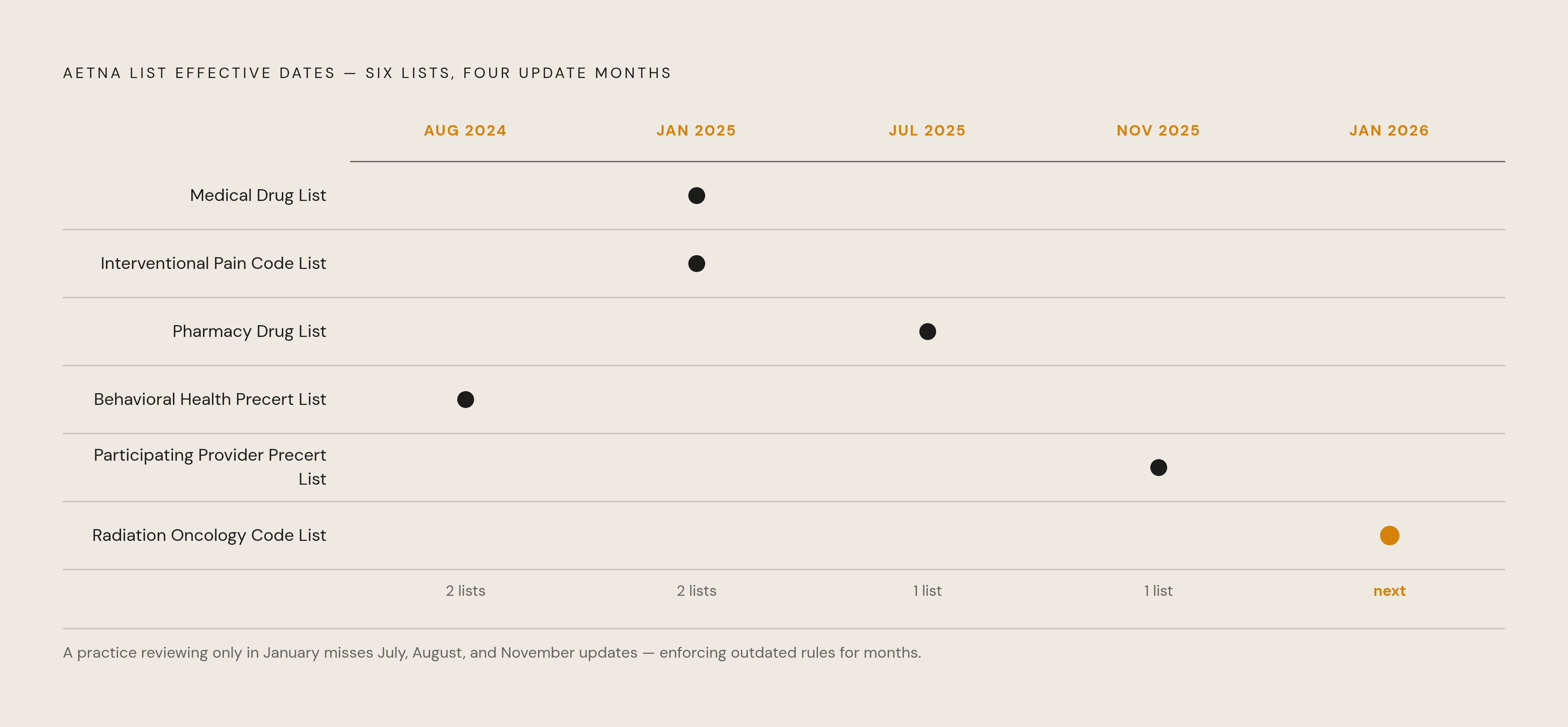
The participating provider precertification list was last updated November 1, 2025, and a new cycle for 2026 has already begun stacking changes on top of it. The biggest 2025 change sent services, including medications and radiation treatments given in physician offices, outpatient hospitals, and ambulatory settings, to Evolent for review, for members 18 and older with qualifying diagnoses. Then, effective January 1, 2026, a new Aetna Radiation Oncology Code List took hold: a wider set of CPT codes now needs sign-off before radiation can proceed. A parallel Aetna Interventional Pain Code List had already gone live a year earlier, on January 1, 2025, adding a run of pain procedure codes to the PA rolls.
Pharmacy runs on its own clock entirely. Aetna updated its pharmacy drug lists on July 1, 2025, and that update pushed step therapy and quantity limit changes downstream into rheumatology, dermatology, and gastroenterology. A separate round of changes to the medical drug lists took effect earlier, on January 1, 2025, while behavioral health has not seen a list update since August 1, 2024, at least as of this writing. That quiet stretch is the trap most practices walk right into: a specialty that assumes stability because nothing has changed recently is exactly the specialty that gets blindsided when the update finally lands.
One change actually cut a requirement instead of adding one, which is rare enough to flag. Effective January 1, 2025, home health care authorizations through Carelon are no longer required in Connecticut, Pennsylvania, and West Virginia. Almost everything else documented across this period moves in the other direction.
Here is where most practices get their process wrong: reviewing the PA checklist once a year, on a single fixed date, guarantees you are wrong for most of it. January, July, August, November: four different effective-date months across five different list types, none synced to a single annual calendar. A practice that reviews its checklist every January will miss whatever changed in July or November and keep working July's rules well into the following spring. Aetna has said publicly, as of April 2026, that it has standardized most of its prior authorization volume and requires PA on fewer medical services than other national health plans. That may be true in aggregate, but it means little to a rheumatologist whose biologic just picked up a step therapy requirement in July, or to a pain management group that found out in February that three of its bread-and-butter codes joined a new list two months earlier. An aggregate claim about volume says nothing about whether your specialty's list moved.
Musculoskeletal and orthopedics: where bundling meets expanded code requirements
Aetna now offers preauthorization bundles for musculoskeletal conditions, covering X-rays, knee surgeries, certain medications, and related care under one submission. One bundle instead of four separate authorizations sounds like relief on paper, but practices that treat it as a time-saver are miscounting the work: bundling does not shrink the list of services that need PA, and it does not cut the staff hours spent managing them. LUGPA-affiliated practices report more friction, not less, because new code-level additions have eaten up whatever time the bundle was supposed to save.
Routing is where this specialty picks up its own layer of confusion. Advanced imaging, MRI, CT arthrogram, and related musculoskeletal procedures go through EviCore rather than Aetna directly, and appeals on those decisions go to EviCore too, not to Aetna's general appeals desk. Outpatient surgical additions, arthroscopy, joint replacement precertification changes, and DME requirements for braces and orthotics have all piled on top of the imaging pathway. An orthopedic practice is often juggling EviCore review for imaging, Aetna's own list for surgical codes, and a separate DME process, all for one patient's episode of care.
Medicare Advantage adds a fourth wrinkle, and this one is geography-specific. For Aetna MA members in New Jersey, New York, Pennsylvania, and West Virginia, post-acute care authorizations, skilled nursing and inpatient rehab, have to run through the MedSolutions portal starting January 1, 2026. That is a separate system from the EviCore pathway used on the commercial side, and it applies only in those four states. A practice that treats Medicare Advantage orthopedic referrals the same way it treats commercial ones, region-blind, will find out the hard way that MedSolutions and EviCore do not talk to each other.
The stakes back this up. Orthopedic practices carry some of the highest PA denial exposure of any specialty nationally, with a meaningful share of revenue tied directly to advanced imaging and surgical PA denials. Underneath it all sits a quiet trap: a practice that has ordered the same imaging study or procedure code for years without needing prior auth can find that code newly listed mid-cycle, with nothing about the clinical service having changed. Aetna just added the code, and that is reason enough.
Cardiology and advanced imaging: EviCore as the effective decision-maker
Treating EviCore like a rubber stamp is the single most costly assumption a cardiology practice can make. EviCore reviews these requests with real clinical scrutiny, and non-urgent requests get decided within two to three business days once all the clinical information is in hand; urgent requests move faster, 24 hours for Medicare and Medicaid members, 72 hours for commercial members. Those clocks only start once the submission is complete, and EviCore employs medical directors across a wide range of specialties, so incomplete documentation is a routine, avoidable cause of both delay and denial.
Cardiology already sits high on the list of specialties with the worst PA denial rates nationally, and Aetna's delegated model sharpens that exposure rather than softening it. A practice that appeals a cardiology imaging denial to Aetna, instead of to EviCore, gets no substantive answer at all, because the appeal window closes while the request sits with an entity that never had authority over the decision in the first place.
Radiology adds one more distinction worth holding onto. The 2026 radiation oncology code list expansion runs through Evolent, not EviCore. A practice handling both diagnostic imaging and radiation oncology for the same patient is managing two entirely separate delegated review channels at once, each with its own portal, its own appeal process, its own clinical review staff. Submitting a radiation oncology plan to EviCore, out of imaging habit, produces the same silent non-response that plagues every other misrouted request in this ecosystem.
Oncology: Evolent's scope and the compounding complexity of combination regimens
Evolent's job for Aetna oncology is regimen review, and the scope runs wider than most practices assume going in. It covers full cancer treatment regimens: supportive drugs, new-to-market medications, new indications, and, critically, combination regimens that span both the medical benefit and the pharmacy benefit inside a single review. That last point is where people trip, and it is worth stating plainly: splitting a combination regimen into a medical-side submission to Evolent and a separate pharmacy-side submission to CVS Caremark generates two incomplete requests instead of one complete one, and both stall. A regimen with one drug billed under medical and another under pharmacy still goes to Evolent as one unified submission.
The scope of services routed to Evolent, for members 18 and older with qualifying diagnoses, expanded further with the November 1, 2025 precertification list update. Radiation oncology runs on a parallel but separate track: the expanded Aetna Radiation Oncology Code List, effective January 1, 2026, adds CPT codes to the roster, and it is worth confirming the current list before submitting any radiation treatment plan, since the code set has moved twice in about a year.
Then there is the drug list layer sitting underneath the regimen approval. Aetna's July 1, 2025 pharmacy drug list update and the January 1, 2025 medical drug list changes both touch oncology-adjacent biologics and specialty injectables, and step therapy tied to those lists can delay a regimen's start even after Evolent has already approved it. Getting the regimen authorized is a step, not a finish line; the individual drug still has to clear its own step therapy gate on its own timeline.
The money at stake here is real. Per-claim denial values in oncology run among the highest of any specialty, a direct function of what biologics and specialty injectables cost. Appeal overturn rates run strong when the documentation is complete, which is exactly why working every oncology denial the day it lands, instead of letting it sit in a queue, is the decision that actually protects revenue. Oncology practices are, in a real sense, the stress test for Aetna's whole tripartite system: Evolent for the regimen, EviCore for any imaging in the workup, CVS Caremark for standalone pharmacy benefit drugs, all three touched inside a single patient's care episode.
Which system handles interventional pain, and what changed with its code list in 2025?
Aetna built a dedicated Aetna Interventional Pain Code List, effective January 1, 2025, and the existence of that list says something on its own: PA here is managed procedure by procedure, at the CPT level, rather than by broad category. That distinction has teeth. A code that did not need PA in 2024 can appear on the list in 2025 while the code sitting right next to it in the CPT manual stays untouched. "Epidural injections require PA" is no longer accurate enough as a rule of thumb; it has to be checked code by code, every cycle, with no shortcuts.
Medicare Advantage denial rates for interventional pain procedures have climbed sharply in recent years, and that climb has carried into 2026, making MA the highest-risk payer segment in this specialty by a clear margin. Part of what is driving it is automation, and this is the part practices underestimate: denial decisions that used to take a payer's staff several business days to work through now come back in hours, generated by algorithms rather than a human reviewer. Per the AMA's 2025 Prior Authorization Survey, those automated denials come back at meaningfully higher rates than human-reviewed ones. That is not a coincidence; an algorithm denying on pattern-match has no reason to extend the benefit of the doubt a human reviewer might.
Run the arithmetic on a practice doing a solid monthly volume of epidural steroid injections: apply a realistic PA denial rate, apply a partial appeal recovery rate on top of that, and the unrecovered revenue adds up to a serious number over a year. Batching denials instead of working them immediately is the choice that produces that number, and the money left on the table scales directly with how long a denial sits untouched.
Behavioral health: where parity law complexity compounds PA denial exposure
Behavioral health's precertification list was last updated August 1, 2024, and practices in this specialty need to check, actively, whether a more recent update has landed since. Aetna's staggered, non-calendar release schedule makes any assumption about "current" rules unreliable once enough time has passed. That checking is the baseline expectation here, not an optional extra.
Behavioral health carries the highest denial rates of any specialty category Aetna covers, running well above the national average and above most surgical specialties too. What sets it apart from orthopedics or cardiology is the cause. Denials here trace mainly to mental health parity law, which requires payers to apply the same non-quantitative treatment limitations to behavioral health benefits as they apply to medical and surgical benefits, rather than to missing paperwork or coding mistakes. Disagreements over what counts as an "equivalent" limitation, how strict a concurrent review schedule can be, how a medical necessity criterion gets worded: these are a persistent, structural source of denial that has nothing to do with whether the practice submitted the right form.
That has a direct consequence for how appeals get argued, and most practices get this wrong: they run a behavioral health denial the same way they'd run a documentation-based imaging appeal, and that wastes the strongest tool available. A behavioral health denial is contestable on parity grounds specifically, meaning the argument that carries the most weight is that a limitation applied to this claim would never be applied to a comparable medical or surgical claim. Lead with that argument, ahead of any paperwork detail.
Concurrent review compounds the burden further. Inpatient behavioral health authorizations are frequently granted in short increments, which means reauthorization has to happen repeatedly during a single inpatient stay, a cadence far more demanding than what most other specialties deal with.
Rheumatology, dermatology, and gastroenterology: the specialty drug list as a moving PA trigger
Aetna's pharmacy drug list update on July 1, 2025, and its medical drug list update on January 1, 2025, both sent cascading step therapy and quantity limit changes into rheumatology, dermatology, and gastroenterology. These three specialties run on biologics and specialty drugs more than most, so drug list changes hit them harder and more often than the precertification list itself does.
Step therapy deserves to be called what it actually is: a second PA layer that never shows up on the precertification list at all. A drug can be approved in principle and still be blocked in practice, because the patient has to try and fail a preferred, cheaper agent first. That requirement lives on the drug list, not the precertification list, so a practice checking only the precertification list is checking half the picture and does not know it.
Routing compounds the confusion further. Specialty drugs under the pharmacy benefit go through CVS Caremark, not Aetna, not EviCore. A rheumatology biologic submitted through the medical precertification portal, when the drug is actually a pharmacy benefit item, gets silence, not a denial with a reason attached. Specialty injectables given in-office under the medical benefit are different again: they route to Evolent if the diagnosis code qualifies as oncology or otherwise in-scope, or to Aetna's own medical precertification team if it doesn't. The same drug, administered in the same exam room, can route to two different reviewers depending only on which diagnosis code lands on the claim.
Quantity limits stack on top of step therapy instead of replacing it. Even after a patient clears step therapy, the July 2025 quantity limit changes can cap the authorized dose below what the physician actually prescribed, which throws off a partial denial requiring its own separate appeal. Practices in these three specialties are best served treating the drug list as a living document, reviewed on the same schedule as the precertification list itself, since July has become an established second update point on the calendar.
How to build a PA routing map that doesn't go stale between list updates
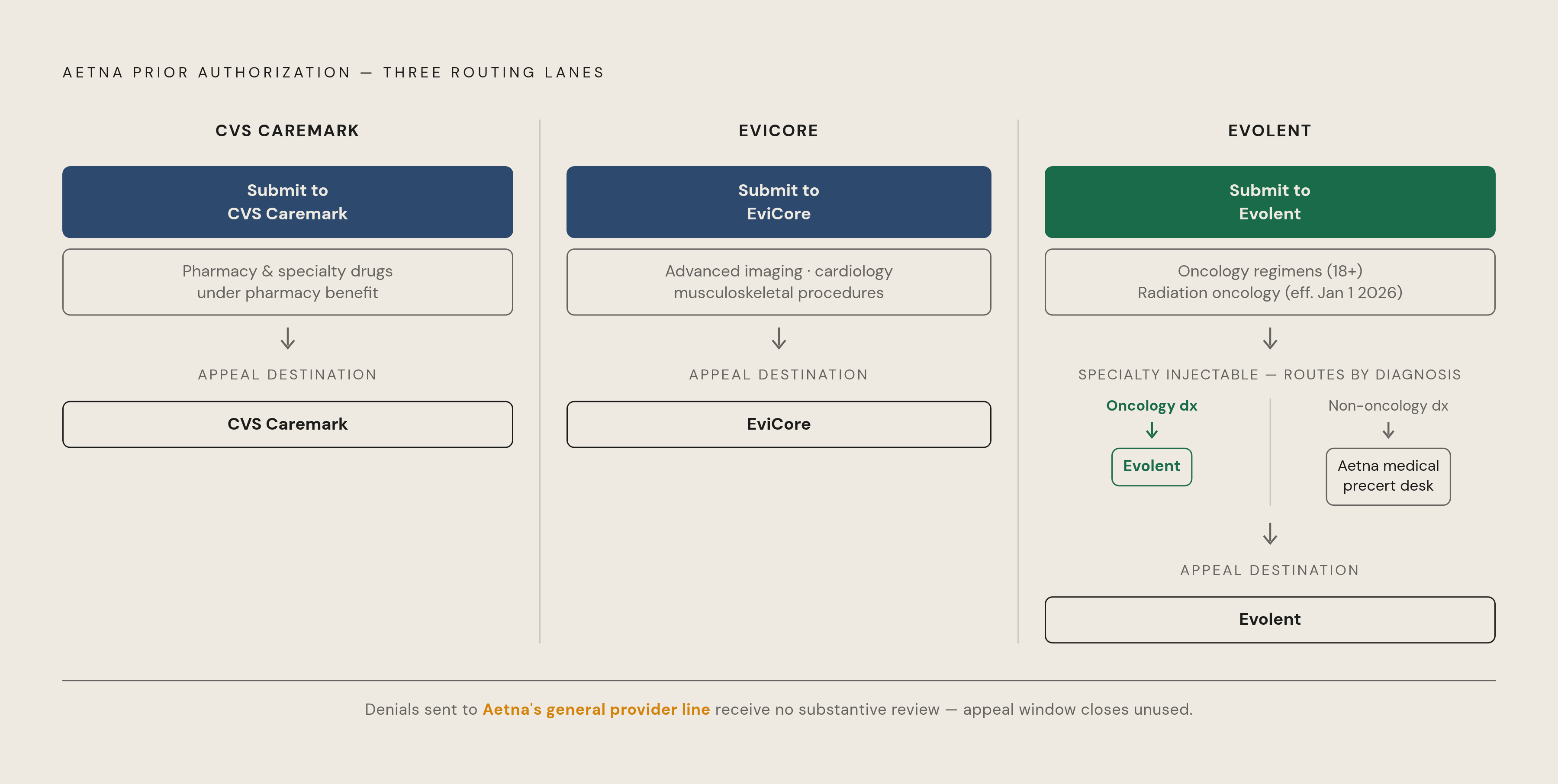
The fix here is a routing map, kept current, that tells staff which of three doors a given request goes through before anyone starts filling out a form, rather than more effort spent per authorization. Aetna's system has three lanes: CVS Caremark for pharmacy and specialty drugs, EviCore for high-cost specialty services like advanced imaging, cardiology, and musculoskeletal procedures, and Evolent for oncology regimen review and, separately, radiation oncology. A map with fewer than three lanes is already wrong, full stop.
The map has to be organized by service line and diagnosis code, not by payer name alone, because the same drug or the same imaging study can route differently depending on the diagnosis attached to the claim. A specialty injectable with an oncology diagnosis goes to Evolent; the identical injectable with a non-oncology diagnosis goes to Aetna's own medical precertification desk instead. A routing map that says "biologics go to CVS Caremark" without a diagnosis-code branch built in will misroute a meaningful share of submissions on its own.
Update cadence matters as much as structure does. Aetna's effective dates land in January, July, August, and November across different list types, and a map reviewed once a year on a fixed date will always be behind on at least two of those four cycles. The practical fix is to check for updates on each of those four months specifically, rather than trusting one annual review to catch everything at once.
Appeals need their own line on the map, separate from initial submission, because the two do not go to the same place by staff habit, even when they should. Every EviCore denial appeals to EviCore, and every Evolent denial appeals to Evolent. An appeal sent to Aetna's general provider line for either one does not get redirected; it just fails to generate a substantive review, and the appeal window closes while nothing happens on the other end.
Geographic exceptions belong on the map explicitly, not as a footnote someone has to remember under pressure. The MedSolutions requirement for Medicare Advantage post-acute care in New Jersey, New York, Pennsylvania, and West Virginia, effective January 1, 2026, applies only in those four states. A national routing rule that ignores that carve-out will misroute every MA post-acute request that originates there.
Volume and timing are what make this hard rather than complicated in principle: three delegated entities, four update months, and diagnosis-dependent routing that changes the answer for the same drug or procedure depending on context. A map built once and left alone will be wrong within a quarter, and a quarterly build cycle is the minimum, not an aspiration. The version that holds up is checked against Aetna's actual update calendar, four times a year, at the months Aetna itself uses, not the month that happens to be convenient for staff scheduling. Practices that lack the internal bandwidth to maintain that cadence have turned to services like Altair Health, an AI-powered medical billing service backed by in-house expert billers who track payer-specific policy shifts and work denials the moment they land, so payer behavior changes don't quietly bleed revenue between annual reviews.