Prior Authorization Burden Data and Physician Practice Time Costs
Physicians spend 13 hours weekly on prior authorizations, with denial rates varying wildly by payer.

Prior authorization has stopped being a narrow cost-control checkpoint and become something closer to a second job for physicians and their staff. The numbers now attached to that job, hours per week, dollars per physician, denial rates by payer, are specific enough to change how a practice decides to manage the process, not just endure it.
The term itself is simple: a payer requires advance approval before it will cover a medication, test, procedure, or piece of equipment. The definition is consistent across payers and regulators: a request submitted for review before the service happens and before any claim goes in for payment. What started as a check on a small number of high-cost services has spread across nearly every specialty and most major payers, and the criteria for approval remain inconsistent enough that practices often can't predict which requests will need authorization or what documentation will satisfy a given plan. Payers describe the requirement as necessary for cost control and verifying medical necessity. Physicians describe it as a barrier that slows down care they've already decided a patient needs. Small and independent practices absorb a disproportionate share of this burden: they lack dedicated compliance staff, run leaner staff-to-physician ratios, and lose whatever institutional memory they've built up every time an employee who understood a payer's quirks leaves.
The weekly volume of authorization work physicians and staff are actually carrying
The 2025 AMA Prior Authorization Physician Survey, which polled 1,000 practicing physicians (400 in primary care, 600 specialists) in December 2024, puts a number on what had mostly been described anecdotally. Physicians complete an average of 40 prior authorizations per week, per physician. Nearly one in three (32%) say requests are often or always denied, which means a meaningful chunk of that 40-per-week volume produces no approved claim at all.
Two in five physicians (40%) now employ staff whose entire job is prior authorization. That is not merely a management preference. It's what happens when volume crosses a threshold that a receptionist or a nurse working the phones between patients can no longer absorb.
The 40-per-week figure also isn't spread evenly. Specialties such as oncology and cardiology tend to carry a heavier concentration of complex, document-heavy requests than a general primary care panel. And the number understates the real load anyway: a denied and resubmitted request generates a full second round of work, on top of peer-to-peer calls and appeals that add to the burden beyond the original request.
The 13 hours per week that authorization consumes and where that time actually goes
According to the same 2025 AMA survey, prior authorization eats up 13 hours of physician and staff time every week. That time splits across a handful of tasks: pulling together clinical documentation and filing the initial request, then following up on it, because payers don't proactively tell a practice where a pending request stands. Add peer-to-peer review calls, where only 16% of physicians say the health plan representative on the other end often or always has the right qualifications to be making the call. Then add appeals for whatever gets denied.
That 13-hour figure is a practice-wide average across physician and staff time combined, not a per-physician number, so the real burden depends on how many physicians are splitting that overhead. A solo or two-physician practice absorbs a structurally bigger hit than a ten-physician group facing the same total hours, because there are fewer people to spread it across.
The cost of managing this process has grown faster than reimbursement rates have kept pace with, a pattern consistently reflected in practice management research. The cost of managing this process is growing faster than the revenue that's supposed to fund it.
Part of why the time cost compounds: payer criteria shift without warning. Staff have to relearn what a given plan requires on a rolling basis, and whatever institutional memory they built up around last year's rules becomes worthless the moment a payer updates its policy.
What prior authorization costs a practice in dollars, from individual physicians to group practices
A study in the Journal of the American Board of Family Medicine put the annual cost of prior authorization to an individual primary care physician between roughly $2,161 and $3,430. That's a direct operational cost, separate from any revenue the practice loses when requests get denied.
Physicians want to be paid for this work. A Physicians Practice survey found 97% believe payers should be required to reimburse prior authorization labor through a dedicated CPT code. Right now, that labor is uncompensated at scale: the 40% of practices carrying dedicated PA staff are funding those salaries entirely out of practice revenue, with no offsetting payment from the payers generating the requests.
For group practices, dollar exposure scales with physician count, and it depends heavily on precision. A specialty group's exposure to denial-related losses often comes down to whether the authorization details, rendering provider NPI, date-of-service range, place of service, match the claim exactly. Mismatches on any of those fields can trigger denials that bypass meaningful human review.
Missed or failed prior authorizations are a recurring and significant driver of claim denials, alongside issues such as missing patient data and eligibility failures. That puts authorization squarely among the drivers of aging accounts receivable and eventual write-offs. Treating authorization as a clinical administrative chore rather than a revenue-cycle function misses the point: a failed authorization doesn't just delay a patient's care. It can turn into a denied claim, and if nobody works that denial before the deadline, the revenue is gone for good.
How denial rates vary by payer and why the range matters operationally for practices
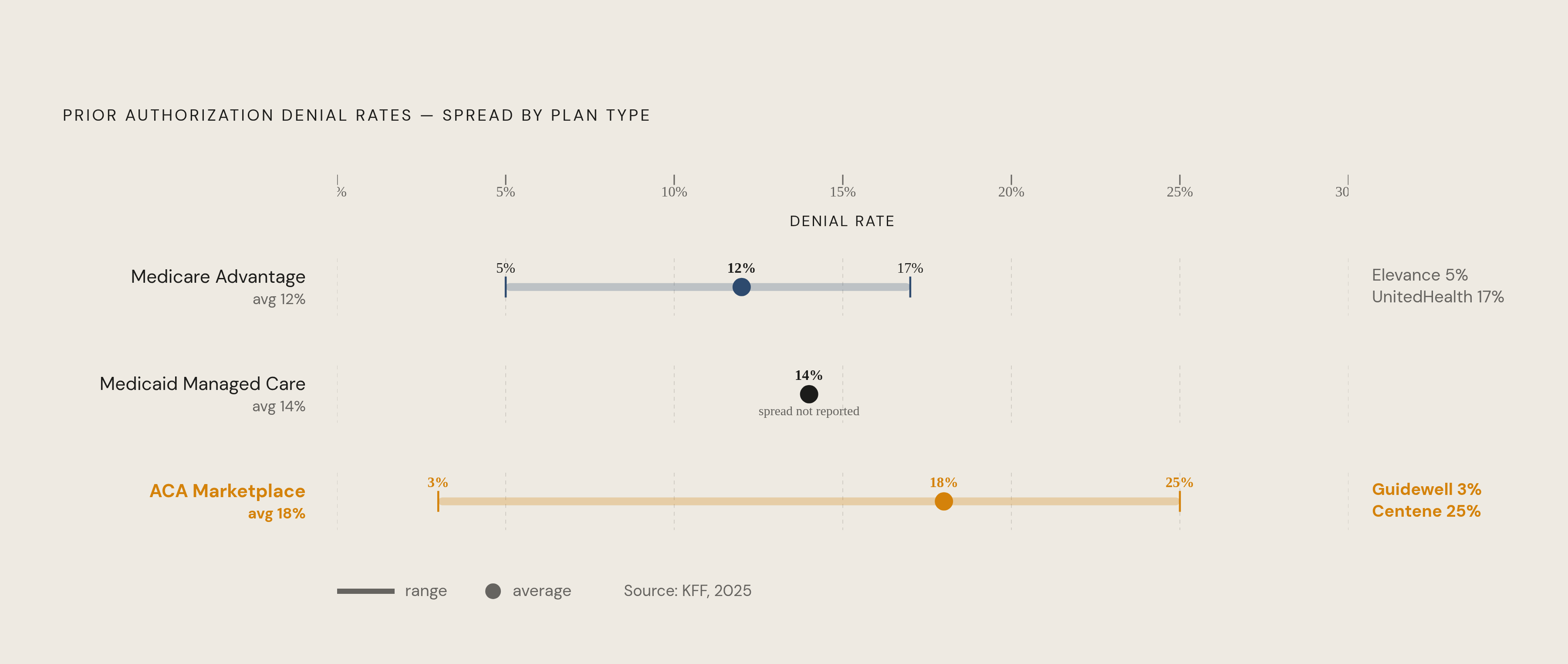
KFF's 2025 analysis of publicly disclosed prior authorization data, drawn from the 14 insurers with the largest enrollment in each market, found average standard denial rates of 12% in Medicare Advantage, 14% in Medicaid managed care, and 18% in ACA Marketplace plans. Those averages hide a wide spread. Medicare Advantage denial rates ranged from 5% at Elevance to 17% at UnitedHealth. ACA Marketplace rates ranged from 3% at Guidewell to 25% at Centene.
The 2025 AMA survey backs this up from the physician side. Asked which commercial payers create high or extremely high authorization burden, physicians named Humana (65%), Anthem/Elevance (61%), Cigna (59%), and Blue Cross Blue Shield (56%) among those generating high or extremely high burden.
Here's the part that should give practices pause about how they're handling denials: appeal overturn rates are high, even though few denials actually get appealed. KFF found 67% of Medicare Advantage denials get overturned on appeal, along with 47% in Medicaid managed care and 43% in ACA Marketplace plans. That gap suggests a large share of initial denials lacked full justification from the outset. It also means working denials pays off financially, but only for a practice with the staff time and payer-specific know-how to file an appeal before the deadline closes.
Payer criteria don't sit still, either. Some specialty benefit managers that oversee authorization programs for major insurers have updated their clinical criteria, adding stricter conservative-treatment duration requirements for musculoskeletal and spine procedures. Practices that got routine approvals for those procedures in 2024 are now getting denied, with no change in their own clinical approach. And 74% of physicians say denials have gone up over the past five years. This isn't trending toward relief.
How automated denial logic at major payers creates a new category of administrative exposure
Sixty percent of physicians in the 2025 AMA survey worry that AI either has already increased prior authorization denial rates or will soon. That worry isn't abstract. A ProPublica investigation found that one AI tool denied more than 300,000 claims over two months, a finding that prompted a legislative response in Connecticut in 2025. A Senate report accused major Medicare Advantage insurers of using AI and algorithmic review tools tied to a sharp jump in post-acute care denials, with skilled nursing facility stays refused at dramatically higher rates as plans rolled out automated review.
For practices, the risk here has little to do with clinical judgment. It's about precision. As payers deploy AI adjudication, the matching logic between authorization and claim has tightened considerably. Administrative mismatches, a date-of-service range that's slightly off, or a place-of-service discrepancy such as a service authorized for an office visit but rendered at an ambulatory surgery center, can result in denials with little or no human review. None of these are failures of medical necessity. They're administrative precision failures, and they're preventable if a practice knows exactly where to look.
The scale problem compounds the precision problem. An algorithm can generate denials faster than a practice can catch, sort, and appeal them within whatever window the payer allows. For a practice that isn't checking authorization-to-claim matches at the field level, these denials don't show up one at a time. They arrive in batches, and the clock to recover them is already running.
Why physicians have stopped expecting voluntary payer reform to change the operational picture
On June 23, 2025, more than 60 health insurers pledged to voluntarily reform their prior authorization programs, with rollout deadlines stretching from 2025 into 2027. Physicians aren't holding their breath: only 33% believe the pledge will meaningfully change anything for patients or physicians, according to the 2025 AMA survey.
The one pledge commitment already supposed to be in effect, that medical necessity denials get reviewed by a licensed, qualified clinician, is already falling short. Only 24% of physicians agree that this is happening consistently. That skepticism has a track record behind it. The 2018 Consensus Statement, signed by the AMA, the American Hospital Association, America's Health Insurance Plans, the BCBS Association, the American Pharmacists Association, and MGMA, made similar promises, and physicians largely didn't experience the improvements it described. A 2024 AMA survey reported in AJMC found that only 16% of physicians working with UnitedHealthcare, and the same share working with Cigna, actually saw those plans' announced cuts to prior authorization scope reduce the number of authorizations they had to file.
Regulation is coming, just slowly. CMS's interoperability and prior authorization final rule, finalized in January 2024, will require Medicare Advantage, Medicaid, and ACA plans to respond to routine requests within seven days and urgent ones within 72 hours, with FHIR-based electronic interfaces required by 2027. That's real relief, on paper, but it's years out.
Gold-carding, where payers waive authorization requirements for physicians with strong approval track records, offers a partial fix. A McKinsey analysis found gold-card programs could cut authorization costs by 5 to 10 percent for both payers and physicians, and states including Texas have passed legislation requiring it. Physician experience with implementation, though, points to inconsistent compliance from payers even where the law requires it. Practices waiting on reform or regulation to shrink this workload are carrying a cost that keeps accumulating in the meantime.
The patient care consequences that make authorization failures more than an administrative problem
The clinical stakes here are not abstract, and the 2025 AMA survey lays them out directly. Ninety-five percent of physicians say prior authorization delays access to care patients actually need. Seventy-nine percent report patients abandoning treatment altogether because of authorization hurdles. Ninety-two percent say the process negatively affects clinical outcomes, full stop.
More sobering: 26% of physicians say prior authorization has led to a serious adverse event for one of their patients, hospitalization, permanent impairment, or death. Eighty-eight percent say the process increases overall health care use, meaning a failed authorization often generates more cost downstream, not less: additional office visits (73%), urgent or emergency visits (47%), and hospital admissions.
Eighty percent of physicians say delays or denials sometimes force a patient to pay out of pocket for medication rather than wait. Fifty-eight percent, among those who treat working patients, say authorization problems hurt job performance, missed workdays from rescheduled appointments or prolonged illness. And 94% say the process contributes to physician burnout, a burnout that drives the staff and physician turnover which then wipes out the payer-specific knowledge a practice needs to manage this whole process in the first place.
The cycle feeds itself. Authorization delays hurt patients, which drives more downstream utilization, which adds to the administrative load, which accelerates the burnout that depletes the very staff capacity needed to manage that load.
Where authorization failures convert into permanent revenue loss in the billing cycle
Authorization failures sit alongside missing patient data and eligibility failures as one of the three most consistent, recurring causes of claim denials year over year. This isn't a marginal line item.
Most denied claims never get worked at all: a large share are never appealed. Once a claim passes the payer's timely filing deadline without action, the money attached to it is gone. Reworking a denied claim costs an average of $25, a cost the practice absorbs whether or not the appeal succeeds.
This is where authorization failures quietly become an AR aging problem. A denial that sits unworked pushes a claim past its filing window, and once that window closes, recovery odds fall off fast. The general benchmark practices aim for is accounts receivable of 30 days or fewer; once AR crosses 50 days, the odds of full recovery drop substantially, and authorization-related denials are a direct contributor to that aging for the claims they touch.
There's a clean-claim angle too. A claim submitted without an authorization that matches exactly isn't a clean claim, period. It gets rejected or denied on the first pass, forcing a resubmission that eats into whatever rework budget the practice has left. The fields that matter, rendering NPI, date-of-service range, place of service, have to line up precisely between what was authorized and what gets billed. A mismatch that might once have triggered a human look now often triggers an automatic denial instead, at some of the largest payers in the country.
Sources
- AMA survey: Prior authorization reform pledge falls short with physicians
- AMA prior authorization (PA) physician survey | AMA
- AMA Survey Highlights Growing Burden of Prior Authorization on Physicians, Patients | AJMC
- Prior Authorization Fuels Physician Burnout, Decreases Access to Care, AMA Survey Finds
- Don’t fall for these myths on prior authorization
- Fixing prior auth: Nearly 40 prior authorizations a week is way too many
- ajmc.com
- kff.org