AI-Generated Prior Authorization Denials and the eviCore and Cohere Health Models
How two AI vendors control prior authorization denials across American healthcare.

Prior authorization has become the defining fight between physicians and payers, and two AI vendors sit at the center of it: eviCore and Cohere Health. Both build the algorithmic layer that decides whether a claim gets approved before a patient ever sees a bill, but they run on opposite incentives. Physicians complete an average of 40 prior authorizations a week, per the American Medical Association, and nearly one in three physicians report that prior authorization requests are often or always denied, according to the American Medical Association. Denial rates have continued to climb across payer types, with Medicare Advantage plans among the hardest hit. Practices that treat these two vendors the same way are leaving money on the table, and most of them don't even realize it.
Denials aren't rising because patients got sicker or billing got sloppier. Insurers are outsourcing the authorization decision itself to specialized vendors instead of making the call in-house. EviCore alone manages prior authorization decisions for roughly 100 million Americans, close to one in three insured people in the country. A practice fighting a denial is very often not fighting the payer at all. It's fighting a third-party algorithm working under contract, with its own criteria, its own review staff, and its own appeal ladder.
That distinction matters, because the denials aren't uniformly deserved. A meaningful share of prior authorization denials are reversible, provided someone on the practice side knows how to work them. Denials that go unworked, or get appealed with generic clinical language instead of vendor-specific knowledge, turn into revenue that's gone for good. Knowing how eviCore and Cohere actually score a request, mechanically, is the difference between recovering that money and writing it off.
How eviCore is structured and what it was designed to do
EviCore by Evernorth is owned by Cigna and contracted by major insurers to review prior authorization requests across six clinical areas: imaging, cardiology, oncology, musculoskeletal and spine, sleep, and lab and genetics. Orthopedic, spine, radiology, cardiology, oncology, and sleep practices sit directly in eviCore's review path. A primary care or dermatology practice may rarely run into it at all.
The business model explains the behavior here. EviCore pitches insurers on a 3-to-1 return, promising to cut $3 in claims payouts for every $1 the insurer spends on its services, according to ProPublica's October 2024 investigation. Salespeople have reportedly touted a 15% increase in denials as a selling point to prospective insurer clients. This isn't a billing intermediary optimizing for accuracy. It's a vendor whose revenue depends on denial volume, and its own sales pitch says so out loud.
Insiders describe eviCore's scoring algorithm as having something close to a literal dial, a setting that gets turned up or down to raise denial rates depending on the client insurer's contract terms. The dial is configurable, not fixed. The same procedure can face very different odds of approval depending on which insurer eviCore happens to be working for that week.
One distinction practices routinely miss costs them dearly: the gap between an administrative denial and a clinical one. If a procedure requires eviCore review and the practice submits the claim without getting prior authorization first, that produces an administrative denial. Overturning it is far harder than overturning a clinical denial, because the dispute isn't about medical necessity at all. It's a process failure, and eviCore treats it that way on appeal, full stop. Once a practice learns that a payer contracts with eviCore, the working reality is that eviCore, not the payer, is the actual decision-maker. Build the workflow around that fact, not around whatever name sits on the insurance card.
Where eviCore denials actually originate: the scoring logic and top denial triggers
Between the fourth quarter of 2023 and the third quarter of 2024, eviCore processed more than 23,000 initial prior authorization requests and denied about 20% of them. The five leading denial reasons from that stretch map out exactly where the algorithm's pressure points sit.
Failure to meet medical necessity criteria tops the list. The catch: eviCore applies its own clinical criteria, which can diverge from both the ordering physician's judgment and the payer's published guidelines. Site declines come next. The proposed care setting, say hospital outpatient versus an ambulatory surgery center, gets rejected even though the procedure itself is approved. A general medical necessity category catches a lot of documentation gaps that get mislabeled as clinical inappropriateness. Investigational or experimental designation shows up for procedures eviCore classifies as non-standard, even ones widely accepted within the specialty. Unapproved sites for specific treatments stack site-of-service restrictions on top of the clinical review entirely.
Denial rates aren't uniform across geography, either. In Arkansas in 2021, eviCore denied 20% of prior authorization requests, nearly triple the 7% average denial rate for Medicare Advantage plans nationally that year. That gap is the dial doing its work: the same clinical scenario, scored differently depending on the client and the region.
EviCore publishes its criteria specialty by specialty, and any practice willing to look can find it. Practices that skip this step are flying blind against the exact rubric that will score their submission. Here's the thing though: the most common failure isn't clinical at all. It's a translation problem. Clinical notes that fully support the ordering physician's reasoning often fail to map onto eviCore's specific criteria language, so a submission that reads as sound medicine on paper still bounces because it never speaks eviCore's dialect. Site-of-service denials deserve separate attention, because they usually signal a payer-level policy change rather than a clinical disagreement. Arguing medical necessity in response to a site denial is arguing the wrong point entirely, and it wastes the one shot a practice gets.
How to work an eviCore appeal: the leverage points at each stage
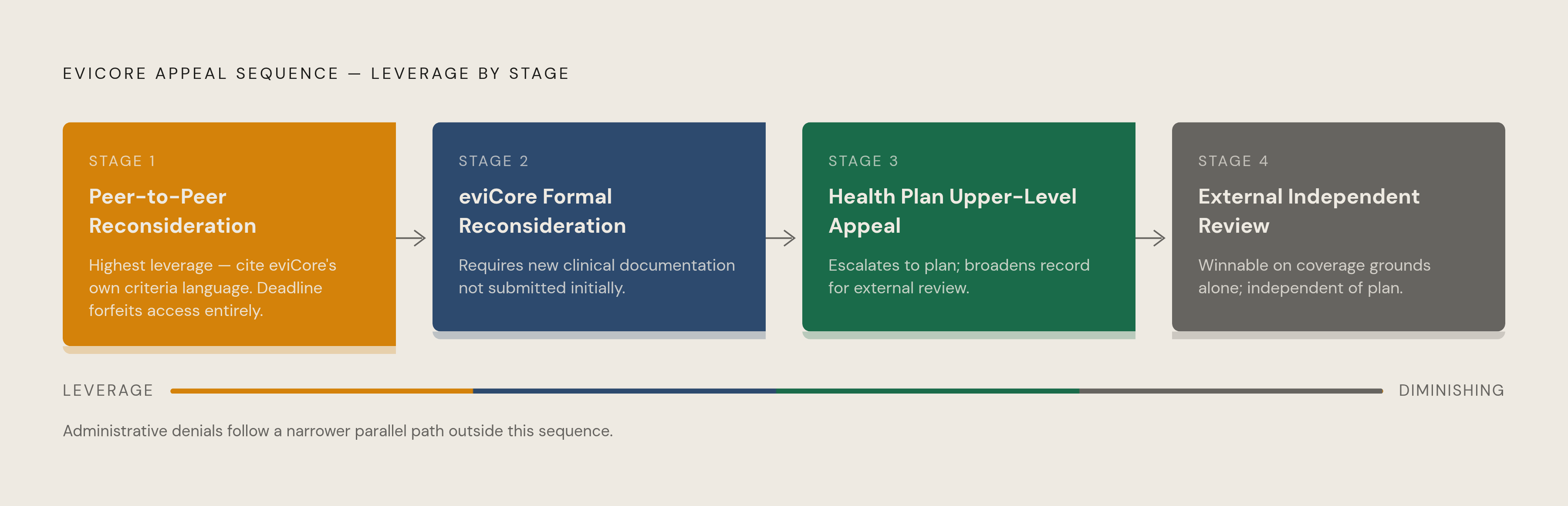
EviCore's appeal process runs in a fixed sequence: peer-to-peer reconsideration, then eviCore's formal reconsideration, then the health plan's upper-level appeal, and finally external independent review. Each stage runs on different logic. Treat them interchangeably and the appeal gets wasted.
Peer-to-peer is the highest-leverage stage, and also the most time-sensitive. The requesting physician gets on the phone directly with an eviCore medical reviewer, and that's a structured clinical conversation, not a form resubmission. Physicians who show up with eviCore's own criteria language in hand, instead of simply restating their original clinical rationale, get noticeably different outcomes. The deadline printed on the denial letter controls eligibility for this step, and missing it forfeits the option outright.
Formal reconsideration only works if the practice brings something new. Resubmitting the same documentation that triggered the denial rarely moves the outcome; the reviewer already rejected that exact record once. External appeal is the backstop, and a real share of eviCore cases that reach this stage are winnable purely on coverage grounds, apart from any clinical argument at all.
Administrative denials, the ones stemming from a missed prior authorization rather than a clinical dispute, follow a much narrower appeal path. EviCore treats these as process failures, so the appeal has to address the procedural gap directly instead of re-litigating medical necessity.
None of this works without memory. Knowing which specific eviCore criterion triggered last month's denial for a given procedure, and knowing exactly what documentation fixed it, compounds every time it gets applied to a future submission. Practices without a system for tracking denials lose that intelligence the moment the billing staffer who knew it leaves. And then they're starting from zero again.
What Cohere Health is and why its model is structurally different from eviCore
Cohere Health is also a health-plan-contracted AI utilization management vendor, but its design runs in the opposite direction from eviCore's. Cohere says its technology speeds up approvals, never denies care on its own, and keeps denial decisions with a human clinician. Where eviCore's financial model rewards denial volume, Cohere's model is built around cutting administrative friction, pointing to approval throughput, not denial volume, as its pitch to health plans.
By Cohere's own reporting, the company automates up to 90% of prior authorization requests and reports 94% provider satisfaction. Those numbers come from the vendor itself, worth keeping in mind, but the underlying design philosophy really is different from eviCore's, and it shows up in the product line.
Cohere Complete is the delegated utilization management product: Cohere takes over a health plan's UM operations entirely for select specialties, pairing RN and MD staff with the AI layer. Reported outcomes, per Intuition Labs, include 50% fewer denials overturned on appeal and up to $4.56 per member per month in savings on medical benefit expenses within a national cardiology program. Cohere has also developed provider-tiering features that calibrate prior authorization requirements based on a clinician's historical ordering patterns, easing the burden for those with a consistent record of appropriate care. Cohere has signaled ambitions beyond outpatient screening, with the company working to broaden its footprint across additional care settings and UM functions.
Cohere has pursued integrations designed to capture clinical documentation at the point of care and feed it directly into prior authorization submission, reducing the administrative steps required from practice staff.
None of this makes the model risk-free. Cohere's AI trains on historical utilization data, and models built this way can reinforce existing patterns of underuse in certain patient populations if nobody's watching closely. Cohere points to human oversight as the safeguard against that, which is an honest answer but not a guarantee. For practices, the number worth tracking isn't the headline approval rate, but the approval mechanism itself: Cohere's delegated UM model means the decision comes from a combined AI-and-clinician process working under the health plan's authority, not from a pure algorithmic screen the way an eviCore administrative denial does.
How Cohere Health scores requests and where denials still occur
Cohere's algorithm scores a request against clinical coverage policy and the submitting provider's own historical authorization and outcomes data at the same time. Align makes this explicit by calibrating prior authorization requirements per individual clinician instead of applying one rule to every provider in a specialty.
A high-performing provider inside Cohere's system, one with a strong track record of appropriate ordering, can land automatic approvals or a lighter prior authorization requirement going forward. A provider with a thin history in the system, or one working outside the specialties Cohere has trained its models on, faces the fuller version of clinical review instead. Simple as that.
Denials still cluster in predictable places even under this friendlier design. Requests lacking structured, parseable clinical documentation trigger manual review queues, because Cohere's AI needs clean data to work with, and messy records get flagged the same way they would anywhere else. Services falling outside Cohere's delegated specialty contracts revert to standard health plan review, stripping away whatever speed advantage the AI layer offered. Acute inpatient authorization, the area Cohere only expanded into in 2025, is newer territory, and the criteria and automation coverage there are both less mature than in Cohere's established outpatient specialties.
Cohere reports 96% digital adoption among the providers it works with, so practices still submitting by fax or phone are a shrinking minority, and likely a slower one. Satisfaction numbers from Cohere's own 2025 national survey show 99% of clinicians and 96% of administrators expressing confidence in AI-driven prior authorization. But that same survey found 97% of administrators and 93% of clinicians had seen prior authorization delays cause avoidable emergency care or hospitalizations. Confidence in the tool and satisfaction with the outcome for the patient are two different measurements. That gap doesn't get talked about enough.
For a practice under a Cohere-managed plan, the leverage point isn't appeal argumentation the way it is with eviCore. It's submission quality and provider standing within Cohere's system. Earning a place in Cohere's trusted-provider tier cuts friction structurally, going forward, rather than case by case.
The broader AI denial risk that neither model eliminates
The outer edge of what algorithmic prior authorization can get wrong shows up in the federal class action filed against UnitedHealthcare over its nH Predict tool in Minnesota. The suit alleges a 90% error rate in the AI's coverage determinations, with more than 80% of prior authorization denials generated by the tool reversed on appeal. A report from the Senate Permanent Subcommittee on Investigations found UnitedHealthcare's denial rate for post-hospital care more than doubled after the algorithm went into use. Separate Senate committee reporting has accused AI denial tools of producing denial rates 16 times higher than is typical, according to the American Medical Association.al rates as much as 16 times higher than typical. The dispute between UnitedHealthcare and HealthPartners, where the reported denial rate ran roughly 10 times higher than other insurers, shows what algorithmic miscalibration looks like once it scales across a large book of patients.
This risk isn't staying confined to Medicare Advantage, either. CMS's WISeR Model pilot launches in January 2026 across six states, extending AI-assisted prior authorization into traditional Medicare for the first time. Traditional Medicare handled 625,000 prior authorization requests in 2024 and denied 143,705 of them. Introducing AI scoring into that pool changes the dynamics for a population that has, until now, been largely shielded from this layer of review.
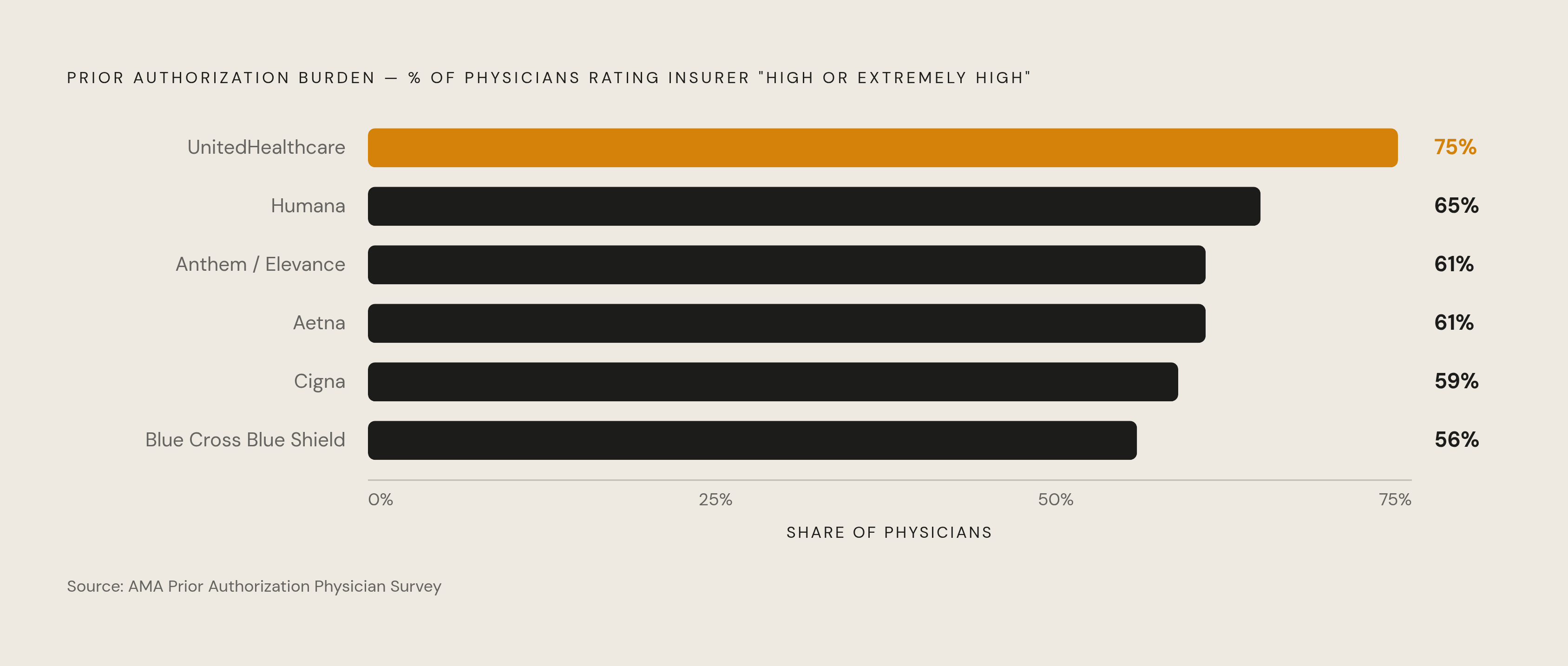
The AMA's payer burden rankings give practices a map of where this friction concentrates today: 75% of physicians rate UnitedHealthcare's prior authorization burden as high or extremely high, followed by Humana at 65%, Anthem and Elevance at 61%, Aetna at 61%, Cigna at 59%, and Blue Cross Blue Shield at 56%. Roughly 60 health insurers pledged in June 2025 to cut prior authorization requirements, but only 33% of physicians in that same survey believe the pledge will make a real difference. Skepticism is the right posture for practices doing operational planning around this, since every major payer now runs some form of algorithmic review. The appeal and documentation habits that work against one engine won't transfer automatically to the next one a practice runs into.
What practices need in their workflow to fight AI-driven denials systematically
The core problem is a mismatch of tools. Practices are fighting algorithmic systems with manual processes, spending an average of 13 hours a week of physician and staff time on prior authorization, with 40% of practices employing staff whose entire job is authorizations. That's a lot of skilled labor pointed at a fight the practice enters half-informed.
Fighting back starts before submission, not after denial. Every request needs to get checked against the specific vendor's published clinical criteria, eviCore's or Cohere's, before it goes out the door, not just against the ordering clinician's own judgment. A practice also needs to know which payer has contracted which AI vendor for which specialty and service line, and those contracts shift more often than most billing offices track. A practice without current visibility into who's actually reviewing the claim is negotiating blind, every time.
Denials need to get flagged and categorized the day they land, not discovered during a month-end reconciliation. Real-time tracking means appeal windows never close before anyone notices, and patterns by payer and by denial code show up while they're still forming instead of after the damage is done.
And then there's memory, which is the part most practices get wrong. The documentation fix that overturned a specific eviCore denial last quarter, or the submission pattern that earned a clinician a lighter review track inside Cohere's Align system, is worth keeping on record by procedure and by payer. Let that knowledge walk out the door with a departing staff member, and the practice ends up re-fighting battles it already won once, paying the revenue cost of relearning the same lesson twice.