Real-Time Prior Authorization Standards and FHIR API Payer Readiness
Practices must separate the 2026 and 2027 deadlines to avoid costly compliance mistakes.
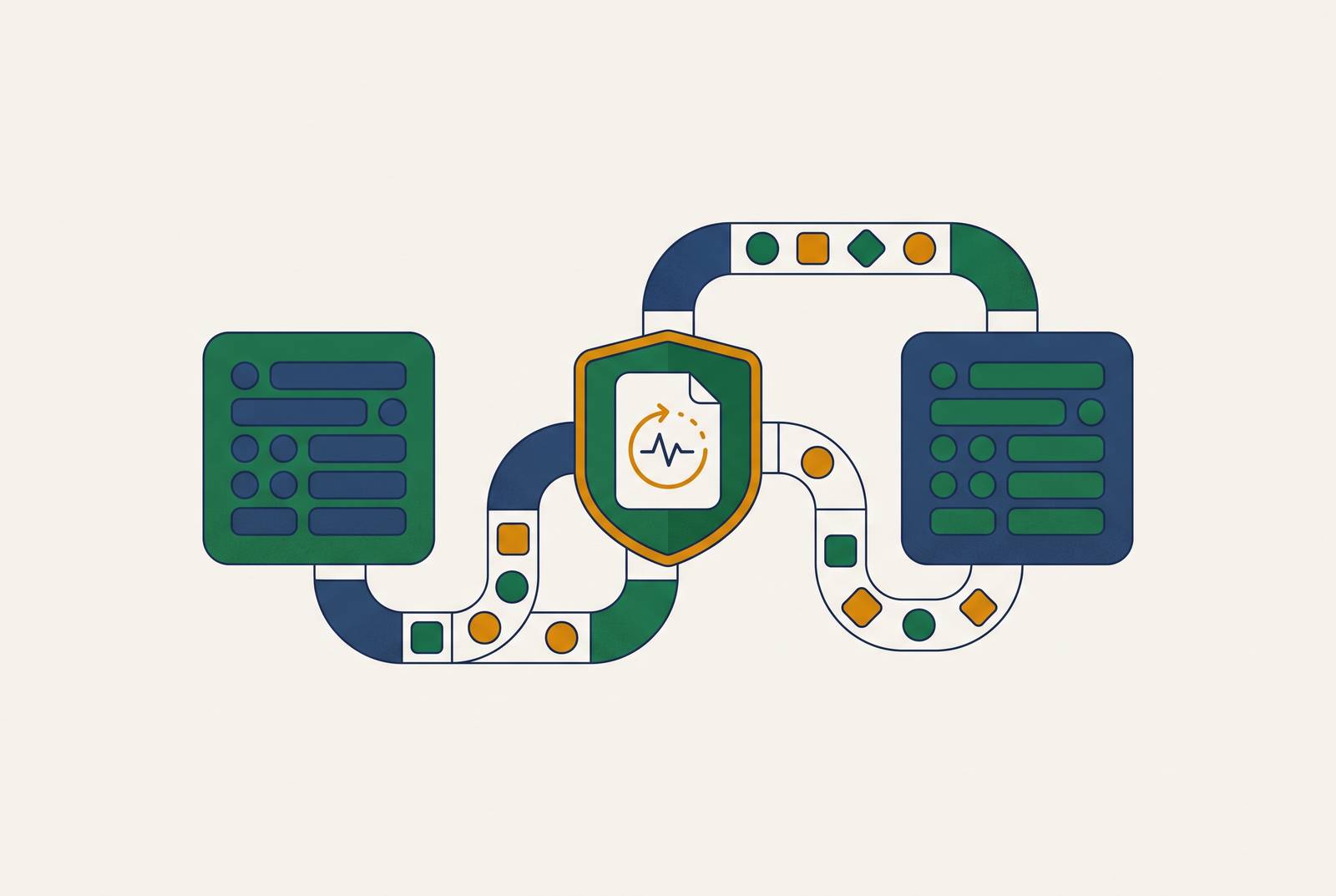
CMS-0057-F sets January 1, 2027, as the hard deadline for payers to run real-time prior authorization APIs in production, and it changes how physician practices submit requests and get answers back. But the rule folds two separate deadlines into one document, and they demand two different kinds of work from a practice. Treating them as a single project is the mistake most practices are making right now, one most likely to leave money on the table.
January 1, 2026, rules are already in force. Standard prior authorization decisions from in-scope payers now carry a 7-calendar-day maximum. Expedited requests get 72 hours, measured in calendar time, not business hours, so a request filed at 1 AM Sunday needs an answer by 1 AM Wednesday. Payers can extend either window by up to 14 additional calendar days, but only under specific program conditions, not at will. Every denial has to include a specific reason now, not a generic code a biller has to decode or call about.
That's policy, and it's enforceable today. A denial that arrives without a specific reason from an in-scope payer is already a non-compliant response, whether or not the practice's staff recognizes it as one.
The January 1, 2027, deadline is a different animal. It requires payers to have four FHIR APIs live in production: Patient Access, Provider Access, Payer-to-Payer, and Prior Authorization, all conforming to HL7 FHIR R4. This is engineering that a compliance officer cannot memo into place. No workflow document satisfies it. Either the API is built, tested, and running, or it isn't, and no amount of good intent bridges that gap.
Coverage splits matter here too, and practices get this wrong constantly. Medicare Advantage organizations, state Medicaid and CHIP fee-for-service programs, Medicaid managed care plans, CHIP managed care entities, and QHP issuers on the Federally-Facilitated Exchanges are all in scope. Traditional Medicare, ERISA self-funded employer plans, standalone Part D, and commercial plans sold off-exchange are untouched. QHP issuers get a specific carve-out: they owe all four APIs plus the denial-reason and public-metrics requirements, but not the decision-timeframe rules. A practice that assumes every exchange plan is racing the same 7-day clock as a Medicare Advantage plan is simply wrong, and that wrong assumption burns staff time chasing an obligation that doesn't exist.
One detail closes a gap that used to trip up compliance teams: HHS's National Standards Group has said it won't pursue HIPAA Administrative Simplification enforcement against covered entities that run a FHIR-only Prior Authorization API instead of the older X12 278 standard. That removes a conflict that would otherwise have forced payers to run two systems at once.
CMS estimates the whole package saves the system roughly $15 billion over ten years, mostly by cutting prior authorization friction out of the process. Whether that number ever shows up depends entirely on whether the pieces underneath it get built on time, and by whom, a question the rest of this piece actually answers.
What the Prior Authorization API and the Da Vinci stack actually do inside a practice workflow
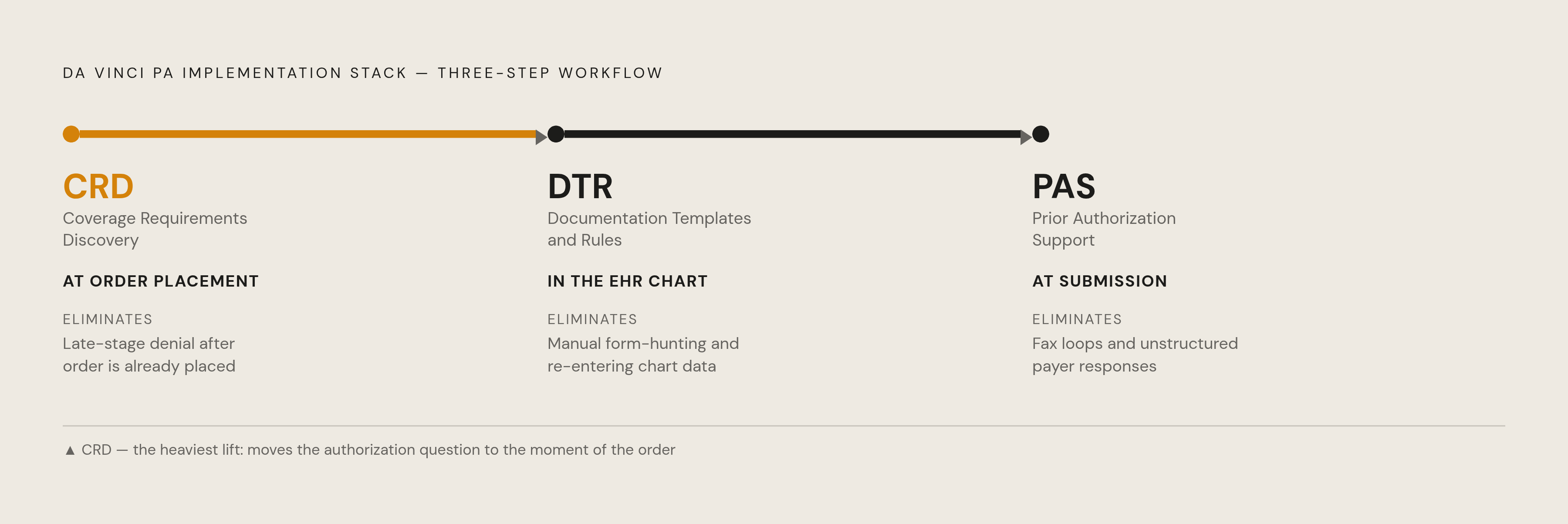
The Prior Authorization API replaces fax with electronic submission, but calling it "an API" undersells what's actually happening. It's an end-to-end workflow built from three components in HL7's Da Vinci implementation stack, and each one solves a different failure point in the current process.
Coverage Requirements Discovery, or CRD, runs at the moment a clinician places an order. It queries the payer in real time and tells the clinician whether prior authorization is required at all, and what documentation the payer will expect, before the order is even finalized. That's a real shift. Right now, practices often learn a service needed authorization only after the claim comes back denied, days or weeks later, which means the clinical decision and the administrative decision happen in the wrong order.
Once CRD flags that PA is needed, Documentation Templates and Rules, DTR, pulls the payer's specific forms and requirements directly into the EHR and pre-populates what it can from data already in the chart. Prior Authorization Support, PAS, then submits the completed request electronically and receives the structured response back into the EHR: an approval with an end date or condition, a denial with a specific reason, or a request for more information.
None of this runs on good faith. The security and data infrastructure underneath draws on the same standards used in serious health data exchange elsewhere, not a lightweight bolt-on.
The Patient Access API adds a layer practices should not ignore just because it's patient-facing. By January 2027, the Patient Access API will give members broader access to their own health information through third-party applications. A patient checking status on a phone before the practice's own staff has even looked at the case is a new dynamic, and it raises the bar on how current the EHR's own view needs to be.
CMS has put a number on what's at stake operationally: prior authorization administrative work runs an estimated $20 to $50 an hour and eats roughly 13 hours a week per provider. That works out to something like 700 hours and $34,000 a year, per provider, spent on a process this workflow exists specifically to shrink. CRD does the heaviest lifting there, because it moves the question of "does this need authorization" back to the point of the order, instead of leaving it to surface at the point of the denial.
What payer denial data published under the new rules reveals about where PA friction is concentrated
The first mandatory public prior authorization metrics reports, covering calendar year 2025, were due March 31, 2026. This is the first time this kind of data has existed as a public, comparable record across payers, and it already proves something practices need to stop pretending isn't true: prior authorization friction is not evenly distributed, not by market segment and not by insurer.
Denial rates cluster differently by market segment. Denial rates vary meaningfully by market segment, and the segment averages hide the real story, which is how wide the spread runs insurer to insurer. The segment averages hide the real story, though, which is how wide the spread runs insurer to insurer.
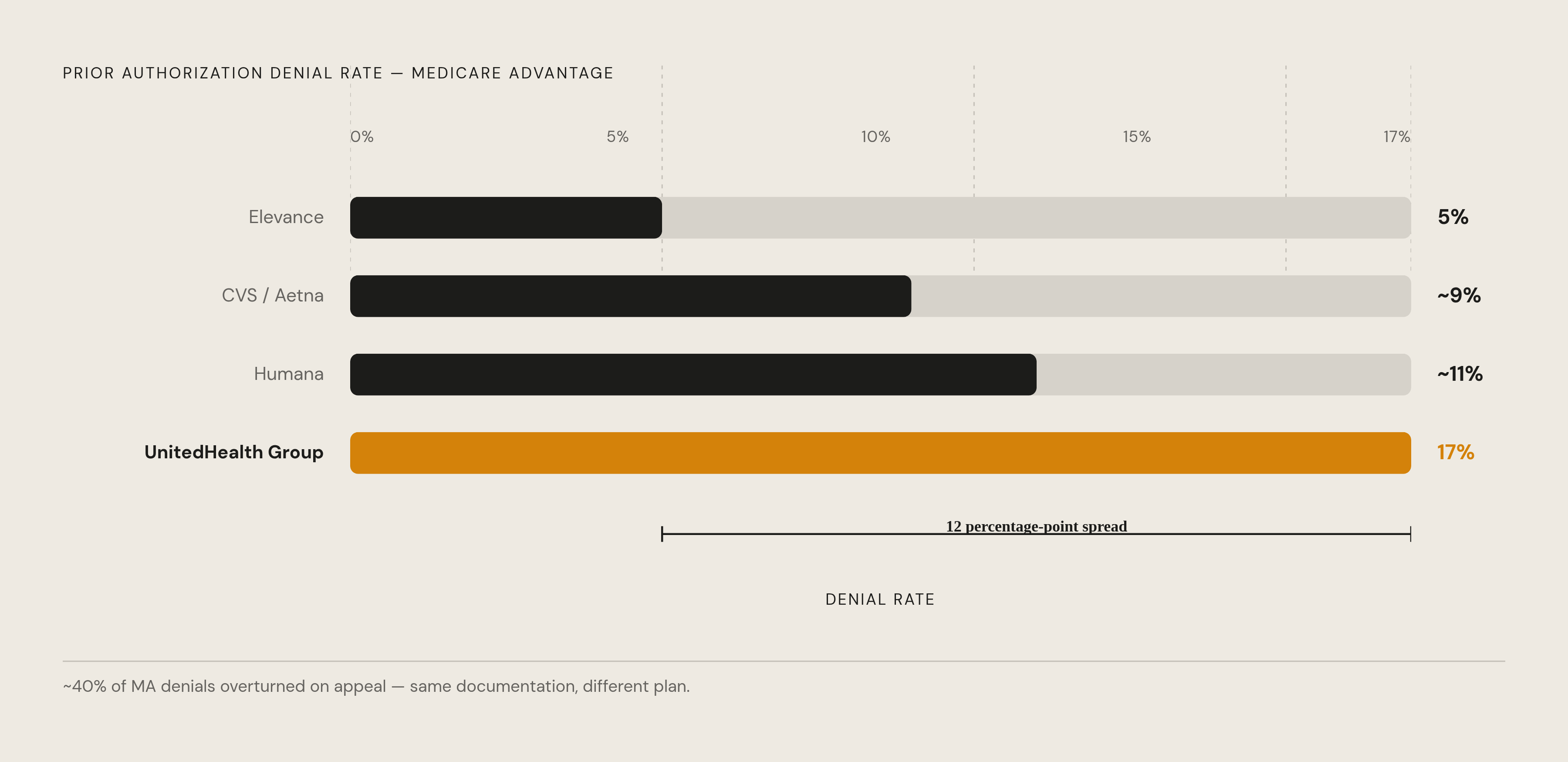
In Medicare Advantage, standard denial rates ranged from around 5% at Elevance to around 17% at UnitedHealth Group. In the ACA Marketplace, the spread between the lowest and highest denial rates across major insurers was similarly wide. Medicaid managed care also showed a substantial spread across plans. These aren't rounding differences. A practice submitting identical clinical documentation could see wildly different outcomes depending purely on which of these plans the patient carries, and that alone should change how a billing team prioritizes its documentation effort.
Appeal overturn rates point to something worse than routine clinical disagreement. A substantial share of Medicare Advantage prior authorization denials get overturned on appeal. A rate that high isn't consistent with close clinical calls breaking the payer's way at the margins. The first decision was simply wrong, at scale, as a matter of course, and the appeal process is functioning as an error-correction layer for a broken first pass rather than a genuine dispute mechanism.
Some of that traces to automation, and the evidence points in one direction. Reporting has linked increased denial rates for certain care categories to Medicare Advantage plans' use of AI review tools. Systematic tools produce systematic errors, and every one of those errors still requires an individual human being to file an individual appeal to fix it. Physician surveys indicate widespread concern that AI tools will push denial rates higher still, which makes the public metrics requirement less of a compliance footnote and more of an early-warning system practices should actually be watching.
For a billing team, this data has one direct use: before submitting a request, look up the payer's published denial rate, average decision time, and appeal overturn rate. A payer sitting at a 20%-plus denial rate with a strong overturn history is a payer worth over-documenting for on the front end, not one worth fighting from behind after the fact.
What provider-side readiness for the 2027 APIs actually looks like from a practice's position
The 2027 mandate legally binds payers, not practices. Some practices read that and conclude there's nothing to do until the deadline passes. That's wrong, and it's wrong in a specific way: a payer's working API delivers exactly nothing to a practice whose EHR can't connect to it. The failure mode here is quiet. It's just business as usual: faxes, portals, phone holds, the same 13 hours a week, while the payer's system sits idle from that practice's vantage point.
CMS's own guidance tells practices to ask their EHR vendor a specific set of questions, not a general one. Is the EHR certified to support FHIR Prior Authorization API integration? What's the vendor's actual implementation timeline for CRD, DTR, and PAS, not a general roadmap slide? Will the practice need to buy an add-on module to get this functionality, or is it included? Is the vendor running pilots with any payers right now, and what testing windows exist before the deadline arrives?
Testing matters more than it sounds like it should. ONC-supported Da Vinci Inferno test kits exist specifically for CRD, DTR, and PAS, and practices should ask directly whether their vendor is using them. A gap found in a test environment in mid-2026 is a fixable problem. The same gap discovered on January 2, 2027, with live patients and live claims, is a crisis, and the distance between those two outcomes is entirely a matter of who asked the right question early.
There's a reporting consequence attached too. CMS has added an Electronic Prior Authorization measure to the Promoting Interoperability category under MIPS. For eligible clinicians, using payers' Prior Authorization APIs and reporting that use affects MIPS scoring directly. Hospitals and critical access hospitals get a softer landing: it's an optional bonus measure initially, becoming mandatory starting in 2028.
Separately, the Provider Access API pushes claims and clinical data for attributed members back to practices in bulk, not just PA-related information. That's a second integration question a practice needs answered, distinct from outgoing PA requests, because incoming data at that volume needs somewhere sensible to land inside the EHR, not just a folder nobody checks.
None of this migrates a practice automatically. A practice running fax and portal workflows today will still be running fax and portal workflows in 2027 unless someone deliberately switches the process over. APIs don't recruit users. They wait for them, and plenty of practices will still be waiting on January 1.
Why the billing operation behind prior authorization determines whether the API's speed translates into recovered revenue
Prior authorization is a gate, and the real money sits on the other side of it. A denied PA that doesn't get appealed quickly turns into a denied claim, and a denied claim that doesn't get resubmitted turns into revenue that's simply gone. A large share of denied claims never get resubmitted at all, and the reason usually has little to do with the strength of the clinical argument. The appeal window closed, or the one person who knew how to fix that particular payer's rejection left the job six months ago.
The new 7-day and 72-hour decision windows create a predictable clock for the first time. A predictable clock only helps a billing operation that's actually watching it, though, and a practice checking prior authorization status once a week will miss a 72-hour expedited window every single time, compliant payer or not.
Payer policy keeps moving underneath all this regardless of what the API says. Coverage requirements shift without warning, and CRD is only ever as current as the payer's own published rules feeding it. A billing operation with payer-specific institutional memory, the kind that knows a particular plan just tightened its criteria for a given imaging code, catches that mismatch faster than a system that only trusts what the API hands back.
The administrative burden this framework is built to reduce, that 13 hours a week, doesn't disappear. It moves. Instead of navigating portals and sending faxes, staff spend that time on exception management, and the exceptions left standing after automation clears the routine cases are the hard ones: the ones that need a human with judgment and payer-specific memory, not a faster form.
Real-time PA status sitting in the EHR helps nobody if nobody reads it consistently. Practices without dedicated billing staff, or with turnover high enough that institutional knowledge walks out the door every year or two, lose the benefit of a specific denial reason the moment there's no one left who remembers what that particular payer actually wants to see on resubmission.
The practices that turn a faster API into faster cash are the ones that layer PA-response monitoring and denial management on top of whatever FHIR connection the EHR builds, without ripping out the existing workflow to do it. The 2027 rule doesn't touch payers' underlying incentive to deny in the first place: speed without a denial-management discipline behind it just moves the same losses faster. Public metrics add reputational pressure, sure, but a practice that can't identify a wrongful denial fast, appeal it fast, and resubmit fast will keep absorbing losses on claims that were always going to be overturned. It'll just absorb them more efficiently than before, which is not the same thing as not absorbing them.
The steps a practice should take before January 2027 to be operationally ready
Start with the EHR vendor conversation, and make it specific. Ask about CRD, DTR, and PAS timelines by name. "We support FHIR" is not an answer, it's a deflection, so press for which in-scope payers the vendor has actually tested against.
Map the practice's payer mix against what's actually covered. Which top payers by volume are Medicare Advantage, Medicaid managed care, CHIP, or QHP issuers on an FFE? Those are the payers whose APIs go live under this rule. Commercial plans and ERISA self-funded employer plans sit outside this timeline entirely, and no amount of EHR readiness changes that fact.
Pull the public denial data now that it exists. For each in-scope payer in the mix, look up the published denial rate, the average decision time, and the appeal overturn rate from the 2025 reporting cycle. Use those numbers to decide where documentation needs to be airtight before submission, not after a denial lands on someone's desk.
Audit current PA turnaround against the enforceable windows already in place. If a payer is routinely running past 7 calendar days on standard requests or 72 hours on expedited ones, that's a compliance gap the practice can escalate, but only if someone's actually tracking it against the calendar instead of against a vague sense of "it's been a while."
Get into testing before the deadline, not after. Early testing is the difference between finding problems on a schedule the practice controls and finding them on January 2, 2027. Ask the vendor when live testing windows open and put the practice on the list.
Check MIPS exposure directly with the billing operation. Eligible clinicians need to know now whether the Electronic Prior Authorization measure will be reportable for the 2027 performance year, and what documentation that requires.
Review the denial workflow itself, because faster decisions from payers only help if appeals move just as fast on the practice's side. A denial sitting untouched until an end-of-month review defeats the entire point of a 7-day decision clock.
The 2027 mandate builds infrastructure. It does not, by itself, recover a single dollar. Practices that treat this purely as an EHR vendor's problem, something to check off once the software update lands, will end up connected to fast, compliant APIs and still watching the same denials pile up. Just delivered a little quicker than before.