Medicare Advantage Plan Policy Divergence from Traditional Medicare
MA plans deny far more services than Traditional Medicare does using hidden, ever-changing rules.

Medicare Advantage now covers a majority of eligible Medicare beneficiaries, and the plans running it have built a rulebook that looks nothing like Traditional Medicare's. KFF counted nearly 53 million prior authorization requests sent to MA insurers in 2024, up from roughly 50 million the year before. That volume is friction built into the system on purpose. A practice that treats MA as one payer category, the way it treats Traditional Medicare, is flying blind across dozens of separate rulebooks, and the 2026 wave of forced plan transitions, beneficiaries pushed into new plans after exits and service area cuts, is about to make that blindness a lot more expensive.
Where MA plans have built their own coverage rulebook, separate from Traditional Medicare
Traditional Medicare runs on one national coverage policy, while MA plans sit inside a CMS framework but get to layer stricter clinical criteria on top of it, and most of them do exactly that. A 2022 HHS Office of Inspector General report found that a meaningful share of MA prior authorization denials and payment denials met Traditional Medicare's own coverage criteria anyway. These were covered services, denied regardless. That fact settles the argument some practices still want to have about whether MA denials are legitimate coverage disputes. The evidence points toward plan-side overreach.
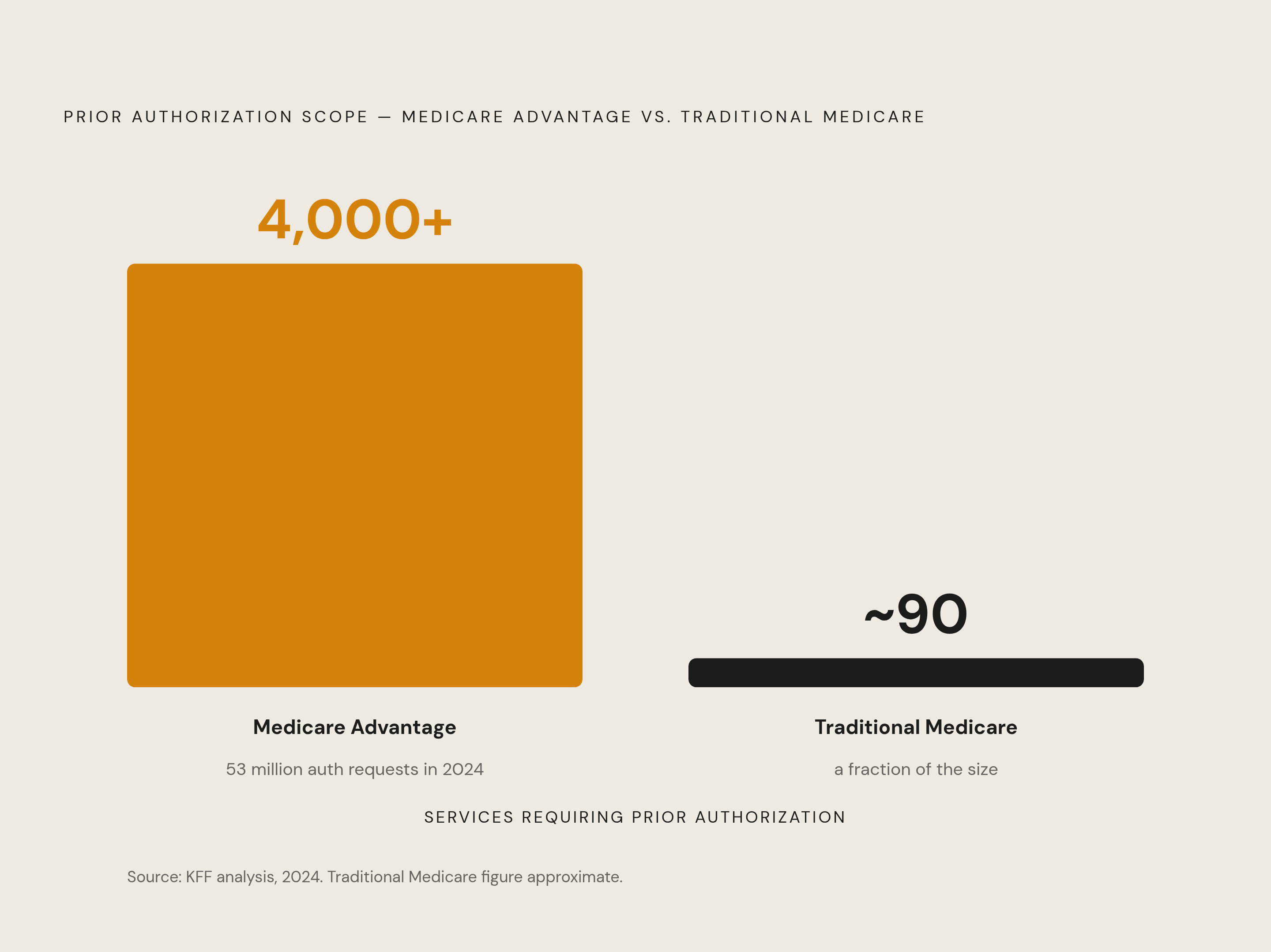
The gap isn't spread evenly across care types, and that's where practices get tripped up. Post-acute care, inpatient rehab, skilled nursing, home health, carries the highest denial volume of any category, by a wide margin. Routine diagnostic imaging and outpatient procedures that clear Traditional Medicare with zero paperwork often need a prior auth under an MA plan, specialist referrals and certain E&M visits for high-utilization patients draw extra scrutiny, and durable medical equipment criteria under MA plans routinely run tighter than the Medicare LCD and NCD standards that would otherwise apply. By 2024, MA plans collectively required prior authorization for more than 4,000 distinct services, per KFF, and that number keeps climbing while Traditional Medicare's list stays a fraction of the size.
A service that sails through under Traditional Medicare can trigger a denial under a plan-specific policy the practice has never seen, and won't see, until the EOB shows up. No published index tracks every MA plan's coverage deviations. Practices learn it the hard way, plan by plan, denial by denial.
How prior authorization requirements vary by plan and why that variation is expanding
Prior auth lists aren't standardized. Each MA plan files its own with CMS, and those lists change every year, sometimes mid-year, with no guarantee the practice hears about it before the next claim gets denied. A service that needed no authorization last plan year can require one this year, and the notice, if one exists, tends to sit in a contract amendment or a portal bulletin nobody checked that week.
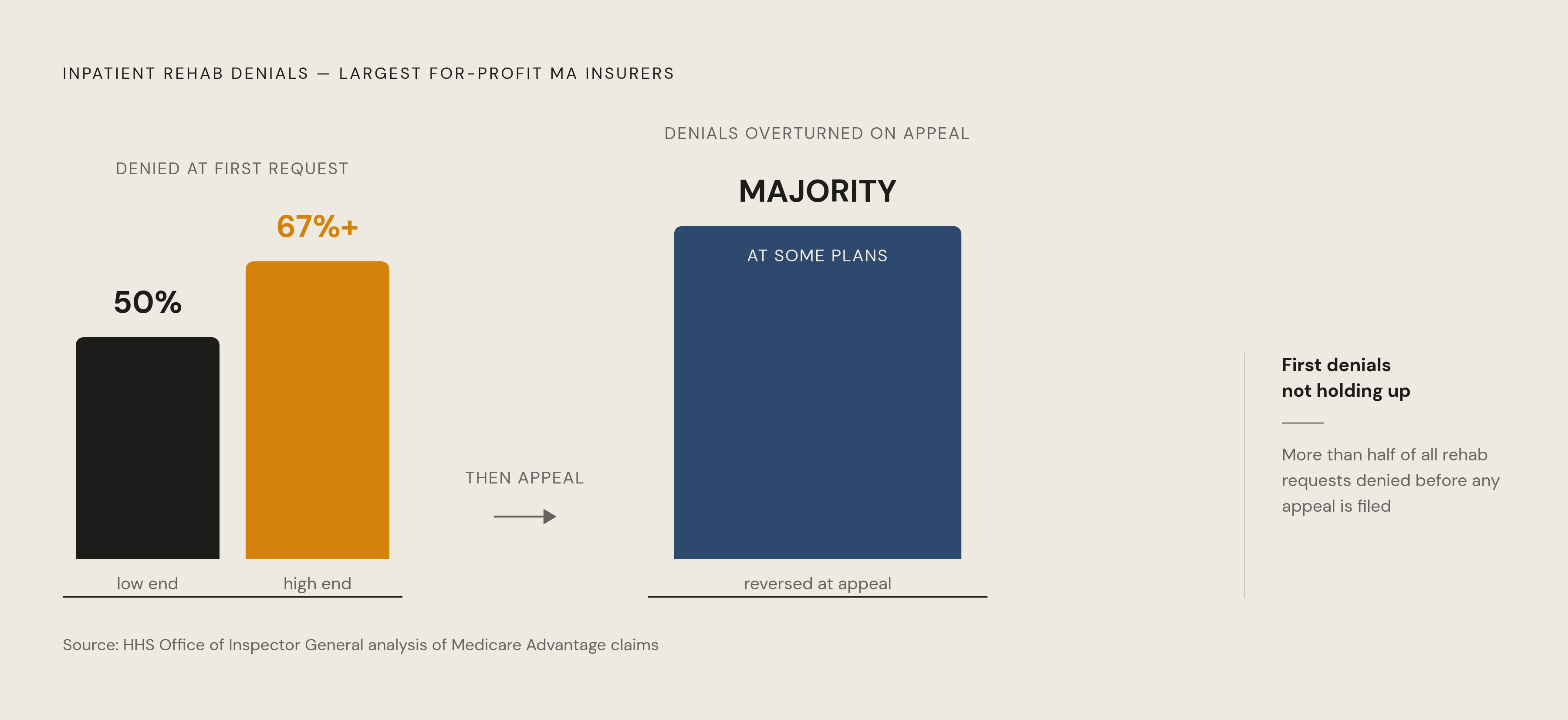
The expansion isn't random, though. It follows the money. Plans have added authorization requirements to their highest-cost, highest-volume service lines: rehab, imaging, DME. Utilization management is doing exactly what it's built to do, from the plan's side of the table. CMS's CY2024 MA final rule required that any reviewer denying care on medical necessity grounds actually hold relevant clinical expertise, and the fact that CMS had to write that rule down at all suggests non-specialist reviewers overruling treating physicians had become routine. Appeal overturn rates confirm it from the other side. At some plans, the overwhelming majority of appealed denials get reversed, a pattern that raises real questions about what the first denial was actually measuring, and how many providers simply gave up before filing.
For a billing operation, the lesson is plain: prior auth management can't be a checklist someone builds once and files away. Someone needs to watch what each plan requires right now, not what was true last quarter.
What algorithmic denial tools at the largest MA plans are doing to claim outcomes
UnitedHealthcare, CVS Health, and Humana cover a dominant share of MA enrollees between them, and all three now run AI tools built specifically to manage prior authorization for post-acute care. UnitedHealth's naviHealth subsidiary and its nH Predict tool drew litigation alleging the algorithm effectively set length-of-stay limits that overrode physician judgment, with claims that a very high share of appealed denials got reversed on review, raising questions about how often the algorithm's first call held up when anyone bothered to fight it. Cigna's PXDX system faced separate accusations of batch-denying claims by the thousands whenever treatments didn't match preset criteria, with no doctor actually looking at the individual case.
Denial volume scales through automation, but the appeal process on the other side stays slow and stays manual for providers. That mismatch looks like a structural feature of the system rather than an accident of underinvestment. HHS OIG analysis found post-acute denial rates at the largest for-profit MA insurers reaching extraordinary levels, with inpatient rehab facility denials ranging from roughly half to over two-thirds of requests, depending on the insurer. Some health systems have started threatening to leave MA networks entirely over denial rates running multiples higher than other payers, which means the billing environment itself now shapes contracting decisions.
For a practice, that information cuts both ways, and it's usable. Knowing which plan sits on a patient's insurance card tells you something real about denial risk before the claim ever goes out.
Network and eligibility mismatches as a separate, underestimated denial driver
MA plans run their own provider networks, and those networks don't map onto Traditional Medicare participation. Accepting Medicare does not put a provider in-network with every MA plan a Medicare beneficiary might carry; those are two separate questions with two separate answers. Network adequacy rules shift plan to plan, and a specialist in-network last year can get dropped during the plan's annual restructuring with zero proactive notice to the practice.
The 2026 forced transitions make this worse in a specific, predictable way. A significant number of long-term patients are walking in with new plan IDs, new networks, and new authorization rules as of January 2026, and eligibility verified at the last visit simply doesn't hold anymore. Out-of-network billing under MA doesn't work the way it does under Traditional Medicare either; balance billing protections, payment rates, and appeal rights all differ by plan contract rather than by any single federal standard.
Front-end verification has to confirm four things beyond basic Medicare status: active MA enrollment, the specific plan name and ID, network status for each treating provider, and whether any service-specific auth requirement changed since the last visit. Most administratively preventable denials get born right here, long before a claim gets built. Fix this one step, and a large share of the downstream mess never happens at all.
The revenue cost of treating MA as a monolithic payer category
MA denial rates run more than double what practices see under Traditional Medicare. That gap reflects a payer category that behaves unpredictably, plan by plan, month by month. A large share of denied MA claims never get appealed, not because the money isn't recoverable, but because chasing each one individually costs more in staff hours than it seems worth against the payoff. The revenue just disappears, quietly, without ever showing up as a deliberate write-off.
Rework cost per denied claim adds up fast even at the low end, and a practice processing hundreds of denials a month burns real labor before a single dollar gets counted as lost. Most of these denials trace back to correctable front-end and prior-auth gaps; MA-specific denials skew heavily administrative rather than clinical, which points toward fixable friction more than an unavoidable cost of doing business with these plans. Staff time on prior auth and denial follow-up adds up to substantial hours per week at practices with real Medicare volume, and MA complexity drives most of that burden.
A practice running MA claims through the same workflow it uses for Traditional Medicare is under-collecting from its largest, fastest-growing payer segment. That gap won't stay theoretical for long. It's already happening, quietly, in the AR aging report nobody's read closely enough.
What CMS has done — and hasn't done — to constrain MA plan behavior
CMS's 2024 MA final rule put real limits on prior authorization timelines and required clinical expertise from reviewers denying medical necessity claims. That's a meaningful standard on paper, though enforcement of it has stayed contested since. A 2025 proposed rule pushed further, toward equity audits and denial transparency requirements that force plans to disclose data they weren't required to share before.
Gold-carding requirements, which would have exempted high-performing providers from routine prior authorization, were set to take effect for plan year 2025. The Trump administration announced in June 2025 that it would not enforce them. Appeal rights under MA also carry a conflict most practices never think about: plans run their own first-level appeals, so the entity reviewing the denial is the same entity that issued it.
Meanwhile, CMS rate increases to MA plans, averaging over 5% for plan year 2026, haven't come paired with proportional enforcement of coverage compliance. Plans get paid more while denial scrutiny stays about the same. Guardrails exist, but they move slowly, get enforced unevenly, and can flip with a change in administration. No practice should build its operational strategy on the assumption that CMS will rein in payer behavior on its behalf. The record so far suggests a slower timeline than most practices can afford to wait on.
The billing operations a practice needs to run MA plans as distinct payers
Eligibility verification has to be plan-specific, not a Medicare checkbox confirmed once per episode of care. Every single visit needs the exact MA plan name, network status, and effective date verified fresh.
Prior authorization tracking needs that same level of specificity. That means a living matrix, plan by plan, of which services require authorization under each MA plan in the practice's payer mix, plus a process for catching plan updates, usually buried in a portal bulletin or contract amendment, before they turn into a denial spike instead of after one. Expired authorizations deserve their own tracking line; they're a clean, entirely preventable denial category that shouldn't exist in a well-run practice.
Denial classification matters as much as prevention does. MA denials need separation from Traditional Medicare and commercial denials, because without that split, denial patterns by plan stay invisible and prevention turns into guesswork. Real-time denial monitoring beats month-end reporting here: an MA denial left unworked for 30 days can already sit past that plan's appeal window by the time anyone notices.
None of this holds up without institutional memory that survives staff turnover. What does this plan require for this service category? What documentation language has actually overturned this denial type at this plan before? What's the appeal timeline and escalation path? A practice with two years of documented MA denial patterns and proven appeal language sits structurally ahead of one that starts over every time a biller quits.
Why AI-assisted billing closes the MA complexity gap that manual workflows can't
Strip it down, and the MA billing problem is a pattern-recognition and memory problem running at a scale no manual process handles well: too many plans, too many service-specific rules, too many changes to track by hand across a full patient panel. AI use across revenue cycle work is already common; most healthcare organizations run some form of it. A positive return on that investment is far rarer, and the gap usually traces back to missing baseline measurement and poor fit with existing workflows, not to the technology itself.
The highest-value uses for MA specifically are narrow and concrete. Pre-submission claim scrubbing against plan-specific rules catches MA denials before they happen instead of after the fact, real-time eligibility and network checks flag plan transitions automatically, which matters enormously heading into a year like 2026, and denial pattern detection by plan, by service line, by denial code shows which MA plans are systematically over-denying which services. Appeal prioritization picks out which denials carry the best odds of reversal based on past outcomes, so limited staff hours go toward the highest-recovery fights first instead of getting spread thin across everything.
AI alone doesn't close the gap, and pretending otherwise sets a practice up for disappointment. The rule changes, the payer-specific documentation quirks, and the tangled appeal escalations MA generates still need a person with billing know-how to sort through. The strongest setup pairs machine pattern recognition with staff who handle the exceptions software can't touch. Fit with the existing EMR and clearinghouse matters just as much: a bolt-on tool that forces front-desk staff to change how they work day to day won't last, no matter how sharp its detection is. The real edge compounds over time, through a billing system that learns from every MA denial and every successful appeal, building payer-specific knowledge that a manual process throws away the moment a biller walks out the door. Practices with real MA volume should track clean claim rate, denial rate, and days in AR by plan, not just in aggregate, and use that breakdown to decide exactly which MA plans need direct intervention.