Cigna Clinical Coverage Policy Updates and Claim Submission Timing
Cigna's policy updates hide coverage losses in procedural gains.

The December 2025 to January 2026 cycle removed nine CPT codes and four HCPCS codes from prior authorization requirements. Read fast, that looks like simplification. But in the same window, several contraceptive products, including Annovera, Nexplanon, Phexxi, and Twirla, dropped off the coverage list effective January 1, 2026. One hand loosens while the other tightens, and a practice that only reads headlines catches the loosening and misses the tightening entirely. That's the mistake this piece is about, and it's the one most billing teams keep making, over and over, cycle after cycle.
March 2026 brought a Wegovy tablet addition with new criteria attached, cut the approval duration for one product from twelve months down to six, and stretched the initial therapy approval window for Obstructive Hypertrophic Cardiomyopathy from eight months to a full year. Three changes, three different directions, inside one monthly cycle. Each change points wherever it points, independent of the others, and treating a cycle as having a single "direction" misreads how these updates actually land.
The April 2026 preventive care update, filed under Policy A004, dropped the three-visit limit on genetic and nutritional counseling. Cigna posted that change on December 26, 2025, but it didn't take effect until April 1, 2026. That gap between publication and enforcement — over three months — is the whole argument of this piece in miniature.
The same April cycle updated two vascular intervention guidelines, Cerebrovascular Intervention and Peripheral Vascular Intervention, opening coverage for some clinical scenarios and closing it for others. Cigna also retired its Medicare Advantage Coverage Policy Development policy, A018, in the same batch. Further back, an October 2025 posting with an early-2026 effective date updated guidelines across six imaging categories, Breast, Neck, Pediatric Neck, Pediatric Chest, Spine, and Pediatric Abdomen, and added five new Cigna-EviCore Lab Management Guidelines, including one covering Expanded Carrier Screening Panels, effective January 1, 2026.
Here's what most billing staff get wrong: they assume a given cycle moves in one direction. It almost never does. A single monthly batch routinely opens coverage in one clinical area while closing it in another, so "Cigna loosened policy this quarter" is never a safe read, least of all for someone working from memory instead of the actual posting. For imaging, behavioral health, cardiology, and OB/GYN practices, the volume of monthly changes has outrun what a spreadsheet someone updates when they remember to can actually track.
The gap between a policy's posting date and its effective date
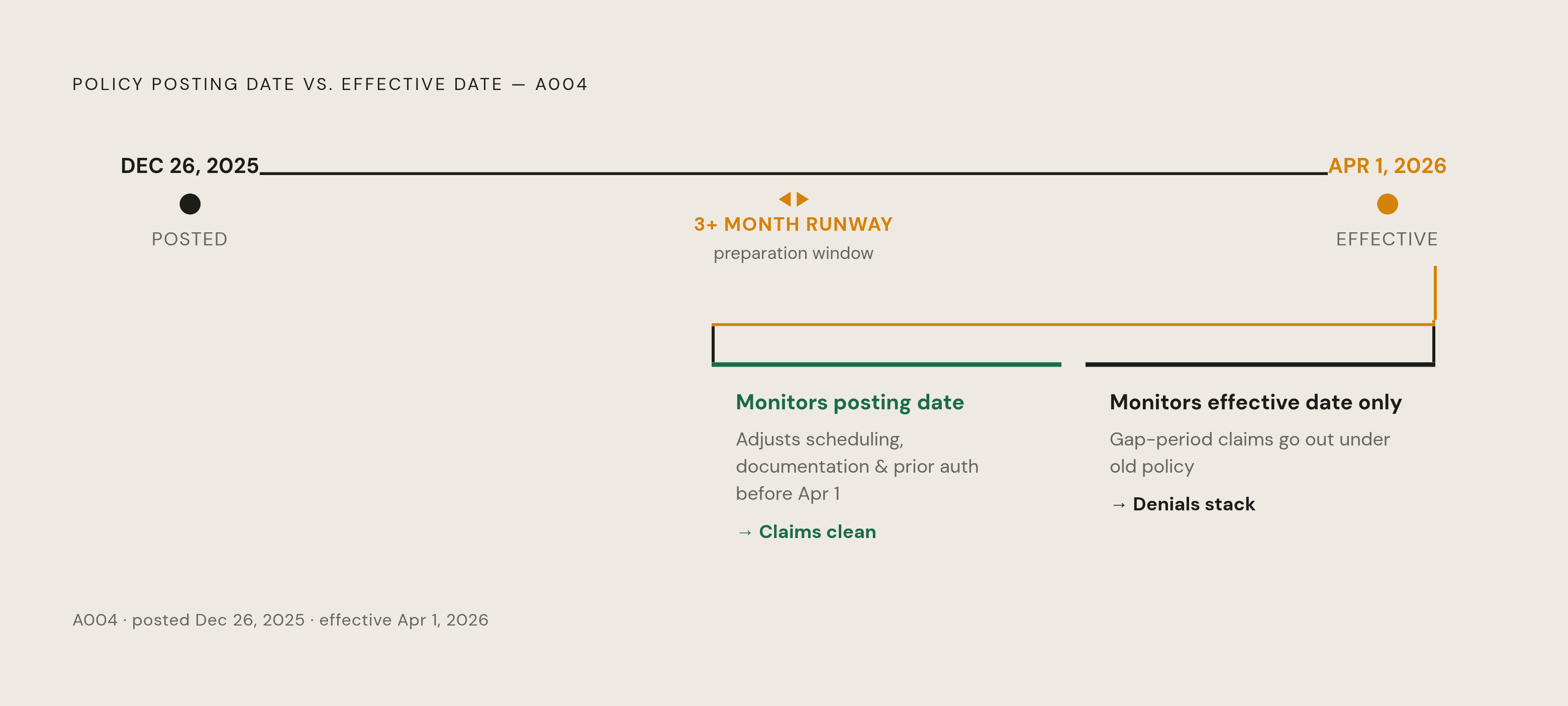
Policy A004 is the cleanest case on record: posted December 26, 2025, effective April 1, 2026, over three months of runway between publication and enforcement. What a practice does with that runway decides whether the gap is a planning tool or a landmine. Most practices treat it as neither, because most practices never look at the posting date at all. They watch the effective date, which is already too late to act on.
The posting date is the one that matters for preparation, full stop. Used right, the gap buys time to adjust scheduling, documentation, and prior authorization workflows before the new rule touches a single claim. Used the way most practices actually operate, checking policy only at or after the effective date, claims for services rendered during the gap go out under the old rule, and the denials stack up before anyone notices there was a change worth catching.
There's a safety net, but it's thinner than it looks. Practices generally have up to a year from the date of service to submit corrected claims, and that only helps if someone catches the mismatch between what was billed and what the policy required, in time to file the correction. Cigna's own deficient claim notification rule requires the company to flag a deficient claim within 45 calendar days of receipt, or 30 days for electronic submissions. That notice arrives after the claim has already failed, closer to an autopsy than a warning.
The posting date should trigger a practice's response. When the effective date becomes the trigger instead, the response clock starts with less time on it than anyone assumes.
Cigna's timely filing deadlines and the events that start the clock
Commercial participating providers get 90 days from the date of service to file, while out-of-network commercial claims get 180 days. Cigna Behavioral Health participating providers have to submit within 60 days, with an additional 30-day grace period; miss the 90-day mark from the date of covered service entirely, and the claim is denied outright, absent a state law exception. North Carolina carves out its own behavioral health rule: 180 days for individual professionals, and 180 days from the date of discharge for facilities. Texas runs stricter on the back end, no later than the 95th day after discharge, and missing it forfeits payment unless the practice can prove a catastrophic event caused the delay.
The clock doesn't start from the same event every time, and that's the second habit worth breaking: most practices never stop to check which event governs which claim. Some Cigna filing periods run from date of service, while others run from discharge, and consecutive-day services measure from the last date of service, not the first. Coordination of benefits claims work differently again, since the filing clock for the secondary payer doesn't start until the practice gets notice from the primary payer, so a claim can sit stalled for reasons that have nothing to do with how fast the practice moved.
Appeals get 180 days from the date of denial on most Cigna plans. Corrected claims go out with a "7" in box 22 of the CMS-1500 form, and if the original claim was filed on time and Cigna asked for more information afterward, the filing limit sometimes doesn't apply to the resubmission at all.
Stack this against the posting-versus-effective-date gap from the previous section, and the risk compounds fast: a policy change caught late eats straight into the window left to correct and resubmit. Once the original filing deadline closes before anyone notices the mismatch, the money is gone, and it doesn't matter how obviously winnable the denial would have been on the merits.
What prior authorization denial data reveals about Cigna's coverage enforcement in practice
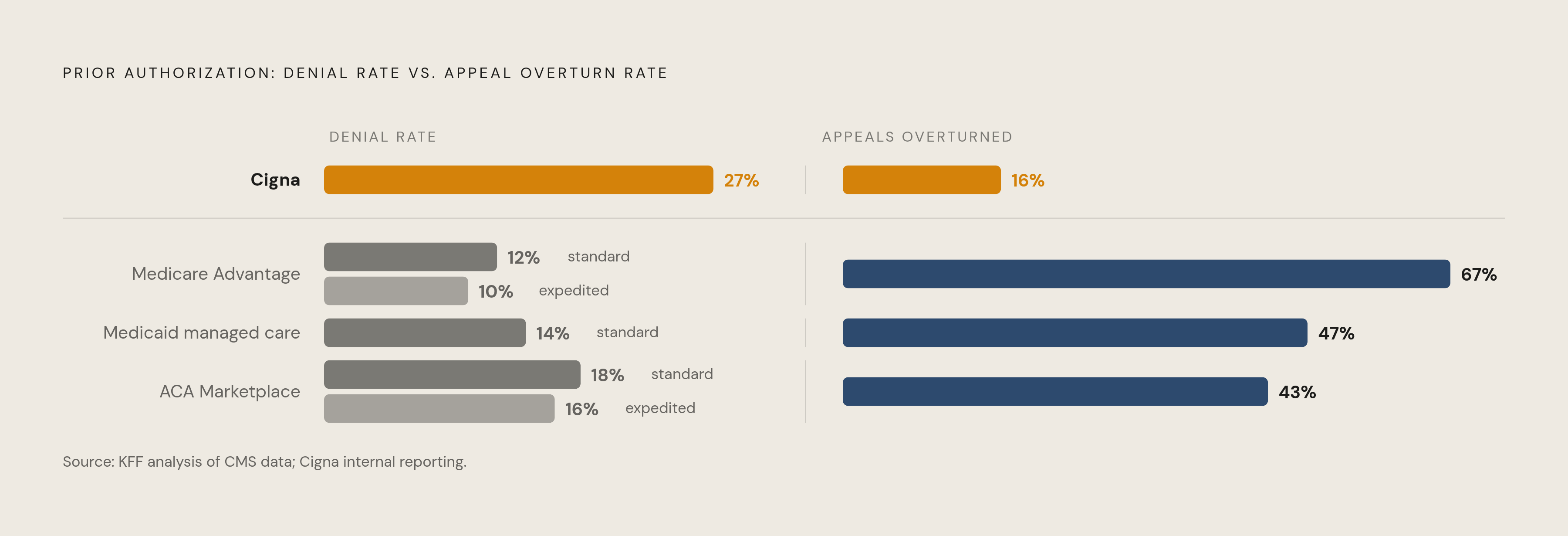
Cigna denies 27% of prior authorization requests, with only 16% of those denials overturned on appeal, per individual insurer filings under CMS-0057-F covering calendar year 2025. A KFF analysis of 14 unique insurers covering roughly 71 million enrollees found denial rates between 12% and 18% across market segments that same year: Medicare Advantage at 12% standard and 10% expedited, Medicaid managed care at 14% standard, ACA Federally Facilitated Marketplace plans highest among that group at 18% standard and 16% expedited.
Cigna's 27% sits above every one of those segment averages, and that gap is not noise. A denial rate that high, occurring before a claim is even submitted, is the upstream symptom of the policy-timing gap described earlier: services approvable under last month's criteria simply fail to meet this month's, and prior authorization is where that mismatch shows up first.
The appeal overturn numbers sharpen the point further. Across the broader KFF dataset, 67% of Medicare Advantage prior authorization denials got overturned on appeal, along with 47% in Medicaid managed care and 43% in ACA Marketplace plans. Overturn rates that high, industry-wide, say most of those initial denials were never medically justified to begin with; many trace back to policy-timing failures or documentation gaps rather than genuine coverage exclusions. Most denials never get appealed, though, so that correction almost never happens, and the initial denial stands as the final word by default.
That's the part worth sitting with. A denial rate measures how often a practice's documentation and timing matched whatever Cigna's criteria happened to be that month, more than it measures medical necessity on its own. Cigna's own 27% is the number that matters when a practice is sizing its exposure to Cigna specifically, not some blended industry figure that flattens insurer-to-insurer differences ranging as wide as 2% to 25% in the same KFF data.
The operational habits that let policy changes cause denials before a practice notices
The most common failure looks almost harmless. A practice checks Cigna's policy once, usually during credentialing or an annual benefits review, then treats that snapshot as gospel until a denial shows up to correct the record. Given a monthly update cadence, the policy in effect when a patient is scheduled and the policy in effect when the claim is actually submitted can be two different documents entirely, especially for services with a longer gap between visit and claim.
The vendor guideline problem is sneakier, and it's the one most compliance checklists miss outright. In certain markets, Cigna uses third-party utilization management guidelines for chiropractic, physical and occupational therapy, and advanced radiology, sourced from vendors like EviCore, or clinical interpretation frameworks like the MCG Care Guidelines. A claim in one of these categories gets checked against criteria that never show up on CignaforHCP.com, and a practice that only watches Cigna's own provider newsroom stays blind, by design, to the rule actually being applied to its claims. On paper this sounds like the vaguest failure mode in the whole piece; in practice it's the most concrete one there is, because the rulebook a biller checks isn't the rulebook the claim gets graded against.
Staff turnover makes all of it worse. Institutional memory, which Cigna policy version applied to a prior denial, which appeal argument actually worked, which vendor guideline governs a given specialty, walks out the door the day a biller leaves, and the replacement starts from zero, every time.
Then there's the timing of discovery itself. A practice that finds out about a policy-driven denial wave during a month-end report is finding out weeks after the affected claims went out, and weeks closer to the timely filing deadline for any fix. Clean claim rates fall apart under exactly this condition: the version checked at the scrubbing stage stops matching the version actually in force, and no amount of scrubbing catches an error nobody knew to look for.
What a practice needs to track Cigna policy changes before they hit claims
Any practice with meaningful Cigna volume needs a floor of monitoring, and it starts with checking CignaforHCP.com's policy update listings every month, not waiting for a denial to prompt the search. Posting dates matter more than effective dates here, and the gap between them is the entire preparation window, one that closes the moment nobody's watching for it.
Vendor guidelines need their own separate tracking line. EviCore, MCG, and any other third-party source Cigna leans on for a given specialty won't necessarily show up in Cigna's own provider communications, so relying on CignaforHCP.com alone leaves a blind spot exactly where imaging, chiropractic, and PT/OT claims live. A practice also needs a running log of which policy version was in force on the date of service for any claim likely to need an appeal, since appeals hinge on the criteria that applied when the service happened, not the criteria in force when the claim got filed.
Timely filing rules turn this from a nice-to-have into a hard requirement. A policy mismatch caught too late to correct and resubmit before the filing deadline closes isn't a paperwork headache, it's lost revenue, permanently, with no appeal path left to recover it.
Manual tracking doesn't scale to this pace, and pretending otherwise is the last bad habit worth naming directly. Spreadsheets updated when someone remembers, shared folders nobody checks twice, a biller's mental list of "the usual" Cigna rules: none of it holds up against a payer publishing dozens of changes a month across a dozen specialties. For practices that can't build and staff this kind of monitoring in-house, a billing system built to track policy changes continuously and check every claim against the current version of the relevant policy before it goes out the door is the alternative worth taking seriously. Altair Clear tracks every Cigna policy and edit as Cigna publishes it, then checks each claim against the payer's current policy set before submission, so claims go out against the rule actually in effect rather than the rule that was current at the last manual review. Altair Memory builds on top of that by accumulating how Cigna behaves across every claim worked over time, building payer-specific pattern recognition that doesn't reset to zero every time a billing employee leaves. Altair Live puts a real-time view of every claim and every dollar in front of the practice owner, so a policy-driven denial spike shows up the day it starts, not at month-end, when the timely filing window has already narrowed past the point of easy recovery.
Cigna's monthly update cadence isn't slowing down; if anything, the volume of changes across recent cycles keeps climbing. A practice's monitoring either matches that pace or it doesn't, and the gap between posting and effective dates stays open for exactly as long as nobody's watching it.