Timely Filing Denial Trends and Payer Deadline Discrepancies
Payers use conflicting deadlines that leave no room for appeals or fixes once they pass.

Timely filing denials work differently than almost every other denial code in medical billing, and that difference is the point of this piece. Most denials leave the door open for a fix. Timely filing denials, coded CO-29 on the remittance, close it permanently, and the closing has nothing to do with whether the service was medically necessary or the chart was clean.
Why CO-29 is different from every other denial code
A coding error can be corrected. An eligibility gap can be documented after the fact. Medical necessity can be argued on appeal, sometimes for months, sometimes with a peer-to-peer review that turns the decision around. CO-29 doesn't offer any of that. Once the filing window closes, the money is gone, full stop, regardless of how well the claim was built.
A3 Medical Billing's payer reference identifies a CO-29 denial as a contractual write-off. The practice absorbs it. The patient cannot be billed for the balance, because the filing failure belongs to the provider's process, not to the patient's coverage. And per CMS policy, confirmed by First Coast Service Options, a late-filing denial isn't even treated as an "initial determination" under Medicare rules. That sounds like a technicality, but it isn't. It means the standard redetermination appeal path, the one every biller uses to fight a denial, never opens. There's no first-level appeal to file, because CMS doesn't view the claim as having been properly reviewed in the first place.
The only door left is a claim reopening under CMS Publication 100-04, Section 70.7, and it only opens for four narrowly defined exceptions. Miss those, and the claim is done. That's why this isn't a "denial" in the way the term usually gets used. It's a write-off wearing a denial code, and treating it like a routine A/R problem, something to work later in the aging report, misreads what actually happened.
How wide the deadline gap is across major payers in 2026
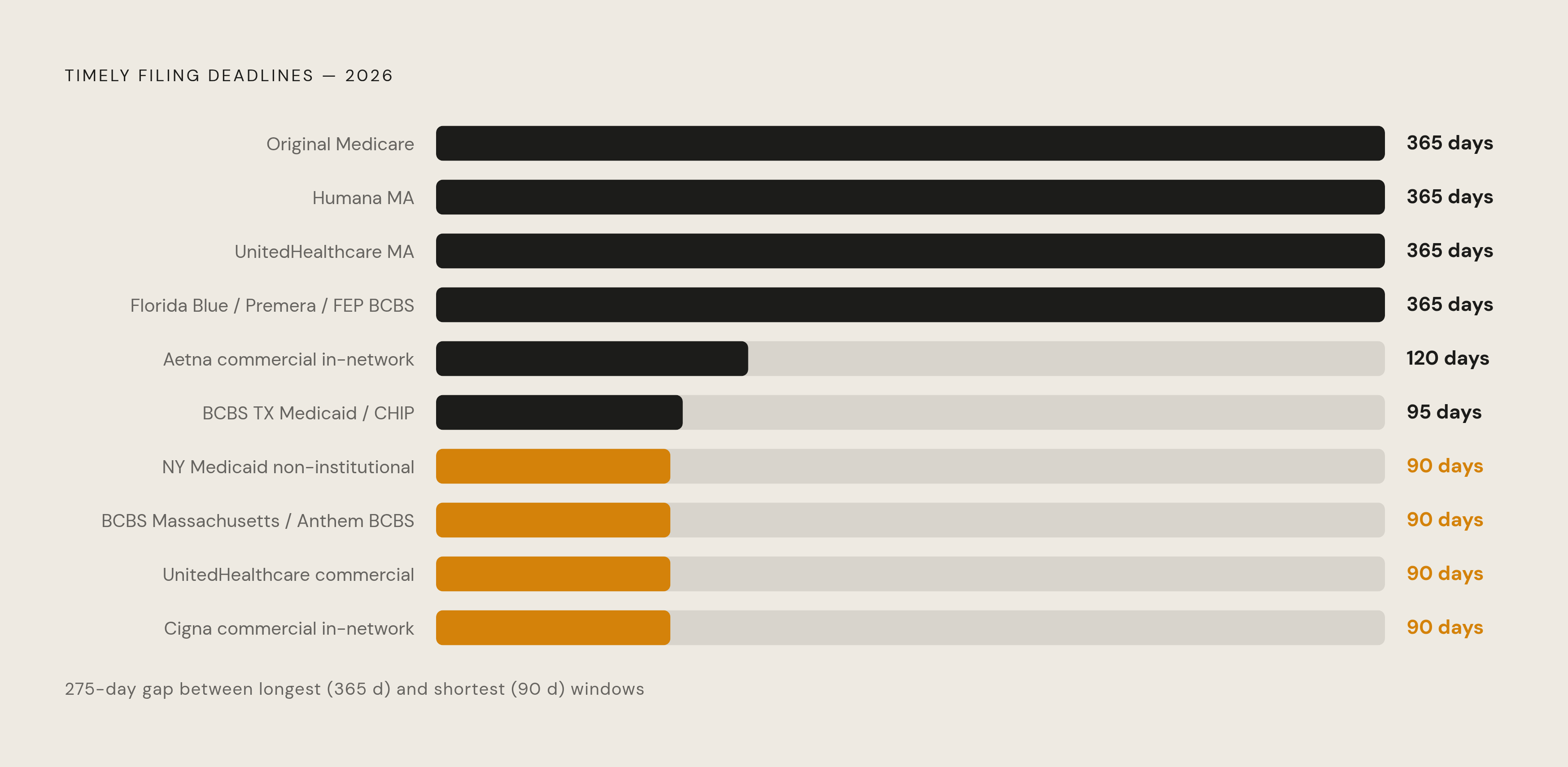
Here's where things get genuinely hard to manage: the filing window isn't one number. It's dozens of numbers, and they don't move together.
Original Medicare fee-for-service gives providers 12 months from the date of service, under 42 CFR 424.44. It's the longest window in the group, and also the least forgiving once it passes, since there's no soft landing built into the rule. Medicare Advantage sits on a CMS-mandated floor of 365 days for non-contracted providers, but individual contracts can and do shorten that. Aetna MA runs 120 days per a medstates.com guide. Humana MA follows the 365-day CMS floor. UnitedHealthcare MA follows the 365-day CMS floor, though providers need to check their own Participation Agreement rather than assume the floor applies universally. Cigna MA runs through December 31 of the following calendar year, and as of January 1, 2026, that plan is administered by HealthSpring, which is its own wrinkle for anyone still routing claims the old way.
Commercial payers move even faster. A3 Medical Billing's quick reference, verified against payer provider manuals, puts UnitedHealthcare commercial in-network claims at 90 days. Cigna commercial in-network is also 90, with out-of-network stretched to 180. Aetna commercial in-network is 120 days, but out-of-network jumps all the way to 12 months, a gap that trips up billing teams who assume in-network and out-of-network rules track together.
A major health insurance brand isn't one payer at all. It's dozens of independent plans, each setting its own clock. BCBS Massachusetts and Anthem BCBS are 90 days. Florida Blue, Premera, and the Federal Employee Program are 365, while BCBS North Carolina's window should be confirmed directly against the provider contract. BCBS Texas commercial windows vary by product and should be verified against the relevant provider manual, and BCBS Texas Medicaid and CHIP drops to 95. Treating "BCBS" as a single filing rule is one of the most common and most avoidable errors in the whole system.
Medicaid adds a third layer. Federal law under 42 CFR 447.45 caps the window at 12 months, but states set their own, usually shorter, limits. New York gives non-institutional claims 90 days. Pennsylvania gives 180. Texas Medicaid splits the difference: 95 days for acute care, a full year for long-term care.
And appeal windows run on their own, shorter clock entirely. UnitedHealthcare's commercial appeal window is 65 days from the denial date, described by A3 as the shortest among the major commercial payers. BCBS appeal windows range from 60 to 180 days depending on the affiliate. A practice seeing patients across even a handful of these payers is tracking not one deadline, but a spreadsheet of them, and the tightest windows, 90 days commercial, 95 days for Texas Medicaid, leave billing teams only a few real weeks of working time after documentation wraps up. Every number here is a floor to start from, not a rule to file by. The specific provider contract governs, and payer manuals need to be checked directly, a point both A3 and MedHeave stress in their 2026 guidance.
The Part A versus Part B clock distinction and why it produces unexpected denials
Even within Medicare, the deadline doesn't start where people assume it starts.
Part B professional claims run their clock from the line-item date of service, the "From" date on the CMS-1500 or its electronic equivalent, the 837P. That covers office visits, outpatient procedures, diagnostics, the bulk of everyday claim volume. Part A institutional claims work differently. The clock runs from the "Through" date on the UB-04, the discharge date, not the admission date.
That distinction has teeth. A patient admitted January 10, 2025 and discharged January 20, 2025 gives the filer until January 20, 2026, not January 10. A billing team that anchors to admission date on every inpatient claim is quietly giving away ten days of runway it never actually had to give.
What counts as "filed" matters just as much as when the clock starts. Filing means receipt by the correct Medicare Administrative Contractor, full stop. Not the postmark. Not the electronic submission timestamp. Not the clearinghouse transmission log showing the claim left the building. A medsolercm.com source states that no MAC has the authority to extend that one-year deadline on its own, no matter how sympathetic the circumstances.
Coordination of benefits adds one more twist. Medicare's clock stays anchored to the date of service, not to when a secondary payer situation resolves, so waiting on another payer doesn't buy extra runway. Cigna handles this differently: its secondary submission window runs 90 days from the primary payer's EOB, an entirely separate anchor date logic. A practice billing both payers on the same COB claim is running two different clock systems side by side, and assuming they behave the same way is exactly how a preventable denial gets generated.
The rejected-claim trap: how a submission that looks filed is not filed
Confirmed by First Coast Service Options in 2026: a returned or rejected claim is not a filed claim. The clock does not pause for it, does not reset, does not care that something was sent.
Picture a claim submitted on day 360 with a coding error. The clearinghouse or the MAC kicks it back on day 365. That claim was never filed. The corrected version has to reach the MAC before the deadline, not merely leave the building before it. This is why submitting close to the deadline is nearly as risky as missing it outright: one bad eligibility field, one invalid data element, and the last correction window disappears along with it.
Rejection and denial aren't the same event, and treating them as interchangeable is a workflow failure in itself. A clearinghouse rejection means the claim never entered adjudication at all; it needs correction and retransmission, and the clock keeps running the whole time. A payer denial means the claim did get adjudicated, and it opens a different process, appeal or corrected-claim submission, with its own rules. Tracking "submitted" dates alone misses this entirely. What matters is confirmed receipt by the correct MAC or payer, not the internal record of when someone hit send.
This gets more dangerous the moment billing gets outsourced. The provider assumes the vendor has filed. The vendor may be sitting on the claim waiting for a signed note or corrected subscriber information. A RevGuard source notes that neither side necessarily notices the gap until the account is already close to the deadline. The clock never stops for that confusion to get sorted out.
How payer deadline behavior has gotten harder to track in 2026
The rules aren't static, and 2026 has made that especially visible.
A significant number of Medicare Advantage enrollees are losing access to their current plan this year as insurers pull out of counties, with major carriers restructuring their footprints. HMOs now make up more than half of all MA plans. That matters for timely filing specifically because a mid-year plan change doesn't carry the old filing deadline forward. A practice still billing against the old plan's rules can be filing into a window that's already closed under the new one, because the mid-year plan change reset the deadline without generating any notice to the practice.
Appeal windows are shrinking too, on a parallel track. UnitedHealthcare has shortened its peer-to-peer review request window, a change that took effect in the first quarter of 2025. expedited appeal windows for urgent prior authorization requests have narrowed at some major MA plans. Standard appeal windows for non-urgent PA denials have also tightened at some payers. A practice running denial review on a weekly or biweekly cycle simply can't catch a 14-day window before it shuts, the math doesn't work.
BCBS affiliate confusion keeps generating the same avoidable errors it always has: treat every Blue Cross plan as one entity, and the errors write themselves. The rule that governs is whichever affiliate issued the card in the patient's wallet, not a national default. When the payer's denial letter, the remittance advice, and the payer portal show three different dates for the same claim, the guidance is to keep all three and escalate before the earliest one closes. That discrepancy isn't a clerical annoyance. It's a warning sign that the payer's own systems don't agree with each other, and the practice needs to act on the most conservative date, not the most convenient one.
Deadline tracking, in other words, isn't a task to finish once during contract review and file away. It needs to run continuously, because the ground underneath it keeps moving.
Where timely filing denials originate in the billing workflow
Most CO-29 denials trace back to slowness somewhere upstream, not to anyone forgetting a payer's rule. Experian Health's State of Claims 2025 identifies missing or inaccurate claim data as the top denial driver overall, cited by roughly half of surveyed providers, with registration errors and authorization failures among the leading contributing factors.
Delayed charge capture causes a lot of this: charges enter the system late, shrinking the time left to file before the clock, which starts on the date of service, runs out. The clock starts on the date of service, not on the date someone finally keys the charge into the system. Slow physician documentation, backed-up sign-off queues, charge entry sitting untouched for days, all of it quietly eats into filing runway before the claim has even been built. High-volume specialty groups and ambulatory surgery centers carry the most exposure here, with certain service lines prone to billing-queue delays that turn into a persistent revenue leak rather than a one-off mistake.
Eligibility verification failures compound the problem. Find a mismatch after the claim has already gone out, and the correction-and-resubmission cycle eats days or weeks of whatever runway was left. Bundling edit updates can add new code pairs that look perfectly fine internally but generate denials once they hit the payer, because they were separately billable in a prior cycle. Practices that haven't updated charge capture logic for that change are producing rejections on codes that used to sail through clean, and each rejection burns more of an already-shrinking window.
Coordination of benefits timing adds one more failure point. A practice that waits for the primary payer to finish adjudicating before it even touches the secondary claim may already be running against a tighter secondary deadline than anyone realizes. By the time someone checks the calendar, the window has narrowed far more than expected. None of this points to a practice that doesn't know the deadline. It points to a practice that doesn't measure how long its own claims sit still.
What it costs to let timely filing denials accumulate
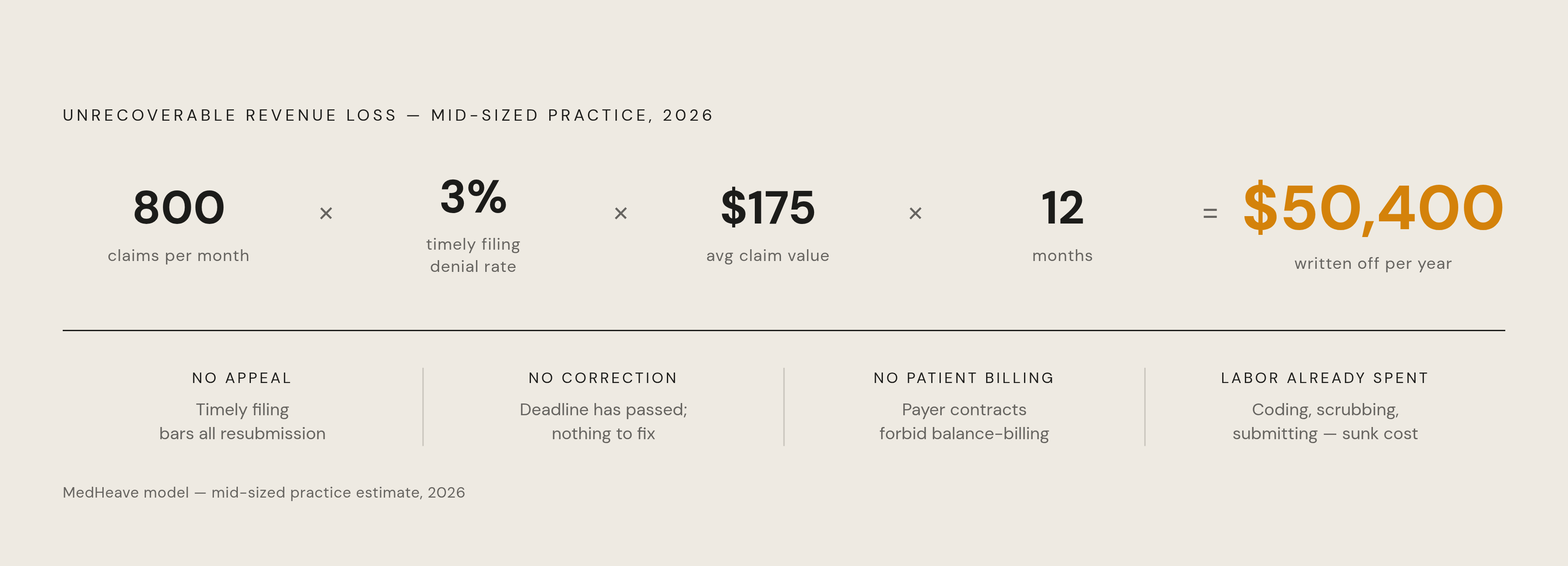
The dollar figures make the case better than any argument about process discipline. MedHeave's August 2026 illustrative model looks at a mid-sized practice submitting around 800 claims a month, with a 3% timely filing denial rate and an average claim value of $175. That works out to roughly $50,400 a year in revenue that cannot be recovered through appeal, correction, or patient billing. That $50,400 cannot be recovered through appeal, correction, or patient billing.
What makes that number sting more than a typical denial figure is what happened before the write-off. Every one of those claims was already coded, scrubbed, and submitted. The labor was spent in full. TFL denials are uniquely wasteful because they destroy revenue after the cost of producing it has already been paid, unlike a denial that gets corrected and resubmitted for the same labor cost twice.
The broader denial environment isn't helping. Experian Health's State of Claims 2025 found that 41% of healthcare providers in the country reported overall denial rates above 10% in 2025, up from 30% in 2022. healthcare providers reported overall denial rates above 10% in 2025, up from 30% in 2022. Net revenue leakage across the industry climbed from $38.6 billion in 2024 to $48.4 billion in 2025, a 25% jump reflecting denials that are getting harder and more expensive to resolve. Timely filing denials, being unrecoverable by definition, are the most efficient contributor to that number, since there's no resolution path to offset them.
There's a signal buried in rising TFL rates that's worth taking seriously on its own. MedHeave notes that a practice watching its timely filing denial rate climb isn't just losing money on those specific claims. It's getting a warning that claims across the board are moving too slowly through the revenue cycle, and other claims are quietly racking up the same kind of delay, just without having crossed a deadline yet. The CO-29 code on a remittance reports a loss that occurred weeks or months earlier, when the filing deadline passed. The denial is the notification, not the event.
The operational controls that prevent timely filing denials before they happen
None of this is unmanageable, but it requires treating the filing deadline as a live operational number from the moment a claim is billable.
Set the clock at intake. As soon as an encounter becomes billable, record the service date, the payer, the plan type, the filing limit, and an internal submission target, all in the same place. RevGuard holds that the whole model needs to be built around confirmed payer receipt, not around the date someone in the office hit submit.
A centralized deadline database affects whether claims across dozens of payer contracts get filed before their deadlines expire or slip through unnoticed. MedHeave treats this as the only reliable method at scale for any practice contracting with dozens of payers, and it needs updating at least annually, ideally at each contract renewal. BCBS affiliates, MA plans, and Medicaid state programs all need their own line items. No national default number should ever stand in for the actual contract. And when a denial letter, a remittance, and a portal display show conflicting dates on the same claim, all three get preserved and escalated immediately, not smoothed over by picking whichever date is easiest.
Rejected and denied claims need to live in separate workflow lanes. A rejected claim needs correction and retransmission against a clock that's still ticking. A denied claim moves into an entirely different process. Blur the two together in one aging bucket, and the resubmission deadline is the thing that quietly slips through.
Every aging claim needs a named owner, not a queue. One person accountable for the next action, the supporting evidence, and the actual deadline date. RevGuard notes that generic aging buckets hide the filing clock instead of displaying it, because nobody owns the specific date until it has already passed. Eligibility should get verified at scheduling and again 24 to 48 hours out, catching the mismatch before it ever reaches a claim, rather than after a rejection has already burned through the runway.
Sources
- Timely Filing Limits in Healthcare: What Providers Must Know
- Timely Filing Limits by Major Payer: 2026 Quick Reference - A3 Medical Billing
- Timely Filing Limits: Deadlines & Denial Prevention - MedHeave
- Medicare Timely Filing Limit 2026 | Updated CMS & MA TFLs
- Medicare Timely Filing Limit 2026: 12 Months, No Appeal
- Denial Management: Causes & 2026 Best Practices | Verimedix
- cms.gov