Bundling and Unbundling Denial Patterns in Surgical and Procedural Claims
Standard NCCI edits mask a repeatable pattern that maps to predictable code pairs and payer rules.
Bundling and unbundling denials in surgical claims follow a pattern that most practices treat as random. The pattern is not random. Both errors trace back to the same source: a mismatch between how a claim was built and how an industry-standard edit table defines the relationship between the codes on it. Because these denials are rule-triggered rather than judgment calls, they're mappable, and a practice that maps its own repeat offenders is looking at a short, fixable list, not an endless grind of one-off mistakes.
The distinction matters because the two failure modes point in opposite directions. A bundling denial means the payer paid the comprehensive code and rejected the component code as already included in it, money left on the table. An unbundling denial means the practice billed components separately when they should have traveled under one comprehensive code, which is a compliance exposure, not just a missed dollar. Both start with the same NCCI logic. What separates them is which side of the edit the claim landed on.
Compare that to a denial for a missing authorization or a wrong NPI. Those are one-off events, tied to a specific claim on a specific day. Bundling denials aren't like that. They repeat on the same code pairs, the same payer, and the same specialty, month after month. That repetition is what makes them mappable.
The NCCI edit structure that generates most bundling denials
CMS publishes the NCCI Procedure-to-Procedure edit tables every quarter. Each edit pairs a Column 1 code, the comprehensive service, with a Column 2 code, the component service. When both codes appear on the same claim, for the same patient, same date, the payer bundles them and pays only Column 1.
What happens next depends on a modifier indicator attached to the pair. Indicator 0 means the bundle cannot be broken, full stop. No modifier fixes it, no documentation fixes it, and appending modifier 59 anyway is unlikely to resolve the denial. The only path forward on an indicator 0 denial is checking whether the payer applied the wrong code pair or pulled from the wrong quarter's table, not writing an appeal letter. Indicator 1 is different: the edit can be bypassed with the right modifier when the clinical facts genuinely support billing the services separately.
The quarterly release cycle is where practices get caught off guard. A code pair's modifier indicator can change between quarterly releases, and a practice running off a cached reference sheet may not catch the shift. A practice running off a cached reference sheet or last year's cheat sheet is billing into a violation it can't even see coming.
Two edit types live inside NCCI and get confused constantly. PTP edits govern the code-pair relationships described above, the actual bundling logic. Medically Unlikely Edits cap how many units of a single code can be billed for one patient on one date, a related but separate mechanism that also drives denials on surgical claims.
Surgical package logic is baked into NCCI from the start. Incision, closure, and any step necessary to complete the primary procedure are already folded into the surgical code's payment. Breaking a laparoscopic cholecystectomy (CPT 47562) into its component steps and billing them individually is a textbook unbundling error. The same logic governs the global surgical period: E/M visits inside the global window, ten days for minor procedures, ninety days plus the day before for major ones, are bundled into the surgical payment unless a modifier documents a distinct and unrelated reason for the visit.
Incidental procedures follow the same rule. A procedure performed alongside a more complex primary one, requiring little extra work, isn't separately billable. Removing an asymptomatic appendix during another abdominal surgery is incidental. Removing one that's actually inflamed is a separate, medically necessary procedure. The difference lives in the documentation, not in the CPT code itself. For any surgical claim carrying a second procedure code, the current NCCI PTP table, checked against the actual date of service, is the first stop, not a memory of what the rule used to say.
How modifier 59 and the X modifiers create a legitimate bypass, and an audit target
Modifier 59 exists to override an NCCI PTP edit when two services that are usually bundled were genuinely distinct on a given claim. It only holds up with documentation strong enough to prove that distinction. Modifier 51 addresses a different problem entirely and isn't a substitute for modifier 59.
The X modifiers exist to make the distinction more precise than modifier 59 alone can. XE marks a separate encounter. XP marks a separate practitioner. XS marks a separate organ or anatomic structure. XU covers an unusual service that doesn't overlap with the other billed procedure. Using the specific X modifier where it fits both describes what actually happened and can reduce audit exposure compared with the broader modifier 59 catch-all.
Modifier 59 remains one of the most scrutinized modifiers in the CPT code set. The OIG has flagged its misuse repeatedly in past audits as a source of improper Medicare payments, though the FY 2026 Work Plan doesn't rank it as the second-largest driver behind E/M upcoding specifically.
Here's where most of these denials actually get decided: the note. Research has found that 37% of physician notes lack enough detail for optimal code assignment. If the operative note doesn't name the distinct anatomic site, or doesn't reflect a genuinely separate encounter or a distinct rendering provider, the modifier has nothing to stand on. The payer's denial holds up on review, because the modifier was never legitimately supported in the first place.
The documentation standard is specific, not general. A separate anatomic site claim needs the note to name the actual structure, not just gesture at "the operative field." A separate encounter claim needs to show distinct patient contact, not two services folded into a single note. A separate practitioner claim needs the claim itself to identify who did what.
And when the underlying edit carries indicator 0, none of this matters. No note, however well written, overrides a bundle that can't be broken. The only useful move at that point is going back to whether the claim was built correctly in the first place, because an appeal on documentation grounds is dead on arrival.
AAPC's frequently cited orthopedic example involves a knee arthroscopy with meniscectomy (CPT 29881) billed alongside chondroplasty (CPT 29877) in the same session. The payer denies 29877 with remittance remark M15, services bundled as components of the same procedure. Whether modifier 59 rescues that claim depends entirely on two things: whether the current NCCI table carries indicator 1 for that specific pair, and whether the note documents a genuinely distinct compartment of the knee. Absent both, the denial is correct.
How UHC layers proprietary bundling logic on top of NCCI
A major payer's claim editing system runs NCCI edits and a separate, payer-owned set of bundling edits at the same time. A claim can pass every NCCI PTP check cleanly and still get denied under a UHC-specific code pair that appears nowhere in any CMS table. That's a different animal than a standard NCCI denial, and it requires a different response.
UHC expanded its proprietary bundling library in the third quarter of 2025, adding 847 new code pairs to its unbundling detection list. Practices billing the same way they'd billed for months suddenly started seeing CARC 4 denials, procedure inconsistent with modifier, on claims that would have cleared cleanly under the prior edit set. There was no notice that the rules had shifted underneath them.
Orthopedics, ambulatory surgery centers, dermatology, wound care, and general surgery carry the highest exposure to this kind of change. For a four-provider orthopedic group, the annual hit from UHC modifier bundling denials runs somewhere between $28,000 and $65,000, based on MBC's denial management analysis across 240 specialty practices. The same analysis found UHC generating substantially more modifier-related denials than BCBS, a gap wide enough that treating the two payers with one generic workflow guarantees leaving money behind.
The CARC codes themselves complicate the picture further. UHC codes modifier bundling disputes as CARC 4. BCBS codes a functionally identical dispute as CARC 97. Same underlying disagreement, different code, different appeal documentation required, and a payer-agnostic appeal letter will fail against one of them every time.
Appeals against UHC's proprietary edits need to name the specific CMS NCCI table showing that no NCCI edit exists for the pair in question, or, where a UHC-specific edit does apply, challenge the clinical basis for that edit through UHC's provider dispute resolution process directly. Per MBC's data, generic appeals arguing that the procedures were "separately performed" fail at a high rate, while appeals citing the specific table conflict succeed far more often. UHC's peer-to-peer review window closes 14 days from the denial date. Miss it, and a recoverable claim becomes a permanent write-off.
Layered on top of all this is UHC's move toward automated claim review powered by a computer model, where natural language processing compares the clinical note against the submitted CPT and ICD-10 codes before a human ever looks at the file. Vague medical necessity language, or a comorbidity left out of the note, that once slipped through manual review now triggers an automatic denial. Surgical claims, being high-value, are seeing elevated denial rates under this kind of automated review.
How BCBS medical necessity denials hit surgical claims through AIM Specialty Health
BCBS runs its specialty prior authorization programs for musculoskeletal, spine, and other high-cost procedures through Carelon Medical Benefits Management, formerly branded AIM Specialty Health. Carelon sits between the practice and the BCBS plan as the actual adjudication layer, which means the criteria a practice needs to satisfy aren't set by BCBS directly, they're set by Carelon.
Those criteria changed in the second quarter of 2025, when Carelon tightened its clinical guidelines, adding stricter conservative-treatment duration requirements for musculoskeletal and spine procedures before surgery gets authorized. Practices that had routinely secured authorization for these same procedures throughout 2024 began seeing medical necessity denials into 2026, without changing a single thing about how they treat patients. The criteria moved. The care didn't.
Orthopedics, spine surgery, interventional cardiology, and pain management carry the heaviest exposure here. For a four-provider orthopedic group, annual losses from BCBS medical necessity denials run between $35,000 and $95,000, per MBC's analysis, which also found BCBS generating close to double the medical necessity denials of UHC. That gap means the appeal strategy for BCBS needs to be built around clinical documentation, not modifier logic, which is the opposite emphasis from what UHC's modifier-driven denials require.
The first move on a BCBS medical necessity denial through Carelon is peer-to-peer review, not a written appeal. Practices that file the written appeal first are running the wrong play and burning clock against a deadline they may not even have mapped correctly. And that deadline isn't uniform: BCBS Texas allows 30 days, BCBS Illinois allows 60 days. Applying UHC's 14-day peer-to-peer window to a BCBS claim, or applying one state's deadline to another state's plan, closes the recovery window through a procedural error that has nothing to do with the clinical merits.
MBC's 2026 RCM data puts a number on what happens when practices don't separate these workflows: an estimated 30 to 45% of recoverable denial revenue goes uncollected when UHC and BCBS denials get run through the same generic process.
What the denial rate data reveals about the scale of the problem in surgical specialties
The trend line matters more than any single year's number. Experian Health's State of Claims survey, fielded between June 23 and July 3 across 250 revenue cycle leaders, found 41% of providers reporting more than 10% of their claims denied, up from 38% in 2024 and 30% in 2022. That's a climb in every year the survey has run, not a plateau.
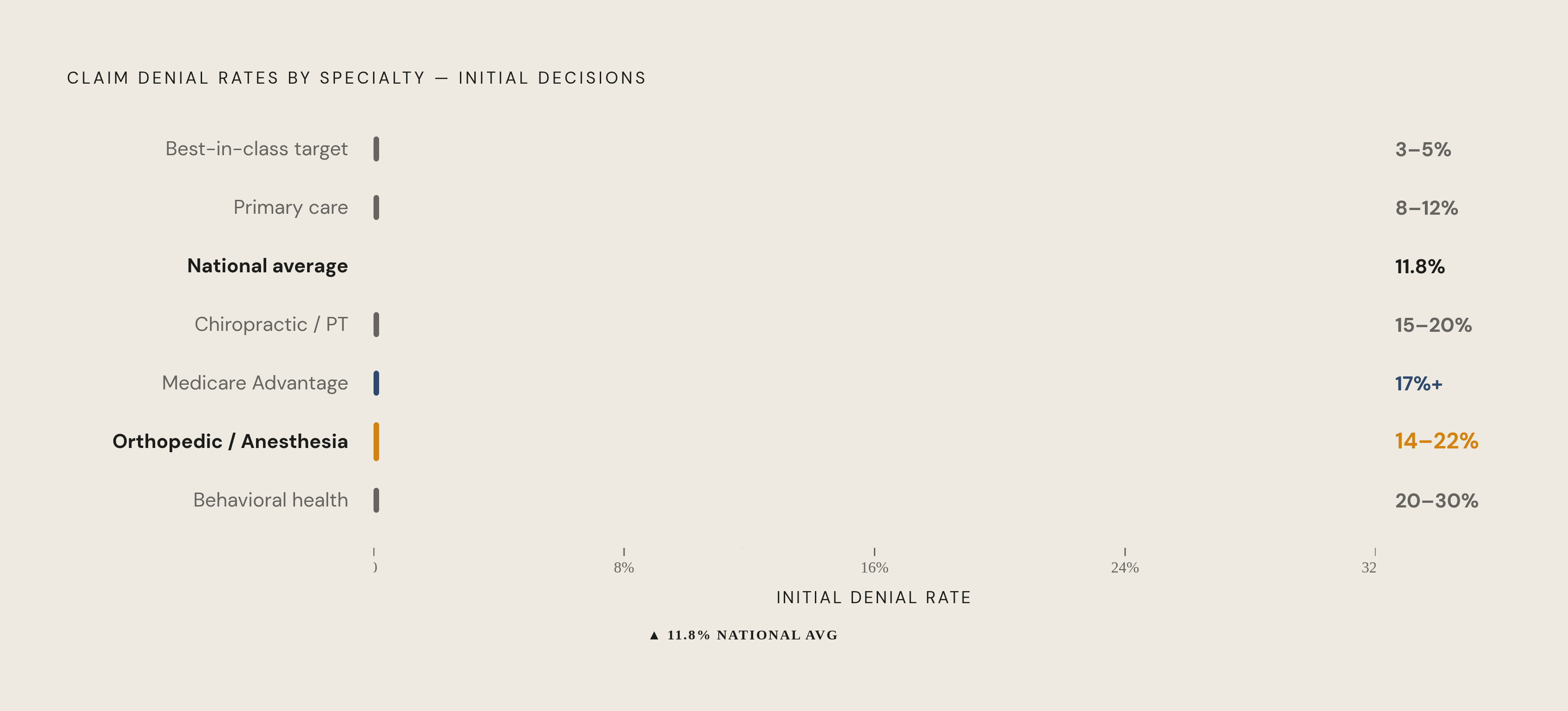
Nationally, the initial denial rate is 11.8%, according to Experian's figures, translating to roughly $262 billion in medical claims denied on first submission annually. Of those, 65% never get resubmitted at all. Most of that recoverable revenue simply gets written off without a fight.
Surgical and procedural specialties sit well above that national baseline. Orthopedic surgery and anesthesia, both heavy on prior authorization, run 14 to 22%. Behavioral health runs 20 to 30%. Chiropractic and physical therapy, when Medicare's modifier logic breaks down, run 15 to 20%. Primary care and internal medicine, by comparison, run 8 to 12%, which is roughly where the whole system used to live before the climb started.
Medicare Advantage deserves its own callout. MA denials rose 4.8% year over year and now exceed 17%, more than double the traditional Medicare rate. KFF reported that MA insurers issued nearly 53 million prior authorization determinations in 2024 alone. MDaudit found that the average denied dollar amount on a Medicare Advantage claim climbed 22.4%, to roughly $1,000, between 2024 and 2025, so more claims are getting denied and each denial is worth more.
Net revenue leakage across the industry grew 25%, from $38.6 billion in 2024 to $48.4 billion in 2025, a rate of growth that outpaces the growth in denial volume alone. That gap points to something specific: denial management itself, the labor and process of chasing these claims down, is getting more expensive and more complicated even as the raw number of denials grows.
All of this becomes visible in days in accounts receivable downstream. High-performing practices in 2025 keep AR days under 30. MGMA and AAFP put the acceptable range at 31 to 40. Past 50 days, cash flow concerns become serious. Bundling denials that sit in a queue instead of getting worked immediately are a direct contributor to that drift. Best-in-class practices run denial rates under 3%, with 5% as a reasonable working target. Surgical specialties running 14 to 22% have a real, quantifiable gap between where they are and where the top performers sit.
The pattern-mapping approach that separates recoverable revenue from permanent write-offs
Bundling denials repeat. Same code pairs, same payers, same specialties, over and over, which means a practice that actually maps its own denial history is working with a finite, fixable list rather than fighting an endless stream of unrelated errors.
A useful pattern map for bundling denials tracks a handful of specific fields for every recurring denial: the exact CPT code pair generating the denial, which payer is behind it (UHC, BCBS, or a specific MA plan), the CARC code attached to the remit (CARC 4 versus CARC 97, same dispute, different payer language), which modifier was on the claim at the time, whether that code pair's NCCI indicator was 0 or 1, and whether a payer-specific proprietary edit, not an NCCI edit at all, actually drove the denial.
Once those fields are filled in across enough claims, the picture stops looking like noise. Indicator 0 denials generally cannot be resolved through documentation appeals; the more productive check is whether the payer misapplied the edit in the first place. Indicator 1 denials with weak notes get routed to a documentation fix before resubmission. UHC-specific proprietary edits get challenged through UHC's own dispute process, using the correct CARC code framing for the denial type. BCBS medical necessity denials go straight to peer-to-peer review, on the correct state deadline, instead of into a written appeal that wastes the clock.
That's the difference between recoverable revenue and a permanent write-off: knowing, before the appeal is even drafted, which bucket a given denial actually belongs in.