AI Claim Scrubbing Tools for Physician Practices and Clean Claim Rate Impact
Practices with clean claim rates in the 70s-80s are leaving thousands monthly on the table.
Clean claim rate measures one thing: the share of claims accepted and paid on the first submission, with no errors, no rework, no follow-up call to a payer's provider line How Medical Claim Scrubbing Software Improves Clean Claim Rates. HFMA sets 98% as the minimum threshold for a high-performing billing operation, and Becker's ASC Review confirms that same number as the industry standard How Medical Claim Scrubbing Software Improves Clean Claim Rates. Most independent and group practices land nowhere close. The typical range is between the mid-70s and mid-80s, which means the distance between where a practice operates and where it should operate isn't a rounding error. It's structural.
That distance costs money in a way that's easy to calculate. Take a practice submitting 500 claims a month at a 15% denial rate: that's 75 denied claims, and using the $118 average rework cost documented in the Change Healthcare Healthy Hospital Revenue Cycle Index, roughly $8,850 in labor spent just re-touching claims that should have gone out clean the first time How Medical Claim Scrubbing Software Improves Clean Claim Rates. Every month. Multiply that across a year and the number stops looking like an operational nuisance and starts looking like a line item someone should be accountable for.
Zero Touch Rate measures whether a claim required any human intervention at all before it left the building, and it's a second metric worth tracking alongside clean claim rate that top performers have started watching closely. This matters because it reframes what scrubbing is actually for. Catching obvious errors is table stakes. The real prize is removing the human touch points entirely, so a biller's day isn't spent fixing what a system should have caught on its own. That reframing sets the terms for everything that follows: what AI scrubbing actually does, where it outperforms traditional scrubbers, and how physician practices can use clean claim rate as the metric that connects scrubbing performance to recoverable revenue.
The denial environment practices are scrubbing against in 2026
The ground has shifted under practices faster than most billing departments have adjusted for. The initial denial rate climbed from 10.2% in 2020 to 11.8% in 2024, the most recent year with complete data, according to the Experian State of Claims Report How Medical Claim Scrubbing Software Improves Clean Claim Rates. It's a slow, steady climb across multiple years rather than one bad year or one policy change, which is in some ways worse, because it means the trend has momentum behind it.
Experian Health's State of Claims survey, which polled 250 healthcare professionals responsible for financial, billing, or claims decisions between June and July 2025, found 41% of providers reporting that more than 10% of their claims get denied. That's up from 38% in 2024 and 30% in 2022. An MGMA Stat poll adds a harder edge to the picture: 60% of medical group leaders reported an increase in denial rates, and only 11% managed to bring those rates back down. MGMA ties that gap directly to the absence of structured front-end prevention, which is a polite way of saying most practices are reacting to denials instead of stopping them before they happen.
The denial rate isn't uniform across payer types, and the differences matter for how a practice should think about scrubbing strategy. Commercial payers run somewhere between 10% and 16%, depending on the carrier, with UnitedHealthcare and Cigna trending toward the higher end. Medicare fee-for-service sits much lower, in the 4% to 6% range. Medicare Advantage, though, behaves nothing like traditional Medicare. It behaves like a commercial payer, and in some cases worse: one study found initial denials at 17% in Medicare Advantage settings.
Layer onto this the fact that payers themselves have started automating their review process. Denial decisions that once took a human reviewer days now come back in hours. The AMA's 2025 Prior Authorization Survey found that six in ten physicians, 60%, are concerned that AI-assisted payer review is increasing prior authorization denial rates, not decreasing them. Speed on the payer's side doesn't translate into accuracy on the practice's side; if anything, it means mistakes get punished faster. Put simply, the environment practices are submitting into has grown materially harder over five years, and the tools used to scrub claims before submission need to match that complexity. A practice running 2020-era scrubbing logic against 2026 denial patterns is bringing outdated defenses to a fight that's already changed shape.
Claim scrubbing and where the traditional rules-based model breaks down
At its core, claim scrubbing reviews a claim before it ever reaches a payer, checking coding accuracy, payer-specific requirements, regulatory compliance, and medical necessity against a defined set of rules, then flagging anything that looks wrong before submission. Every scrubber, no matter how sophisticated, is built on a foundation of NCCI edits. Procedure-to-Procedure edits identify code pairs that shouldn't be billed together under Medicare Part B, while Medically Unlikely Edits flag procedure codes billed in quantities that don't make clinical sense. CMS updates these edits every quarter, and yet, per available data, 73% of medical practices are currently out of compliance with NCCI guidelines, a gap that produces denials that were entirely avoidable.
Bill a procedure code without a diagnosis that meets the payer's documentation requirements linking a covered diagnosis code to that procedure code, and the claim may be denied for lack of medical necessity. That's a frustrating kind of denial, because the clinical decision was sound and the paperwork simply didn't match the payer's specific ask.
This is where static, rules-based scrubbers start to show their age. Rules libraries are, definitionally, fixed at a point in time. They cannot track the continuous, often unannounced policy changes commercial payers make to coverage requirements, prior authorization rules, and billing guidelines. A change that goes live at a major commercial payer this week can take weeks, sometimes months, to appear in a rules engine. So the rules catch the universal, well-known errors, the ones every practice already knows to look for, but they miss the payer-specific nuance: a service that passes clean at one payer and denies outright at another for the exact same clinical scenario. The result is a claim that passes every rule in the engine and still bounces back denied because the scrubber was never built to know how that particular payer has been behaving lately. That's the exact gap AI scrubbing is designed to close.
AI's contribution to claim scrubbing beyond the rules layer
Not every tool marketed as "AI" actually behaves differently from a rules engine with a new label stapled on. The distinction that matters is whether the system genuinely learns, from a practice's own data, from payer behavior, from a history of denials, or whether it's just running the same generic logic every other customer gets.
Real AI scrubbing does a few things a static rules engine structurally cannot. It scans clinical documentation in real time, before submission, checking whether the note actually supports the code being billed. If a diagnosis is coded but the physician's documentation doesn't clearly back it up, the system flags it before the claim ever leaves the practice, not weeks later when the denial letter arrives. It also builds payer-specific intelligence over time, trained on historical adjudication data, learning which modifiers a given payer accepts or rejects, which diagnosis-procedure pairings draw extra scrutiny, and what authorization patterns that payer tends to apply. That knowledge gets applied at the point of scrubbing, rather than being learned the hard way after a denial teaches the lesson.
Predictive denial scoring works the same logic forward: claims get flagged as high-risk based on patterns specific to individual carriers, giving a biller the chance to intervene before submission instead of reworking the claim after it bounces. Real-time eligibility integration closes another loop, connecting scrubbing to live coverage data so gaps, inactive policies, and out-of-network status get caught at the claim level rather than only at scheduling. AI-assisted insurance card processing, which had become widely adopted by 2025, eliminates a subtler failure point: the manual data entry errors that quietly produce eligibility mismatches downstream.
There's a useful test for telling genuine AI systems apart from rebranded automation. Pull a claim that was actually denied last quarter and ask a vendor how their system would have prevented that specific denial. Tools doing real work walk through the reasoning step by step. Rebranded rules engines tend to change the subject. And the strongest systems carry a transparency feature: showing the exact line in the clinical note that supports a given code suggestion, alongside a confidence score. That audit trail matters twice over, once for supporting an appeal if a claim does get denied, and once for catching the moments the AI itself gets it wrong.
The root causes AI scrubbing is solving and which ones it cannot fix alone
The data on why claims actually get denied tells a story that runs against the assumption that coding complexity is the main culprit. In the 2025 Experian survey, 50% of providers named missing or inaccurate claim data as the top factor driving denials, 32% cited registration data errors, and 35% cited authorization failures. The AMA's 2023 Physician Practice Benchmark Survey found something even starker: demographic and technical errors, a wrong date of birth, an outdated insurance ID, a missing prior authorization reference number, account for 61% of all claim denials. They're basic registration errors that a well-designed front-end system should catch before a claim is ever generated.
That finding reshapes how a practice should think about scrubbing ROI. The majority of denial volume is preventable at or before submission, not recoverable in the appeals queue after the fact. Scrubbing that operates at the front end, where these errors actually originate, addresses the dominant category of denials directly, rather than chasing them downstream.
Five CARC categories account for roughly three-quarters of all denials, and each one responds to a different kind of prevention. Eligibility issues get caught through real-time verification built into the scrubbing workflow. Missing information gets caught through payer-specific scrubbing rules. Missing authorization gets caught through prior-auth tracking that runs before the service is rendered. Coding errors get caught through NCCI edits paired with AI-assisted code validation. Timely filing issues get caught through daily submission discipline and active claim-status monitoring.
None of this means scrubbing is a complete fix on its own. If a prior authorization was never obtained before a service was delivered, no scrubber, however intelligent, can retroactively conjure one into existence. If clinical documentation is genuinely thin, flagging the gap only creates value if a person actually acts on the flag before the claim goes out the door. Scrubbing reveals the problem. Whether that problem gets solved in time still depends on staffing and process. The practical implication follows directly: AI scrubbing delivers its highest impact when it's wired into front-end workflows, scheduling, eligibility, prior authorization, rather than bolted on only at the point where a claim is generated.
Clean claim rate benchmarks and their financial outcomes for a practice
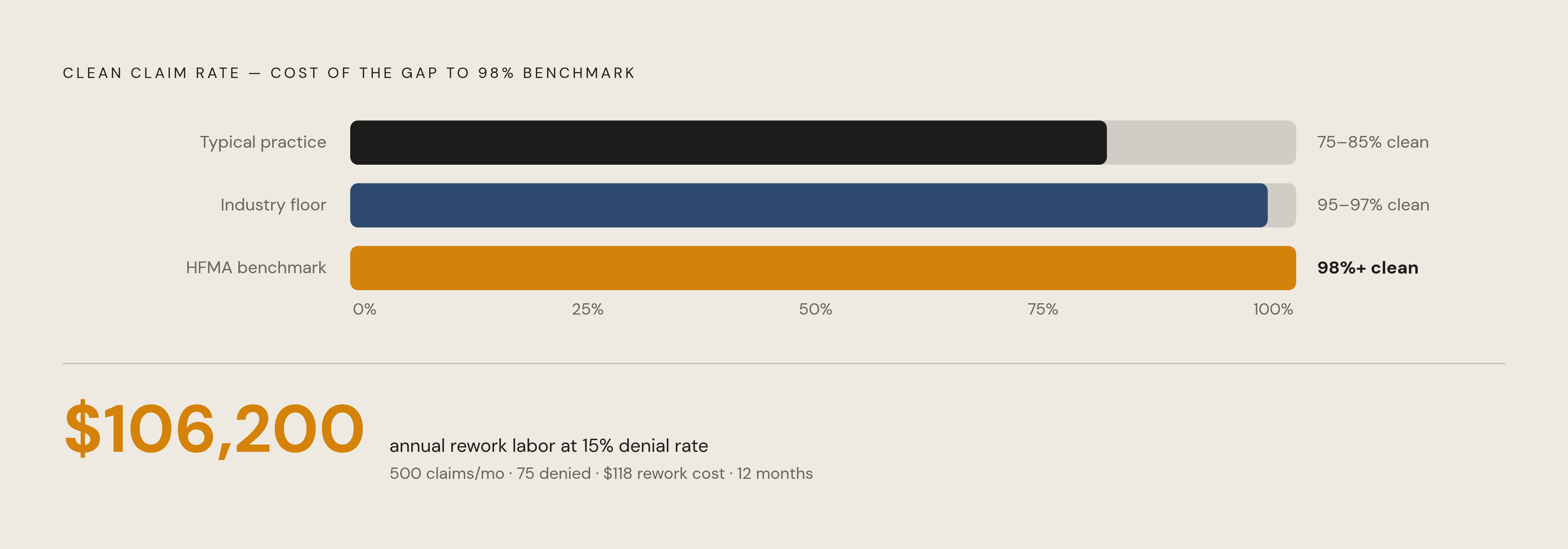
HFMA's benchmark hierarchy gives practices a clear ladder to measure against. A clean claim rate of 98% or higher marks the minimum for a high-performing operation. Between 95% and 97% is the stated industry floor, and anything below that starts signaling structural billing problems rather than isolated mistakes. Fall below 90%, and the practice is likely bleeding revenue through rejections and rework in a way that may not become visible until a cash flow gap turns urgent.
The corresponding denial rate targets tell the same story from the other direction. HFMA puts the optimal denial rate under 5%, with 5% to 10% marking the industry average range, and MGMA attributing top-quartile performance to that same sub-5% tier. The current published industry average, though, is 9% to 12% per MGMA DataDive and HFMA, which puts a meaningful share of practices operating closer to the leak than the benchmark.
Each point below benchmark compounds in a very literal, dollar-denominated way. At the average $118 rework cost per denied claim, and with single-specialty practices running roughly an 8% denial rate, the math isn't theoretical. It raises payroll hours spent on rework instead of new patient intake. Days in AR is the downstream indicator that tends to catch a practice's attention faster than a percentage point on a dashboard. HFMA targets 30 to 40 days, with top performers holding under 30. In 2026, AR days trended up by 2.4 days at the median industry-wide, a shift driven largely by Medicare Advantage prior authorization backlogs and claims pended for medical record review.
Net collection rate rounds out the picture. HFMA lists 95% as the floor, with 97% to 99% considered optimal, and MGMA data shows top-performing practices hitting that upper range while the national average is 95% to 96%. The spread between average and optimal represents recoverable revenue sitting on the table. The average practice loses 10% to 15% of its claims to denial, and roughly two-thirds of those denied claims never get paid at all. That last figure alone explains why front-end prevention carries a far better return than back-end appeals work. Money spent chasing a denial after the fact is money spent against odds that are already stacked against recovery. A higher clean claim rate means faster first-pass payment, which compresses AR days, while a lower clean claim rate means more claims aging past 90 days, where collection probability drops sharply.
Integration depth and its effect on the AI scrubbing metric
A scrubber applied only at the point of claim generation is, by definition, arriving late. Most denial root causes, registration errors, eligibility lapses, missing authorizations, originate earlier in the workflow, well before a claim is even assembled. Catching them at generation means catching damage that's already been done.
High-impact AI scrubbing works differently, threading itself across the full pre-submission workflow. That means eligibility verification running at scheduling and again just before the service is rendered. It means prior authorization tracking that flags a missing authorization before the appointment happens, not after the claim bounces back weeks later. It means real-time payer policy monitoring that updates scrubbing logic the moment a payer changes a requirement, rather than waiting for a quarterly refresh cycle. And it means documentation gap detection that alerts clinical staff while the chart is still open and correctable, not after it's been signed and locked.
EMR integration deserves more weight than it typically gets in a vendor evaluation. If a scrubbing tool requires staff to manually export claim data into a separate system, the friction that creates in daily workflow can easily cancel out whatever accuracy gain the tool provides. Practices need scrubbing that lives inside the workflow they already use, not a parallel step that depends on someone remembering to run it.
There's also a compounding asset at play that's easy to overlook: payer behavioral memory. AI systems that learn from a practice's specific denial history with specific payers build a kind of institutional knowledge that a static rules engine simply discards with every update. That's the same kind of knowledge billing staff turnover erodes every time an experienced biller leaves and takes years of payer-specific instinct out the door with them. It's precisely where a learning system has a structural advantage over a human-only operation, because it doesn't forget. The Zero Touch Rate metric, again, is the way to operationalize this: measuring not just how many claims pass scrubbing, but how many passed with zero human intervention, reveals how much of a clean claim rate is genuinely automated versus how much still depends on a staff member catching what the scrubber missed. Practices running AI-integrated billing platforms report first-pass acceptance rate gains of up to 30% compared to manual scrubbing workflows, though that figure tracks how deeply the tool connects to front-end data, not simply whether it's labeled AI.
Evaluation criteria for AI scrubbing tools
The single most useful diagnostic a practice can run during vendor evaluation is also the simplest. Pull a claim that was actually denied last quarter, hand it to the vendor, and ask how their system would have prevented that specific denial. A tool doing genuine work will walk through its reasoning, step by step, tied to that claim. A rebranded rules engine tends to pivot to generalities.
Beyond that test, a handful of concrete questions separate systems built for real payer complexity from systems dressed up to look like it. Does the AI actually adapt to a practice's specific payer mix, specialty, and denial history, or does it apply the same generic logic to every customer regardless of who they bill? Can it show the specific line in a clinical note that supports a code suggestion, alongside a confidence score, or does it hand over a recommendation with no audit trail behind it? Does it catch problems before a claim goes out, or mostly detect them after a denial has already landed? Does it track payer policy changes as they happen, or only on a fixed update schedule that lags real payer behavior by weeks? Does it integrate into the EMR a practice already runs, without forcing a platform migration or retraining the entire front desk? Does it connect eligibility verification, prior authorization tracking, and claim scrubbing into one coordinated workflow, or leave staff to stitch together three separate tools on their own? And finally, does the vendor back the AI with actual human billing expertise for exception handling, or is the algorithm the only layer of review a claim ever gets?
None of these questions has a universally right answer that applies to every practice size or specialty mix. But a vendor that can answer all seven with specifics, not marketing language, is signaling something real about how the system was built. A vendor that can't is signaling something too.