Payer AI in Claims Adjudication and Prepayment Audit Expansion
Insurers are using AI to deny claims faster and earlier, before practices can respond or appeal.

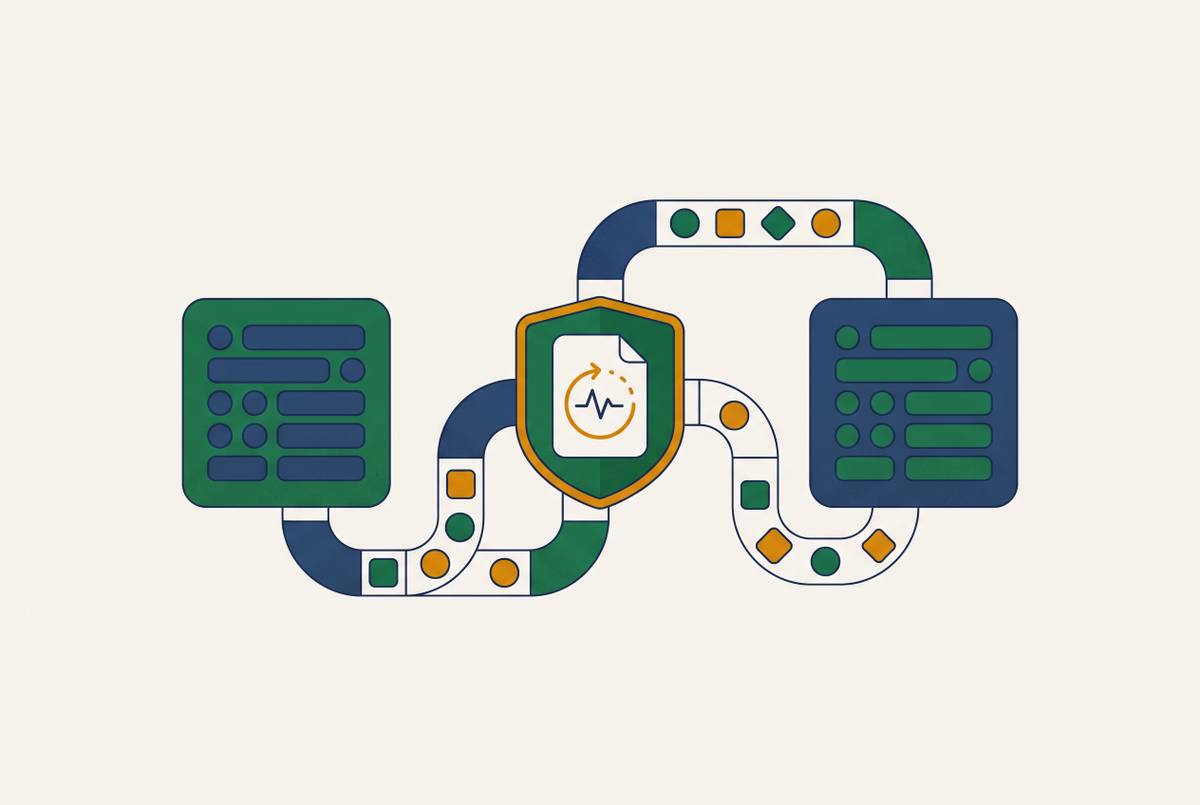
Payer AI is not one piece of software sitting behind a claims desk. It is a stack of systems working in sequence: triage and routing tools sort incoming claims, eligibility checks run automatically, rules-based editors flag coding problems, and machine-learning models score the likelihood that a claim should be denied before a human ever sees it. Roughly 80 to 85% of health insurance claims already move through this pipeline without anyone touching them, and insurers are now pointing the more advanced layer of that stack at the complex cases that used to require a live reviewer. Sit with this: the claims left for AI to handle aren't the easy ones anymore. They're the surgical bundles, the multi-code visits, the borderline medical necessity calls.
The bigger shift is about timing, not automation volume. It's about timing. Payers used to pay a claim and chase down the money later if something looked wrong, an approach the industry still calls "pay and chase." The structural change underway now is prepayment prevention: catching and stopping the claim before money ever moves. That single change in sequencing rewires who carries the financial risk while a dispute gets sorted out. Under pay and chase, the practice had the money and the payer had to fight to get it back. Under prepayment review, the practice never gets the money in the first place, and has to fight to get it released.
Aetna's rollout of its second-generation Claims Assist Manager, launched May 26, 2026, shows where this is headed. The system pulls together eligibility, coverage, member, and provider data through agentic AI, so the software doesn't just flag a claim, it recommends and in many cases executes the next action itself. Aetna reports processing time cut by more than 20% on the complex claims that require manual review, which sounds like an efficiency win, and for the payer, it is. For the practice on the other end, that same speed means less time to catch a problem before it hardens into a denial.
The speed problem: what automated denial at scale means for a practice's revenue window
Cigna's algorithm is the case everyone in revenue cycle circles points to now. Over two months, it denied 300,000 claims, spending an average of 1.2 seconds reviewing each one https://www.lilesparker.com/2026/06/05/cms-crush-update-providers-must-prepare-for-ai-driven-audits-in-2026/. On appeal, 90% of those denials got reversed: the system was wrong nine times out of ten https://www.lilesparker.com/2026/06/05/cms-crush-update-providers-must-prepare-for-ai-driven-audits-in-2026/. Read that number again: not occasionally wrong, not wrong at the margins. Wrong nine times out of ten on claims it had already rejected.
That reversal rate is a cash flow problem and a pointed piece of evidence for a lawsuit. It's a cash flow number. Every one of those wrongly denied claims that a practice doesn't appeal is money the practice never sees again.
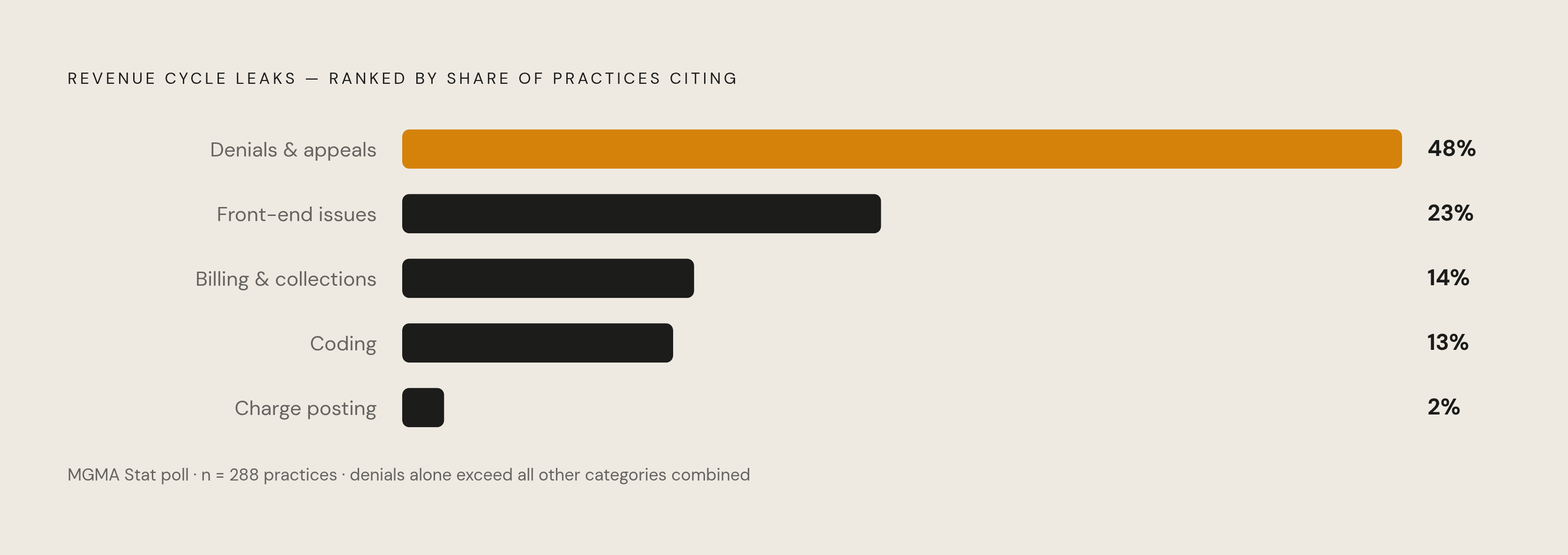
Insurer adoption of full-scale AI accelerated sharply between 2024 and 2025, and the practical result is that denials now arrive faster than most billing departments were ever built to respond to. A MGMA Stat poll of 288 practices found that denials and appeals are now the single biggest revenue cycle leak, cited by 48% of respondents https://www.lilesparker.com/2026/06/05/cms-crush-update-providers-must-prepare-for-ai-driven-audits-in-2026/. Front-end issues came in a distant second at 23%, followed by billing and collections at 14%, coding at 13%, and charge posting at just 2% https://www.lilesparker.com/2026/06/05/cms-crush-update-providers-must-prepare-for-ai-driven-audits-in-2026/. The gap between the top item and everything else tells you where the pressure has actually shifted. This is a denial-and-appeal problem now, not a coding problem or a collections problem. It's a denial-and-appeal problem, and it dwarfs every other line item combined.
Where payer AI intervenes most aggressively: prior authorization, high-value services, and Medicare Advantage
Prior authorization sits at the front of the funnel, and it's where physicians feel the squeeze first. The American Medical Association reported that 74% of surveyed physicians said prior auth denials had climbed over the previous five years https://www.lilesparker.com/2026/06/05/cms-crush-update-providers-must-prepare-for-ai-driven-audits-in-2026/. That's not a fringe complaint.
High-value service categories, imaging, specialty drugs, surgical procedures, carry denial rates well above routine office visits, which is exactly where you'd expect payer AI to concentrate its attention: dollar amount and denial probability tend to move together.
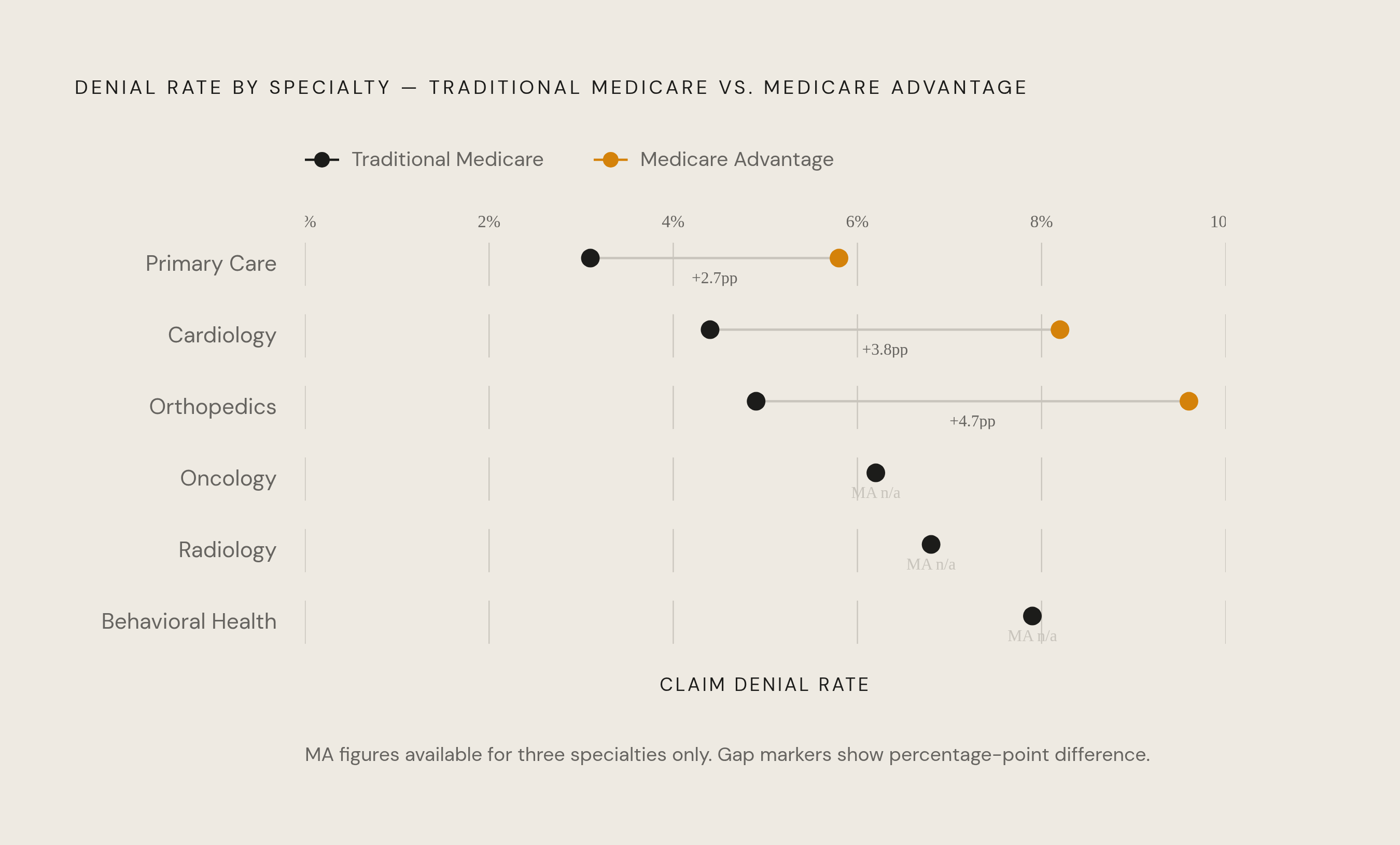
Medicare Advantage shows this pattern most starkly, in the best-documented example of a structural pattern rather than a one-off. Under traditional Medicare, denial rates by specialty run low: 3.1% for primary care, 4.4% for cardiology, 4.9% for orthopedics, 6.2% for oncology, 6.8% for radiology, and 7.9% for behavioral health https://www.lilesparker.com/2026/06/05/cms-crush-update-providers-must-prepare-for-ai-driven-audits-in-2026/. Every specialty, without exception, runs hotter under MA than under traditional Medicare, and that consistency is what makes this a structural feature of how MA plans administer utilization management rather than noise in the data.
Algorithmic downcoding layered on top of that makes the picture worse before it gets better. The plans flagged most often for downcoding include Humana Gold Plus, Aetna Medicare Advantage, Anthem MediBlue, and Devoted Health. That's real operating margin, gone to a scoring model nobody in the practice ever sees run. MA specialty denial rates stand at 5.8% for Primary Care, 8.2% for Cardiology (concentrated in cardiac imaging and electrophysiology), and 9.6% for Orthopedics (driven by PT authorization and DME billing complexity).
The government layer: CMS CRUSH and the prepayment audit expansion practices must understand
CMS didn't quietly roll this out. On February 25, 2026, at a White House press conference, Vice President Vance, Secretary Kennedy, and Administrator Oz announced the CRUSH Initiative (Comprehensive Regulations to Uncover Suspicious Healthcare). The framing was explicit: move away from pay and chase, toward a real-time "Detect and Deploy" model built on AI. Notice the language mirrors exactly what commercial payers have already been doing. Government audit policy and private payer software design are converging on the same idea at almost the same time.
CRUSH isn't confined to Medicare, either. CMS has explicitly tied the initiative to Medicaid, CHIP, and the federally facilitated marketplace exchange. The scope covers most of the payer relationships a typical practice manages. The primary policy document so far is a Request for Information published in the Federal Register on February 27, 2026, and as of June 2026 a comprehensive CRUSH regulation hadn't been finalized. So the rule itself is still being written. The enforcement posture has already been announced and staffed, well before the rulebook is locked down.
The broader executive branch timeline shows this building for over a year. A June 6, 2025 Presidential Memorandum targeted waste, fraud, and abuse in Medicaid. On July 2, 2025, DOJ and HHS reestablished the False Claims Act Working Group. And on March 16, 2026, an executive order created a Task Force to Eliminate Fraud within the Executive Office of the President, chaired by Vice President Vance. Each step on its own might look like routine fraud-prevention housekeeping. Strung together, they describe a steady escalation toward audit infrastructure that runs on the same real-time AI logic private payers already use.
How the regulatory environment is reshaping prior authorization timelines and payer transparency obligations
Some of this regulatory movement actually cuts in the practice's favor, at least on paper. CMS-0057-F, the Interoperability and Prior Authorization Final Rule, started its phased rollout with turnaround timeframes and denial reason requirements taking effect January 1, 2026, while the API requirements follow by January 1, 2027. Three changes matter here in practical terms. Expedited decisions have to come within 72 hours https://www.lilesparker.com/2026/06/05/cms-crush-update-providers-must-prepare-for-ai-driven-audits-in-2026/. And payers can no longer issue a bare denial with no explanation attached; a specific reason is now required.
The catch sits in the timing. Payers have until January 1, 2027, generally, to meet the API interoperability piece of the rule, so the transparency infrastructure that's supposed to make all this visible and auditable is still under construction. The faster clock is running now. The system that lets practices see why and verify how isn't live yet.
CMS-0062-P would extend much of this same framework to drug prior authorizations. Public comment closed June 15, 2026, and the rule hadn't been finalized as of that date https://www.lilesparker.com/2026/06/05/cms-crush-update-providers-must-prepare-for-ai-driven-audits-in-2026/. If adopted, it would also pull small group market insurers on the ACA small business exchange into scope and apply HL7 FHIR data standards across every HIPAA-covered entity handling prior authorization requests. That's a meaningfully wider net than the current rule covers, though it's still a proposal, not law. Standard prior authorization decisions are now capped at 7 calendar days, down from as many as 14 for many payers (a 50% reduction).
What the front-end data failures that feed AI denials look like inside a practice
Payer AI just needs to be fast to catch a practice's own mistakes. It just needs to be fast. Half of providers name missing or inaccurate claim data as the single biggest driver of denials, which puts the largest point of failure squarely on the practice's own side of the transaction, not the payer's. Registration errors account for 32% of denial triggers, and authorization failures account for 35% https://www.lilesparker.com/2026/06/05/cms-crush-update-providers-must-prepare-for-ai-driven-audits-in-2026/. None of that is exotic. Payer AI catches them instantly, at the exact moment of adjudication, with no grace period.
Eligibility problems alone account for about 22% of preventable denials, avoidable with a pre-visit verification step https://www.lilesparker.com/2026/06/05/cms-crush-update-providers-must-prepare-for-ai-driven-audits-in-2026/. That's the maddening part. Almost a quarter of denials in this category shouldn't happen at all; they're not clinical disputes or medical necessity arguments, they're paperwork that could have been checked the day before the appointment.
A moving target sits beneath all of this: payer policy changes without warning. Payer policy changes without warning, and a claim that was clean and compliant last month can be non-compliant this month, with no notice that a rule shifted. A wave of denials reveals to a practice that a payer updated its coding edits, since there is no reliable way to know beforehand. That instability is exactly the environment payer AI is built to exploit: a system that can re-score claims against a new rule the moment it changes has a permanent head start over a billing team that finds out only after the rejection letter arrives.
Why payer AI creates a compounding disadvantage for practices that respond slowly
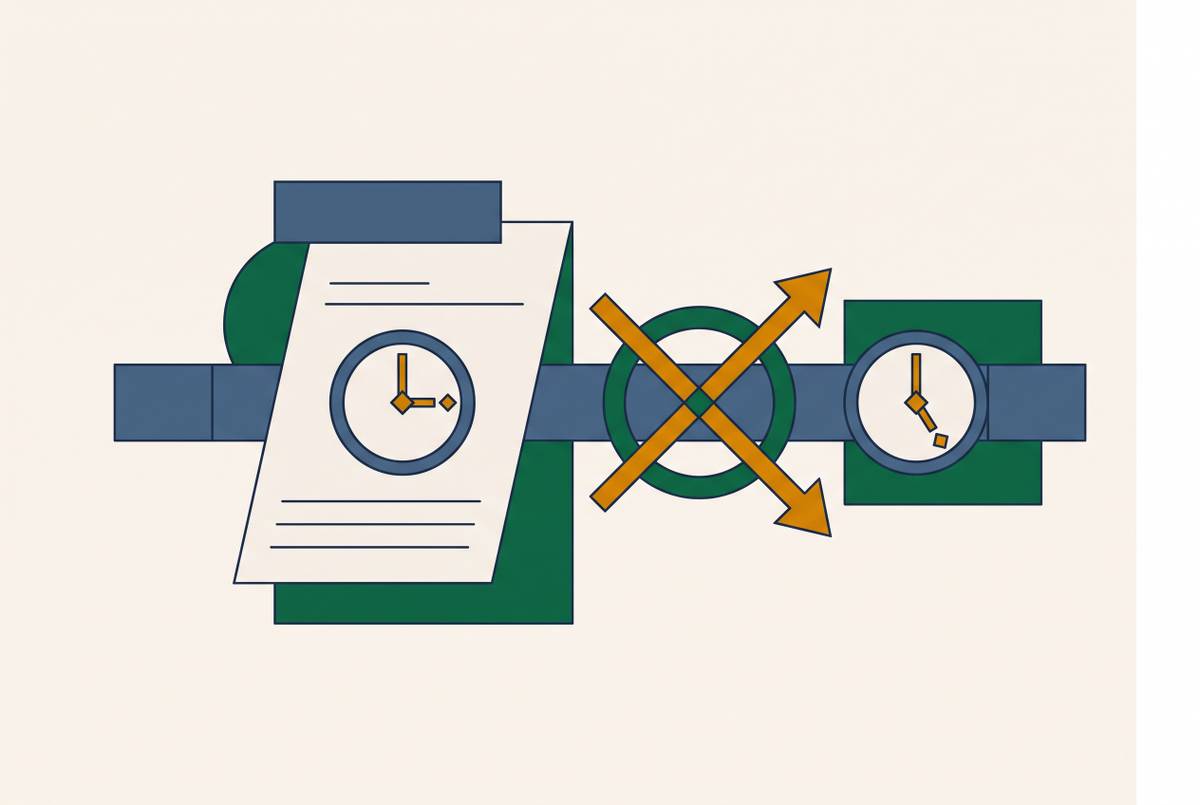
Payer AI runs in real time. Most practice denial management workflows do not operate in real time the way payer AI does, and claims can bounce back on technicalities while appeal deadlines run and the revenue window narrows before the practice knows the denial exists. Claims bounce back on technicalities while appeal deadlines quietly tick down, and the window to recover that revenue narrows before anyone on staff even knows a claim was denied. Speed asymmetry, once it exists, doesn't stay flat. It compounds.
The dollar evidence backs this up. The national claim denial rate hit 12.4% in 2025, the highest mark in a decade https://www.lilesparker.com/2026/06/05/cms-crush-update-providers-must-prepare-for-ai-driven-audits-in-2026/. Experian Health's State of Claims survey shows the trend line moving in one direction only: 30% of providers reported more than 10% of claims denied in 2022, rising to 38% in 2024, then 41% in 2025 https://www.lilesparker.com/2026/06/05/cms-crush-update-providers-must-prepare-for-ai-driven-audits-in-2026/. Net revenue leakage grew substantially from 2024 to 2025, which points to something sharper than rising denial volume alone: resolution costs and complexity are climbing faster than the denials themselves, and the administrative drag of fighting AI-generated denials is now compounding on top of the denials it's fighting.
Days in accounts receivable make the compounding effect visible on a practice's own books. HFMA benchmarking data shows AR days rose year-over-year in 2024, and a slow denial response is a direct contributor: every day a wrongly denied claim sits unappealed is a day added to AR, and a day closer to a deadline that quietly closes the door on recovering it. HFMA's top-quartile target is a denial rate under 5%, with best-in-class multi-specialty groups running 3 to 4% and high performers holding clean claim rates at 95% or better https://www.lilesparker.com/2026/06/05/cms-crush-update-providers-must-prepare-for-ai-driven-audits-in-2026/. A 2026 survey from the Medical Group Management Association found 40% of group practices already have three or more full-time administrative staff members per physician to handle administrative needs, pointing to a gap rooted in something other than headcount https://www.lilesparker.com/2026/06/05/cms-crush-update-providers-must-prepare-for-ai-driven-audits-in-2026/. It's about whether that staff is working at the same speed as the systems deciding whether they get paid. Nearly 50 insurers voluntarily reduced prior authorization requirements under commitments made in June 2025 https://www.lilesparker.com/2026/06/05/cms-crush-update-providers-must-prepare-for-ai-driven-audits-in-2026/. Internal medicine and primary care physicians lose $18,000–$42,000 per physician annually due to downcoding by Medicare Advantage plans https://www.lilesparker.com/2026/06/05/cms-crush-update-providers-must-prepare-for-ai-driven-audits-in-2026/. Cardiologists lose $22,000–$55,000 per physician annually due to downcoding by Medicare Advantage plans https://www.lilesparker.com/2026/06/05/cms-crush-update-providers-must-prepare-for-ai-driven-audits-in-2026/. Hospitalist medicine physicians lose $15,000–$38,000 per physician annually due to downcoding by Medicare Advantage plans https://www.lilesparker.com/2026/06/05/cms-crush-update-providers-must-prepare-for-ai-driven-audits-in-2026/. Orthopedics physicians lose $12,000–$30,000 per physician annually due to downcoding by Medicare Advantage plans https://www.lilesparker.com/2026/06/05/cms-crush-update-providers-must-prepare-for-ai-driven-audits-in-2026/. Multi-specialty groups lose $120,000–$320,000 in aggregate annually due to downcoding by Medicare Advantage plans https://www.lilesparker.com/2026/06/05/cms-crush-update-providers-must-prepare-for-ai-driven-audits-in-2026/. Under CMS-0057-F, effective January 1, 2026, standard prior authorization decisions now have a 7 calendar day limit https://www.lilesparker.com/2026/06/05/cms-crush-update-providers-must-prepare-for-ai-driven-audits-in-2026/. CMS states that the 7-day prior authorization window represents a 50% improvement for some payers compared to the previous 14-day standard https://www.lilesparker.com/2026/06/05/cms-crush-update-providers-must-prepare-for-ai-driven-audits-in-2026/. As of early April 2026, at least 25 states have issued guidance based on a model bulletin adopted in 2023 by the National Association of Insurance Commissioners (NAIC) regarding AI use in insurance https://www.lilesparker.com/2026/06/05/cms-crush-update-providers-must-prepare-for-ai-driven-audits-in-2026/.