Payer Formulary and Step Therapy Policy Changes and Their Billing Downstream Effects
Payers are tightening formularies now, not in 2026, reshaping pharmacy billing immediately.

The IRA's Part D redesign, taking full effect in 2026 with a hard cap on out-of-pocket spending, is already reshaping how health plans build formularies and manage step therapy, and most practices are treating that date as a distant deadline instead of the current billing reality it has become. Payers are tightening coverage now, not later, and the denial queues already show it. Waiting for a calendar date that has already stopped mattering is the mistake, and it is costing practices money every week they keep making it.
The mechanism is straightforward once you follow the incentive. Part D sponsors now carry more of the cost once a patient hits the out-of-pocket cap, so plans have a direct financial reason to push utilization toward cheaper drugs before a patient ever gets there. A Spherix Global Insights survey found 68% of payers are increasing step therapy requirements and 54% are widening formulary exclusions outright. What was a forecast is standard operating procedure now, and treating it as a future problem is an error still being made.
Scale is what turns this from a payer issue into something closer to a universal billing problem. As of early 2024, the top five integrated health plans and pharmacy benefit managers controlled roughly 92% of all pharmacy prescriptions in the country, so a formulary change at any one of those five entities moves through most of the patient population within a billing cycle or two. Regulatory snapshots of formulary and prior authorization activity tend to lag behind what plans are actually doing at the point of care, and the payer survey data on active tightening is the better real-time signal. Practices are better off weighting what payers are doing over what regulators report about them after the fact. The regulatory snapshot is always a step behind the plan documents, and treating it as current information is the error.
Benefit design is shifting underneath all of this too. Payers expect copay-led plan designs, where patients pay a flat dollar amount, to drop from 60% of plans down to 27% by 2029, replaced by coinsurance models where patients pay a percentage of the drug's cost. That shift increases what patients owe at the pharmacy counter, and it complicates billing at the point of service, since the amount due is no longer fixed or predictable from one refill to the next.
Which therapeutic categories are absorbing the most formulary disruption
Formulary restructuring is not spread evenly across drug classes. Treating it as a general billing risk rather than a category-specific one is exactly how practices miss it. Payers concentrate the disruption in high-spend categories where moving a drug's tier placement saves real money, and per Spherix, diabetes is taking the most disruption in preferred placement, at 57%, with dermatology at 32%, with rheumatology also among the heavily disrupted categories.
Those three categories share a profile worth naming plainly: branded, high-cost drugs, biosimilar competitors entering the market, and enough clinical evidence that several drugs in a class work about the same way. That combination gives payers cover to tier or exclude the pricier option without much clinical pushback. Endocrinology, dermatology, and rheumatology practices carry the most direct exposure, but the risk does not stop at specialists; primary care physicians managing diabetes and hospitalists ordering biologics run into the same formulary walls.
Step therapy is the sharpest edge of this. It requires a patient to try and fail the payer's preferred drug before the plan will cover the one originally prescribed, which turns documentation into a gate that has to open before the claim can even be submitted. The American College of Rheumatology has documented that step therapy delays appropriate treatment, and that up to 11% of patients who attempt to fill a non-preferred drug never get treated at all. A patient who gives up on treatment is also a claim that never resolves, and there is no appeal path for revenue that was never generated in the first place.
Here's the pattern worth internalizing: when a payer restructures its formulary in one of these categories, every active patient sitting on a newly non-preferred drug becomes a near-term prior authorization risk, and a likely denial, whether or not anyone in the practice has noticed the formulary changed yet.
The billing cascade that starts the moment a formulary changes
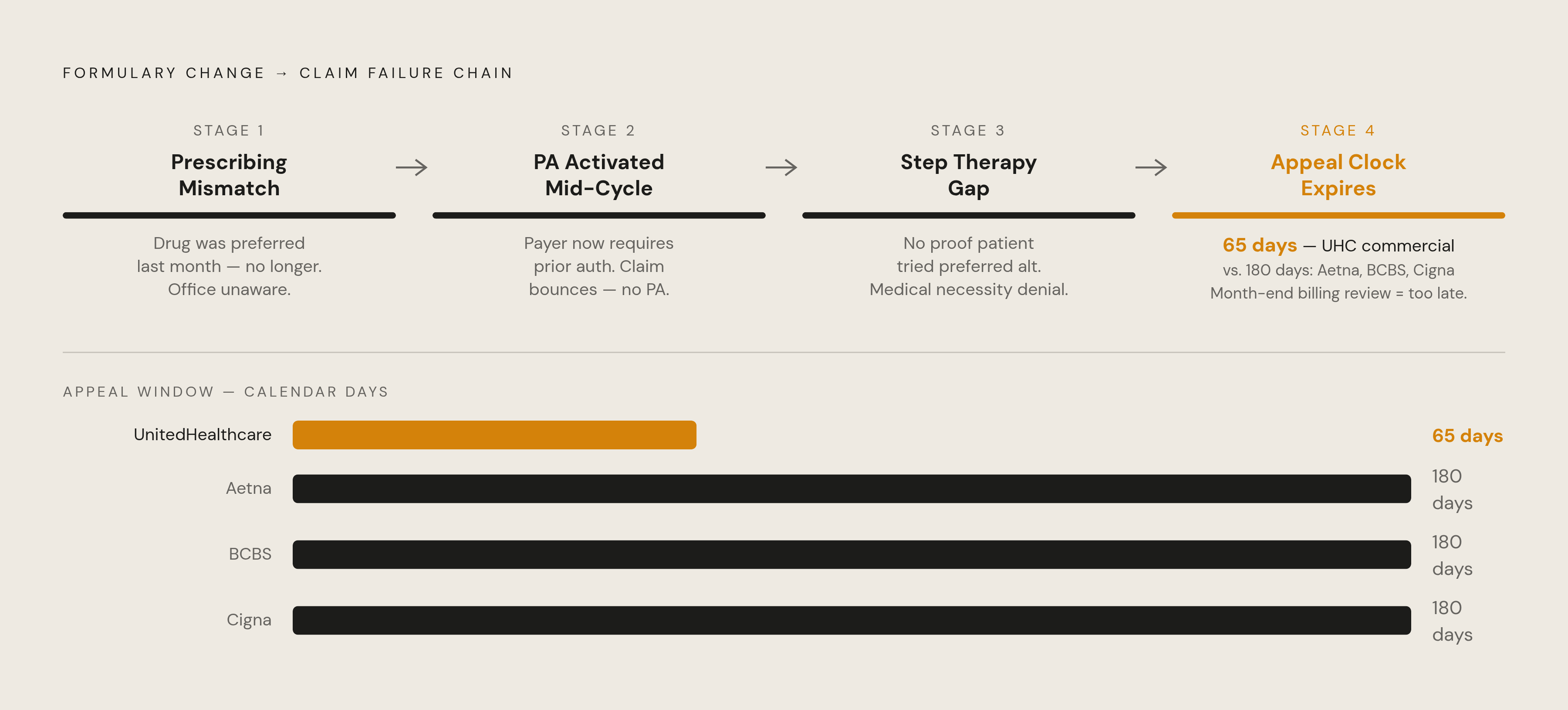
A formulary change does not cause one billing problem. It sets off a chain, and each link fails differently.
Stage one is the mismatch at the point of prescribing: the practice writes for a drug that was preferred last month, the payer's formulary has since moved, and nobody in the office knows yet. Stage two is the mid-cycle activation of a prior auth requirement, where the payer now demands a PA for a drug that did not need one before; front desk staff submit the claim without it, and the claim bounces straight back. Stage three is the step therapy documentation gap, where the payer wants proof the patient already tried and failed a preferred alternative. The clinical record might have that proof, but if it has not been pulled together in the exact format the payer wants, the claim gets denied on medical necessity grounds, which is a much harder problem to unwind than a paperwork fix. Stage four is the appeal clock, and it starts running whether or not the practice has noticed the denial yet. Appeal windows vary by payer: UnitedHealthcare's commercial plans allow only 65 calendar days, while Aetna, Blue Cross Blue Shield, and Cigna allow 180.
Lately, what makes this cascade harder to reverse is a shift in how denials get coded, and the shift is deliberate. Denials tied to authorization issues, the kind that are relatively easy to fix and resubmit, have been giving way to denials coded as medical necessity or requests for more information. Payers are moving away from administrative denial codes, which are vulnerable to a quick correction, toward clinical grounds that are much harder to overturn on appeal. That is not a clerical drift; it is a strategic shift in where the burden of proof sits, and it sits with the practice now.
The documentation gap usually decides the outcome. Step therapy requires a paper trail showing the patient tried the preferred drug first and it did not work; if that record is not attached to the claim or the PA request at submission, the payer has a clean, defensible reason to deny it. The practice is then stuck reconstructing evidence after the fact, often weeks after the actual visit. Practices that only catch these failures during month-end billing review are already behind: appeal windows may have closed, the sudden pile of rework eats into staff time budgeted for something else, and the original encounter with the patient is ancient history by the time anyone acts on it.
How payers' AI-driven authorization reviews make step therapy denials faster and harder to catch
Payer AI systems pattern-match against a rule set, and formulary compliance is exactly the kind of yes-or-no check an algorithm runs in milliseconds. That speed is the whole point, and it is also the whole problem. A machine that decides in under two seconds has no mechanism for noticing that the step therapy proof is sitting three tabs over in the chart, filed under a heading it was not built to search.
Cigna faces a lawsuit alleging its AI claim-review system spends 1.2 seconds per claim, and that number says most of what needs saying about how little individual clinical context the system evaluates. It is built to check boxes, not to read a chart. Reports and payer data have consistently shown that denial rates rose as AI-based authorization review expanded across Medicare Advantage plans, which is about as clear a signal as this kind of evidence ever produces that the tool is doing what its critics say it does.
The practical result is bulk denial of clinically appropriate prescriptions for newly non-preferred drugs, with no human ever checking whether the step therapy requirement was already satisfied somewhere in the patient's chart. When practices appeal with proper documentation attached, a striking number get overturned. Centene's Medicare Advantage denials are overturned on appeal at a 94.6% rate, and that figure points squarely at the original denial as the mistake, not the treatment decision. The burden of catching and fixing that mistake falls entirely on the practice, though. The payer's AI is built to err toward denial, and the practice has to supply the human correction, every time, on its own dime.
Medicare Advantage denial rates have risen sharply in recent years, a trend that coincides with the period when AI authorization review expanded across MA plans. For step therapy, the algorithm's blind spot is predictable once you know to look for it: it checks whether a PA exists and whether the preferred drug shows up somewhere in the record, with little capacity to locate supporting documentation that is not where the system expects to find it.
What the denial rate data actually shows about payer-level risk
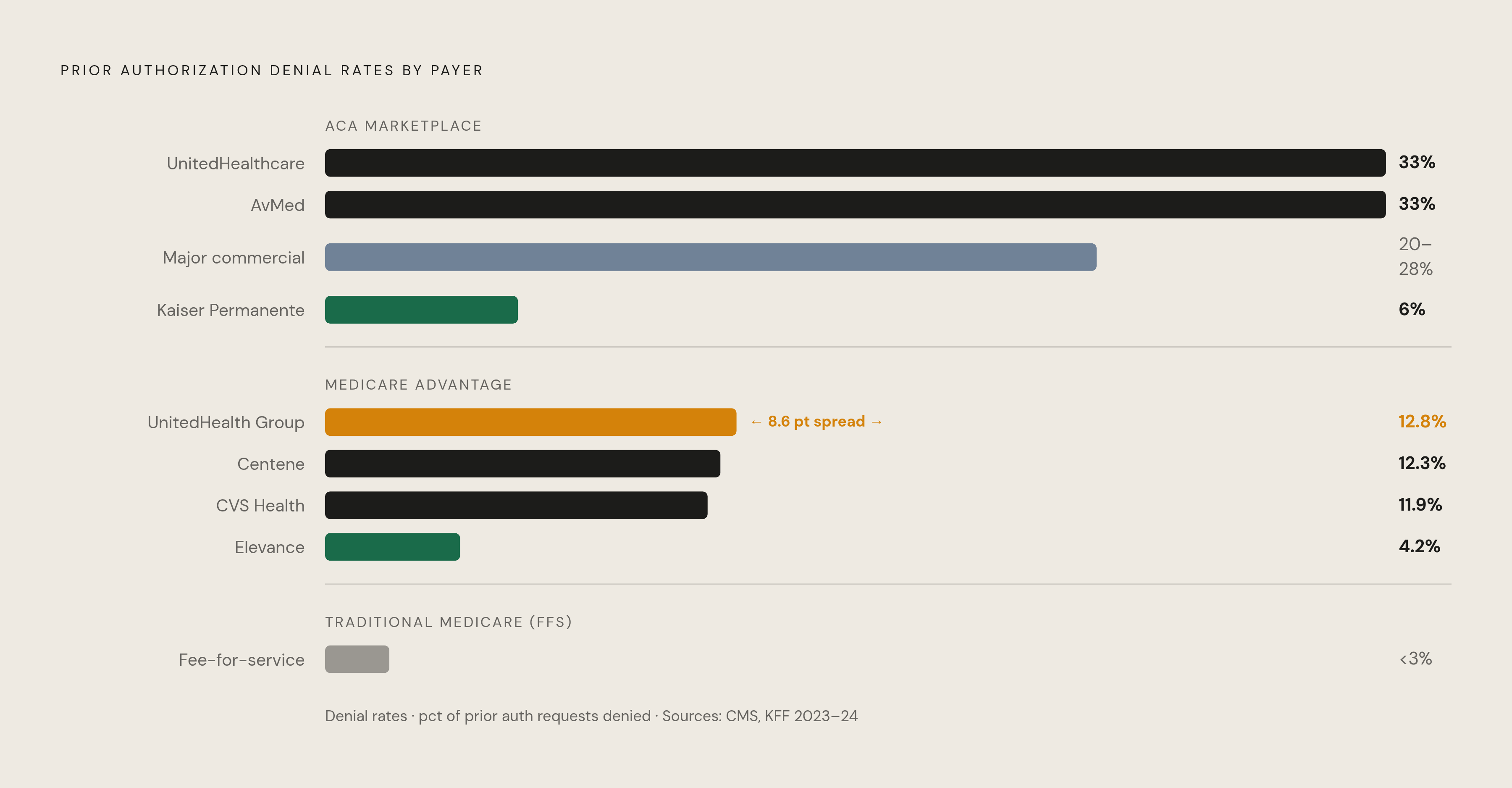
Double-digit denial rates have gone from an outlier problem to something close to the norm, and the trajectory across recent years points consistently upward.
The variance between payers is where the real strategic information sits, and it is larger than most practices assume. In Medicare Advantage, UnitedHealth Group denied the highest share of prior auth requests at 12.8%, followed by Centene at 12.3% and CVS Health at 11.9%. Elevance had the lowest denial rate among major MA plans, at 4.2%, a gap wide enough to matter for any practice weighing payer mix. Zoom into UnitedHealthcare's own book of business and the picture gets more granular still: across the company's 69 Medicare Advantage contracts, plan-level denial rates range from 0.0% all the way to 27.8%, and 51 of those 69 contracts sit above the program's own median of 7.2%. The aggregate number understates the exposure most practices actually face, because most of them are not dealing with the median plan. They are dealing with whichever specific contract their patients happen to carry, and that is the number that should drive strategy, not the headline average.
On the ACA marketplace side, UnitedHealthcare and AvMed tied at 33% denial rates, with most major commercial carriers landing somewhere in the 20% to 28% range. Kaiser Permanente was the clear outlier at 6%. Traditional Medicare fee-for-service remains the lowest-denial environment of all, running in the low single digits, a real contrast for any practice juggling a mixed payer panel.
UHC commercial's 65-day appeal window compounds all of this. It is the shortest window among the major payers, and for a practice that does not catch a formulary-related denial until routine billing review turns it up, that window may already be closed by the time anyone notices. Meanwhile the cost of dealing with denials is rising faster than the volume of denials itself: the cost of dealing with denials is rising faster than practices can absorb it. Every denial that sits unworked in a queue gets more expensive to recover, not less.
Where the regulatory framework is supposed to help, and where it still leaves gaps
CMS's Interoperability and Prior Authorization final rule, CMS-0057-F, issued in January 2024, sets binding decision timelines for the first time: seven calendar days for standard prior auth requests and 72 hours for expedited ones, plus a requirement that payers give a specific reason for any denial along with a clear path to appeal it. That is a genuine structural change, on paper.
The compliance timeline, though, is staggered out over several years. Certain provisions do not take effect until January 1, 2026, and the API requirements mostly kick in by January 1, 2027. Practically, that means practices are still operating under the old, less accountable prior auth system for most of their payer interactions right now.
There is a sharper gap underneath the timeline issue, and it is the one that matters most for this discussion. CMS-0057-F applies to non-drug items and services. It does not touch drug prior authorizations, which make up a large share of PA volume overall. The 2026 proposed rule, CMS-0062-P, is aimed directly at that gap, proposing electronic PA requirements and shorter decision windows specifically for drugs. Until that rule is finalized and actually implemented, drug PAs, including every step therapy documentation requirement discussed above, sit entirely outside the streamlined framework CMS has built so far. That is the gap that matters most, and it is the one nobody's compliance calendar is currently tracking.
Industry has made some voluntary moves in the meantime, and it is worth being clear-eyed about how little they have changed on the ground. A group of insurers committed in 2025 to cut back on prior auth requirements, and a survey from AHIP and BCBSA reported an 11% reduction in PA requirements since that commitment, roughly 6.5 million fewer authorizations required, with more than a 15% cut specifically in Medicare Advantage. That reduction is concentrated in lower-complexity services, not the high-cost drug categories where step therapy lives. A 2024 AMA survey found that 9 in 10 physicians had experienced care delays because of prior auth. Read those two facts together and the in-progress regulatory fixes have delivered very little where it counts, whatever the press releases claim. The regulatory direction is favorable if the horizon is several years out; the billing reality for 2025 and 2026 is that drug PA and step therapy documentation still have to be managed manually, payer by payer, against deadlines that do not wait for the rule to catch up.
The operational practices that intercept formulary-related denials before they happen
Catching these denials means moving the detection point earlier, away from denial review and back toward pre-authorization, and further back still, to the moment of prescribing itself, wherever that is possible. Practices that wait for the denial to teach them something have already paid for the lesson, and the lesson was avoidable.
Formulary monitoring has to become an ongoing billing function, checked continuously rather than once during credentialing. Payers update formularies annually, quarterly, and sometimes mid-year without much warning, so a drug's tier placement or step therapy requirement can change in the gap between a patient's last visit and their next refill. Practices working in diabetes, dermatology, and rheumatology need a standing process that checks formulary status for active patients on the affected drug classes on an ongoing basis, not only at the moment a new prescription gets written.
Step therapy documentation needs to work as a pre-claim checklist, assembled before submission rather than scrambled together after a denial arrives. For any drug that requires step therapy, the billing record needs the preferred drug or drugs that were tried, the dates they were tried, the outcome or adverse effect that led to stopping them, and the clinical reasoning for moving to the prescribed drug instead. Payer AI systems check for this documentation in a specific, structured format. If it is not present at the moment the PA request goes in, the denial is close to automatic, regardless of whether the treatment decision was clinically sound.
Prior auth status has to be checked against the current formulary, not the formulary in place when the last authorization was granted. A PA approved under last year's rules may no longer cover a drug that has since been reclassified, and resubmitting the same PA without rechecking the formulary is a common, avoidable source of mid-cycle denials.
Payer-specific denial tracking by drug category matters more than it gets credit for. Practices should know which payers in their mix generate the most formulary-related denials, in which drug classes, and which documentation actually resolved those denials in the past. That is institutional memory, and it is exactly the kind of knowledge that walks out the door when billing staff turn over. Eligibility verification at the point of prescribing, not just at the point of service, should include formulary status and active PA requirements for chronic medications. Catching a tier change during the visit itself prevents a claim failure that would otherwise surface weeks later, long after anyone remembers the details of that appointment.
Why the practices losing the most revenue on formulary denials share a structural problem
The practices absorbing the most revenue loss from formulary denials are not the ones with the worst billing staff, and that is the part worth correcting first. They are the ones whose billing operation runs on lag: month-end reporting, denial queues worked only reactively, and staff knowledge that disappears the moment someone leaves for a new job. No amount of individual diligence fixes that once the person who knew the pattern is gone. The system they are working inside was never built to catch this in time, and blaming the staff inside it misses where the actual failure sits.
Payer formulary and step therapy changes follow a predictable logic, category by category and plan by plan, once someone bothers to track where the pattern actually sits. The practices that hold their ground treat payer behavior as data worth studying: which payers tend to shift tier placement in the fourth quarter, which step therapy rules apply to which drug classes, which specific appeal arguments actually worked against which denial codes last time around.
That kind of intelligence builds on itself over time. A billing operation that tracks it deliberately gets harder for a payer to deny, while one that treats every claim as a fresh, unconnected encounter keeps relearning the same lesson, denial after denial, at full cost each time.