PAHPA and Federal Prior Authorization Legislation Status in Congress
Two stalled congressional fights threaten public health and patient care access.

Congress has spent more than two years failing to reauthorize the Pandemic and All-Hazards Preparedness Act, the law that funds the country's public health emergency infrastructure, while a separate and unrelated fight over prior authorization reform sits stuck in committee. Both matter enormously to how medicine gets practiced and paid for in the country, and both are, right now, going nowhere in the federal legislature. This piece lays out what each fight actually covers, where it stands, and what CMS has done on its own to fill part of the gap, because physician practices can't afford to wait on Washington to figure out what comes next.
Start with the distinction, because it gets muddled constantly: PAHPA is not prior authorization legislation. It's the law that funds BARDA and medical countermeasure development, the Strategic National Stockpile, the Hospital Preparedness Program, Public Health Emergency Preparedness cooperative agreements, biosurveillance systems, and the National Disaster Medical System. Prior authorization reform, meanwhile, is a fight over how insurers decide whether to pay for care that's already been ordered. They share a Congress and a news cycle. They do not share a committee, a sponsor, or a fix.
Why PAHPA reauthorization has stalled despite broad bipartisan support
PAHPA first passed in 2006 and got reauthorized twice since, in 2013 and in 2019, both times riding the momentum of a recent public health scare. That pattern broke this time. Authorization for the law's core programs lapsed in September 2023, and more than two years later, Congress still hasn't passed a full reauthorization, despite the fact that almost nobody in either party actually opposes the underlying programs.
The closest anyone came was December 2024, when bipartisan PAHPA language got folded into a continuing resolution package. It got stripped out before the vote, after members of President-elect Trump's incoming transition team raised concerns about the bill's size and scope. That single decision has shaped the entire fight since.
The deeper obstacle is structural, and it has nothing to do with partisanship. The Senate committee's bill, S. 2333, takes a broad approach: drug shortages, vaccine injury compensation, laboratory biosafety and biosecurity, all bundled into one vehicle. The lower chamber went the other way, splitting the work into two narrower, committee-passed bills, one covering agency funding. That bill covers one public health agency, and a companion bill covers another. 4421 covering ASPR, each proposing roughly a four-year reauthorization window. Neither chamber's approach has cleared a floor vote, and neither side has shown much appetite for adopting the other's model. A bill that's too big to pass quickly and a bill that's too narrow to satisfy the Senate are not the same problem, but they produce the same outcome: nothing moves.
Layered on top of that is a live fight over what the executive branch even wants these programs to look like. The Trump administration's FY2026 budget proposed eliminating certain ASPR programs outright and shifting others into the CDC and a newly proposed "Assistant Secretary for a Healthy Future" position. That leaves Congress in the odd position of debating how to reauthorize programs the administration is simultaneously trying to restructure or eliminate. Reauthorizing a program that might not exist in its current form by the time the bill passes is not a small technical wrinkle. It stalls a bill for another year.
The 2026 reauthorization effort's status and coverage
Early 2026 brought a change in leadership on the House side. Congressman Neal Dunn (R-FL) took over the House PAHPA bill, co-leading the effort with Congresswoman Lori Trahan (D-MA). The two issued a Request for Information seeking stakeholder input, and bill text is expected sometime later in 2026, though no firm date has been set.
The response from the public health and scientific community has been loud and specific. The American Society for Microbiology, which represents more than 38,000 members, responded to the RFI pushing for several concrete asks: reauthorizing and reconvening the Presidential Advisory Council on Combating Antibiotic-Resistant Bacteria (PACCARB), formally authorizing the CDC's National Wastewater Surveillance System (the same system that tracked COVID-19 spread through sewage data during the pandemic), folding in language from the PASTEUR Act to address antibiotic development incentives, strengthening the Regional Biocontainment Laboratories network, and building a more coordinated national approach to biosecurity.
Industry has weighed in too. The Biotechnology Innovation Organization joined more than 80 other organizations and companies in a September 14 letter urging congressional leaders to pass a PAHPA bill before the year's end. And the concern isn't limited to public health researchers and biotech firms. The Trauma Coalition, which includes the American Association of Neurological Surgeons, wrote to congressional leaders back in February 2025 warning that PAHPA's role in trauma system surge capacity, the ability of hospitals to absorb a mass casualty event, depends directly on stable, reauthorized funding, and without it that surge capacity fails.
Federal prior authorization reform: the bills in the 119th Congress and what each would do
Three bills make up the current federal push on prior authorization, and each does something meaningfully different.
H.R. 3514, the Improving Seniors' Timely Access to Care Act, got reintroduced in May 2025 by a genuinely bipartisan, bicameral group: Rep. A member of the House from Pennsylvania's 16th district, A member of the House from Washington's 1st district, A physician serving in the House, representing Pennsylvania's 13th district, A physician serving in the House, representing California's 6th district, along with a senator, A physician serving in the Senate, (KS), and Sen. Mark Warner (VA). It amends Title XVIII of the Social Security Act to set requirements around how Medicare Advantage plans use prior authorization, aiming at electronic processing and faster turnaround specifically within that program.
H.R. A companion bill, the Reducing Medically Unnecessary Delays in Care Act of 2025, came back in late March 2025 from a member of the House. A physician serving in the House, (R-TN) and Rep. A physician serving in the House. (D-WA). This one targets how Medicare, Medicare Advantage, and Medicare Part D plans make and communicate coverage decisions, adding requirements around the basis for those determinations and the transparency of the process.
The Prior Authorization Accountability Act, as of June 23, 2026, has only reached the committee referral stage, sent to Energy and Commerce and additionally to Ways and Means and Education and Workforce. No floor action has happened.
All three bills share the same structural weakness: they are focused on Medicare programs, leaving commercial insurance and other coverage types outside their direct reach, which limits how broadly even a successful bill would apply across the insured population.
CMS actions through rulemaking while Congress stalls
While Congress has debated scope and jurisdiction, CMS has simply gone ahead and acted through the regulatory process, using authority it already has.
The CMS Interoperability and Prior Authorization Final Rule, known by its rule number CMS-0057-F, hit its first major milestone in early 2026: the first public reporting deadline. Under the rule, insurers now have to post prior authorization metrics publicly, approval rates, denial rates, appeal overturn rates, and processing times, covering calendar year 2025. That's the first time this kind of data has been available in this form, at this scale, across payers.
Starting in 2026, the rule also tightens payer response windows considerably. Standard prior authorization decisions now have to come back within seven calendar days. Urgent decisions have to come back within 72 hours. CMS has projected substantial long-term savings from the rule, with most of that benefit flowing to providers rather than payers or patients directly.
There's more coming. By 2027, payers have to have standardized electronic prior authorization systems in place, built on HL7 FHIR-based APIs, with CMS projecting real-time responses for a large share of electronic prior authorization requests once the infrastructure is running. That's a meaningful shift toward interoperable electronic systems, assuming the deadline holds.
Findings from the first round of mandatory public reporting on payer behavior
The 2026 data, the first set drawn from mandatory CMS-0057-F reporting covering calendar year 2025, gives the clearest picture yet of how insurers actually behave when required to show their work.
Across Medicare Advantage, Medicaid managed care, and ACA marketplace plans, health insurers denied somewhere between 12% and 18% of standard prior authorization requests, with real variation among the largest payers. That's not a narrow band. A patient's odds of getting denied depend heavily on which plan they happen to be enrolled in.
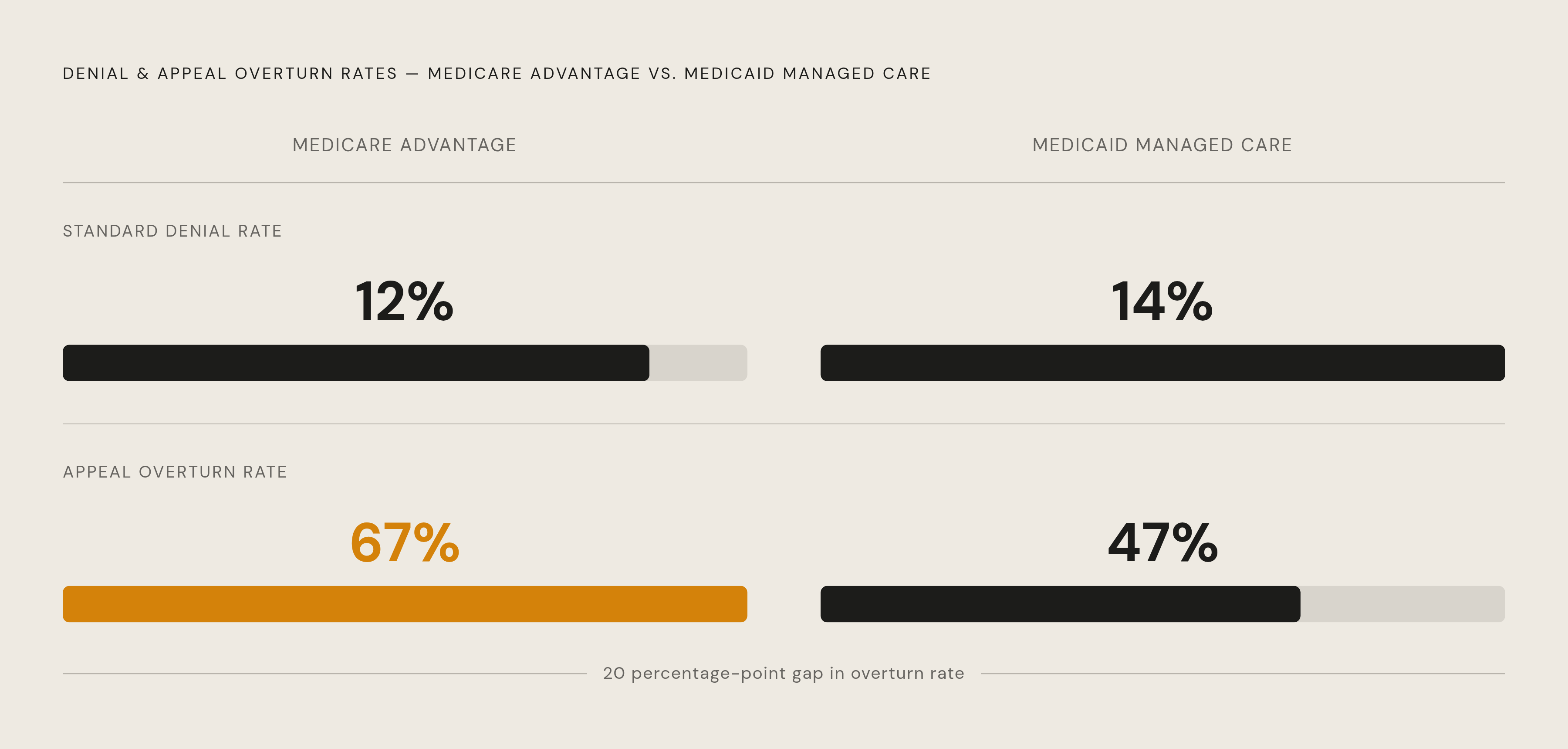
Break it down by program and the picture sharpens. Medicare Advantage plans posted a 12% standard denial rate and a 10% expedited denial rate, and roughly 67% of appealed denials got overturned. Medicaid managed care posted a 14% standard denial rate and an overturn rate of only about 47% for appealed denials. The gap between those two overturn rates, 67% versus 47%, says something uncomfortable about how much depends on which population is asking for the appeal.
The legislative stall's role in producing a damaging patchwork across states and payer types
With Congress stuck, state legislatures have simply stopped waiting. A growing number of states have passed prior authorization legislation in recent years, with more actively implementing new protections in 2026, moving on a subject the federal government hasn't touched with comprehensive legislation since PAHPA and prior authorization reform both stalled out.
One especially fast-moving front: artificial intelligence in coverage decisions. Several states enacted laws in 2026 restricting how insurers can use AI in prior authorization and coverage determinations. The restrictions aren't uniform. Some states bar insurers from using AI as the sole basis for denying care. Others focus more narrowly on transparency and reporting requirements. Effective dates run out through 2027, so the rules are still phasing in even as more states consider similar bills. Some states moved earlier still, with laws already in place requiring physician involvement in medical necessity determinations.
Response-time requirements are diverging too. Some states set tighter windows than the federal rule for both standard and urgent requests. Other states have passed similar legislation, in some cases layering on their own restrictions around automated denials. None of these numbers match the federal CMS-0057-F timelines of seven days and 72 hours. A practice operating across state lines is now tracking multiple, non-identical deadlines depending on where the patient lives and which payer is involved.
Gold carding, the practice of exempting high-performing physicians from routine prior authorization requirements, has become its own patchwork. Arkansas, Colorado, Louisiana, Texas, West Virginia, and Wyoming have all enacted gold carding legislation, and some of them have since updated their laws to extend gold card privileges to group practices rather than just individual physicians. A solo practitioner in Texas and a physician in a ten-person group in the same state may now qualify for very different levels of exemption, depending on how the amendment applies to their situation.
The impact of this legislative deadlock on billing operations at physician practices right now
Congress has not passed comprehensive prior authorization reform, and there's no indication it will in the near term. CMS-0057-F tightens timelines and forces transparency, which matters, but it does nothing for commercial insurance or for most drug authorization decisions, and voluntary pledges some insurers have made carry no enforcement mechanism behind them. A pledge without a penalty is a press release.
Practices can't sit around waiting for a federal fix that has now been delayed for years running. The patchwork described above, state AI restrictions, divergent response-time rules, gold carding programs that vary by state and now by practice structure, is a permanent condition. It's the operating environment, and every sign points toward it getting more complicated, not less, as more states pass their own rules in the vacuum Congress left behind.
The claims data backs up how much is riding on this. Experian Health's 2025 State of Claims survey found that roughly 41% of providers reported more than 10% of their claims denied, up from 38% in 2024, a steady climb that's now run multiple years in a row. Missing or inaccurate claim data and authorization failures together account for the majority of preventable denials in that survey. A real share of this problem is fixable at the practice level, independent of whatever happens in Congress.
The appeal overturn numbers matter here too, and they cut both ways. An overturn rate of 67% for Medicare Advantage and 47% for Medicaid managed care means most contested denials are not actually the final word, if someone appeals them. But appeal windows are shrinking, in some cases down to as little as 14 days at certain payers, and a denial that sits in a batch queue for three weeks before anyone looks at it has often already missed its own appeal deadline. Practices must work denials the day they arrive. It is the only way the appeal overturn rate does a practice any good.