Emerging Denial Categories in Behavioral Health Billing
Payer AI is tightening documentation rules and creating new denial categories in behavioral health.

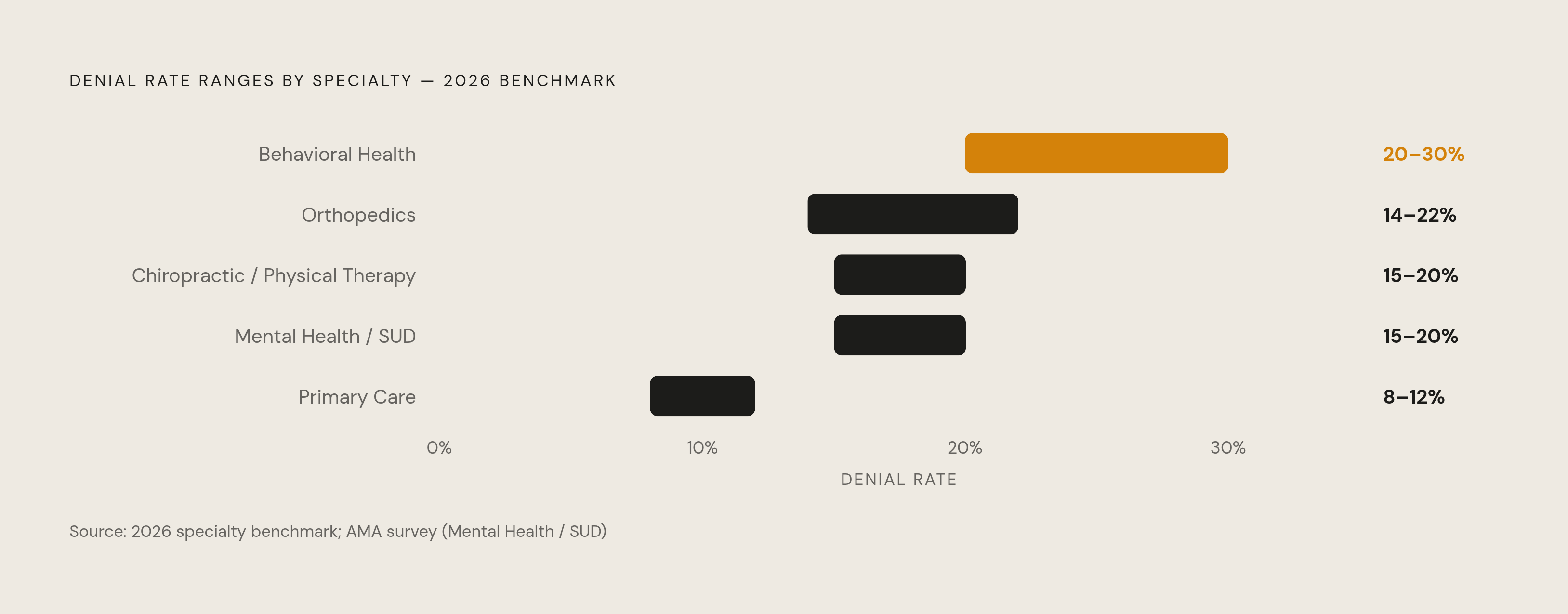
Behavioral health billing runs on a different set of rules than the rest of outpatient medicine, and the denial patterns in 2025 and 2026 prove it. The AMA's Prior Authorization Physician Survey puts denial rates for mental health and substance use disorder claims at 15 to 20 percent, close to double the 5 to 10 percent average for medical and surgical claims. One 2026 specialty benchmark puts behavioral health even higher, at 20 to 30 percent, ahead of orthopedics at 14 to 22 percent and chiropractic and physical therapy at 15 to 20 percent, while primary care holds steady at 8 to 12 percent. That gap costs behavioral health practices across the country an estimated $3.7 billion a year in billing errors, underpayments, and denied claims. None of the categories driving that number are generic billing mistakes. Each one is built into how behavioral health services get authorized, timed, documented, and reviewed. Medical-billing fixes don't transfer over cleanly as a result.
Session-by-session medical necessity denials and payer AI's rising documentation bar
Most specialties let a diagnosis carry the treatment plan forward. A patient gets diagnosed with a condition, a plan gets built, and individual visit notes don't draw much scrutiny after that. Behavioral health doesn't work that way. Every single session has to justify its own medical necessity on its own terms, a requirement with no real parallel elsewhere in medicine.
That's part of why the time-based psychotherapy codes, 90832, 90834, and 90837, are the most-audited coding area in the field. Session length sets the reimbursement rate, and length is the easiest thing in the world for a payer's system to measure and flag.
What's changed going into 2026 is the sophistication of the review. Payer AI systems now audit high-value psychotherapy claims directly, looking for notes that skip quantified symptom severity, skip functional impairment tied to a validated scale like the GAF, PHQ-9, or PCL-5, and skip documented progress toward a measurable goal. A note that says "anxiety present" reads nothing like a note that says "panic attacks four times a week disrupting work attendance," and payers know the difference. One is defensible. The other invites a denial.
The exposure compounds, too. A single thin progress note doesn't just risk that one claim, it can trigger a retroactive review across the whole treatment episode. Payers have shortened their authorization review cycles at the same time they've raised the documentation bar, so practices still working off free-text notes without a template tied to medical necessity language are the ones getting hit hardest.
The pattern across the industry is consistent: payers are moving clean, simple claims faster, but clinical initial denials are rising as providers get asked to prove medical necessity, which pushes final denial rates up too. A large share of behavioral health denials are preventable. This isn't an unsolvable problem, it's a documentation problem, and documentation problems have fixes.
CPT session-time mismatches: how auto-populated billing software creates a systematic audit target
The time brackets themselves are unforgiving. 90832 covers 16 to 37 minutes, 90834 covers 38 to 52 minutes, and 90837 covers 53 minutes or more. Nothing in general medical billing works this way, where the clock itself decides the code.
What has to hit the chart is the actual start and stop time of the psychotherapy. A note that just says "60-minute session" with no start and stop times documented isn't compliant, and it's exactly the kind of note an auditor pulls first.
A lot of the damage actually happens when scheduling software or the EHR auto-populates the claim based on the appointment type booked, not the session that actually occurred. A session scheduled for an hour that starts fifteen minutes late and runs 48 minutes belongs under 90834, not 90837. That's real money on one side and real audit exposure on the other, and the software doesn't know the difference unless someone tells it.
90837 draws the most attention because it pays the most, and payers now run peer-group analytics that flag providers billing 90837 above the norm for their specialty, even when every one of those sessions was clinically appropriate. The outlier flag comes first. The audit follows.
A related trap: CPT 90792, the psychiatric evaluation with a medical services component, requires a prescribing provider, such as a psychiatrist, a psychiatric nurse practitioner, a physician, or a physician assistant. Billing 90792 for evaluations done by a licensed counselor or social worker without prescribing authority is a known OIG audit flag. HHS's Office of Inspector General has pointed to missing or insufficient documentation as the leading cause behind a large volume of improper Medicare payments for psychotherapy services. None of this is about providers not knowing the codes. It's about scheduling and billing workflows that were never built to match what the code actually requires.
Telehealth place-of-service and modifier mismatches: the reimbursement error hiding in plain sight
Behavioral health went virtual faster and deeper than any other specialty after 2020, so telehealth billing mistakes land harder here than almost anywhere else in medicine.
Two modifiers carry most of the weight: modifier 95 for a synchronous audio-video visit, modifier 93 for audio-only. Missing one, or swapping them, is the single most common cause of telehealth denials in this field. Audio-only telehealth has also been permanently extended for behavioral and mental health care even when audio-video isn't an option, and practices still get tripped up because they're unsure whether audio-only sessions are covered.
Place-of-service codes carry just as much weight and get treated far too casually. POS 10 (patient at home, audio-visual) and POS 02 (patient at an approved facility, audio-visual or audio-only for Medicare) pay differently, and POS 10 typically reimburses at a meaningfully higher rate than POS 02. Bill POS 02 for a session where the patient was sitting at home, and the underpayment is direct and quantifiable, no ambiguity involved.
None of this is standardized across states or payers, either. Florida Medicaid requires an HE modifier for recovery coaching. Practices treating patients in New York for trauma-focused CBT should confirm modifier requirements directly with NYS Medicaid or the relevant managed care plan rather than assume a blanket rule, since no such statewide mandate appears in official guidance. A single modifier template built for one payer will misfire against another, and multi-state practices feel this constantly.
Denial code CO4, tied to modifier errors, appears across a meaningful share of telehealth-related denials in the data, though no single published figure is confirmed enough to cite precisely. What matters is the shape of the problem: this category has nothing to do with clinical documentation. It's a workflow and administrative failure from end to end, which also makes it the most preventable denial category covered here.
Prior authorization gaps in IOP, PHP, residential, and inpatient levels of care
Intensive outpatient, partial hospitalization, residential, and inpatient psychiatric care all run on multi-tier authorization structures with their own timelines and renewal cycles, layered on top of everything outpatient psychotherapy already demands. The administrative load is heavy, and missing a renewal window carries real financial consequences.
IOP, typically billed under H0015 or H2011, needs prior authorization from almost every commercial insurer and most Medicaid managed care organizations. The initial approval usually covers a limited window, with concurrent review kicking in after that, and the auth request has to spell out the clinical criteria supporting IOP-level care rather than just naming a diagnosis.
PHP, billed as H0035 or S0201, pays more than IOP and gets watched more closely as a result. Medicare Advantage plans generally require prior auth for PHP, and the documentation needs to show why a step-down level of care failed, or why medical or psychiatric instability requires PHP-level monitoring.
Inpatient psychiatric care usually runs on retrospective notification rather than upfront pre-authorization, but plenty of Medicaid managed care organizations and commercial plans still require pre-auth within a narrow window after admission. Missing that window causes the denial that follows to be technical, which makes it harder to appeal: nothing in the clinical record can undo an administrative failure that already happened.
One thing practices routinely miss: the payer listed on the insurance card often isn't who actually handles behavioral health prior auth. Major commercial insurers frequently delegate behavioral health PA to separate carve-out vendors, so a claim can go to the right payer while the authorization sat with an entirely different entity the whole time.
The administrative burden is substantial. The AMA's most recent physician survey found practices completing an average of 40 prior authorization requests per physician per week, eating roughly 13 hours of physician and staff time, with 40 percent of physicians employing staff whose entire job is prior authorization. Services delivered under an authorization that quietly expired, claims denied for a missing auth number, sessions that ran past an approved visit limit: revenue lost this way is often unrecoverable, because the appeal window closes before anyone at the practice even notices there's a problem.
Major insurers did commit to streamlining prior authorization starting in January 2026, but the early rollout is aimed at physical health services first. Behavioral health reform sits later in the queue, so practices shouldn't expect relief here anytime soon.
MHPAEA parity denials: how a federal enforcement pause shifted the battleground to state regulators
A parity denial has a recognizable shape once you know what to look for. A commercial payer downcodes a 90837 session to 90834, denies a SUD residential stay on medical necessity grounds, or trims approved IOP days, all while applying tighter scrutiny to behavioral health than it applies to a comparable medical claim.
Federal parity law requires that if a plan covers mental health and SUD services at all, it has to cover them under terms no stricter than what it applies to comparable medical and surgical benefits. In billing terms, that means a meaningful share of behavioral health denials can be appealed specifically as parity violations, often on firmer legal ground than a standard medical necessity appeal would offer. Revenant Care's audit data across practices puts the share of commercial behavioral health denials from major payers that are parity-appealable at 12 to 18 percent.
The regulatory backdrop has shifted hard and fast. In September 2024, the Departments of Labor, HHS, and Treasury issued a final rule updating MHPAEA regulations, effective November 22, 2024, with applicability starting in plan years on or after January 1, 2025, and again January 1, 2026. Then, in May 2025, the same agencies announced they would stop enforcing that 2024 final rule. By March 30, 2026, they told a federal district court they intended to pursue significant revisions and publish a new proposed rule by December 31, 2026, rather than defend the 2024 rule in the pending ERIC lawsuit. Federal enforcement, for the moment, has effectively paused.
States haven't waited around. Georgia's insurance commissioner levied roughly $25 million in parity fines across 2025 and 2026. California's regulator landed a $200 million enforcement action against Kaiser Permanente. Other states have moved to strengthen their own parity enforcement frameworks independently of whatever happens at the federal level.
For practices, the operational takeaway is straightforward. Denial patterns that look like parity violations, stricter prior auth, lower network rates, tougher medical necessity criteria for MH and SUD claims than for medical ones, are still legally challengeable, just at the state level now instead of the federal one. The appeal path exists. Most practices simply aren't working it, because they don't recognize a payer's undercoding or downgrading behavior as a parity issue in the first place, rather than a routine denial to write off.
SUD confidentiality documentation gaps under 42 CFR Part 2 as a denial trigger
42 CFR Part 2 governs confidentiality for substance use disorder patient records, and its consent requirements go beyond what HIPAA demands, with no equivalent for general mental health or medical records.
The denial mechanism runs through claims adjudication: some SUD services require documentation of patient consent before a claim gets paid, and an incomplete or missing Part 2 consent form triggers a CO16 denial for missing or incorrect information. On paper it looks administrative. A compliance gap that started back at intake is producing this pattern.
A few specific contexts surface this repeatedly. Medication-assisted treatment billing is high-risk when OTP (Opioid Treatment Program) certification for methadone is missing, and missing MAT consent forms generate the same CO16 pattern. Telehealth IOP sessions run into it too, when the originating site (POS 02) doesn't get documented for a virtual session, stacking a telehealth documentation requirement on top of an already complex SUD billing chain. Group therapy for SUD carries its own layer: CPT 90853 requires individual participant names on Medicare claims, a documentation requirement that adds a layer of complexity specific to SUD group billing.
One documented fix shows how narrow the actual problem often is. A detox clinic in Missouri cut CO16 denials by 62 percent simply by adding auto-reminders for patient signatures on MAT consent forms. Nothing clinical changed. The workflow did.
This category is growing because SUD treatment capacity has expanded, MAT adoption keeps rising, and telehealth-delivered IOP is now common, all of which multiply the number of claims carrying Part 2 obligations. Plenty of practices built their intake workflow around in-person, non-MAT care years ago and never updated it for the mix of services they actually deliver now. Institutional knowledge like this walks out the door with staff turnover: when the person who knew which consent form attaches to which claim type leaves, the denial pattern appears months later with no obvious cause.
Medicare Advantage authorization walls and the compounding denial risk for behavioral health
Medicare Advantage plans layer their own authorization requirements on top of everything already described in this piece, and behavioral health services sit squarely inside that overlap. A practice managing IOP or PHP authorization for a commercial plan is already tracking initial approval windows, concurrent review cycles, and carve-out vendors separate from the primary payer. Adding a Medicare Advantage plan into that same caseload makes the authorization rules stack rather than simplify.
That compounding effect is the real risk. Each layer, prior auth timing, session-based coding, telehealth modifiers, parity exposure, Part 2 consent, has its own failure point and its own denial code. A Medicare Advantage claim that trips one of these doesn't just risk that single claim. It sits inside a system where a missed authorization renewal, a mismatched modifier, and a thin progress note can all hit the same episode of care at once, and no single fix addresses more than one piece of that stack. Practices treating Medicare Advantage behavioral health claims as a standard billing category, rather than the compounding risk it actually represents, are the ones most likely to keep losing revenue to denials they never saw coming.