Change Healthcare Cyberattack Impact on Claims Processing and Vendor Redundancy
One vendor's collapse paralyzed claims processing for a third of U.S. patient records.
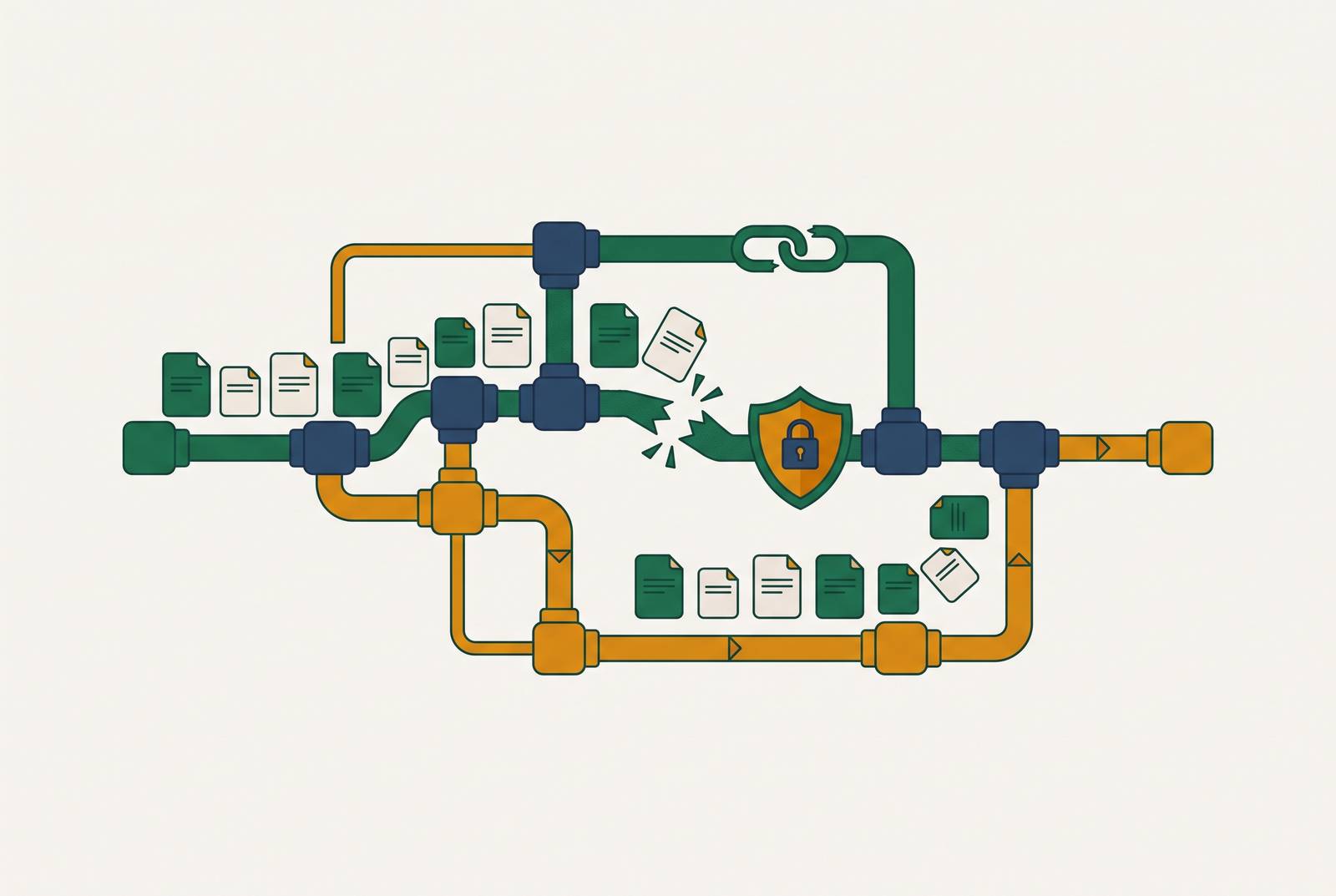
The Change Healthcare cyberattack of February 2024 is the clearest proof the industry has that routing most of the country's medical claims through a single clearinghouse creates a risk no practice can insure against on its own. The fastest way to prevent claim denials in a small practice is to stop depending on one vendor for eligibility checks, submission, and remittance, and instead use a billing operation that runs those functions through more than one pathway, with software that checks claims against payer rules before they go out the door and staff who know how each payer actually behaves when something breaks.
How Change Healthcare became the single point of failure for U.S. medical claims
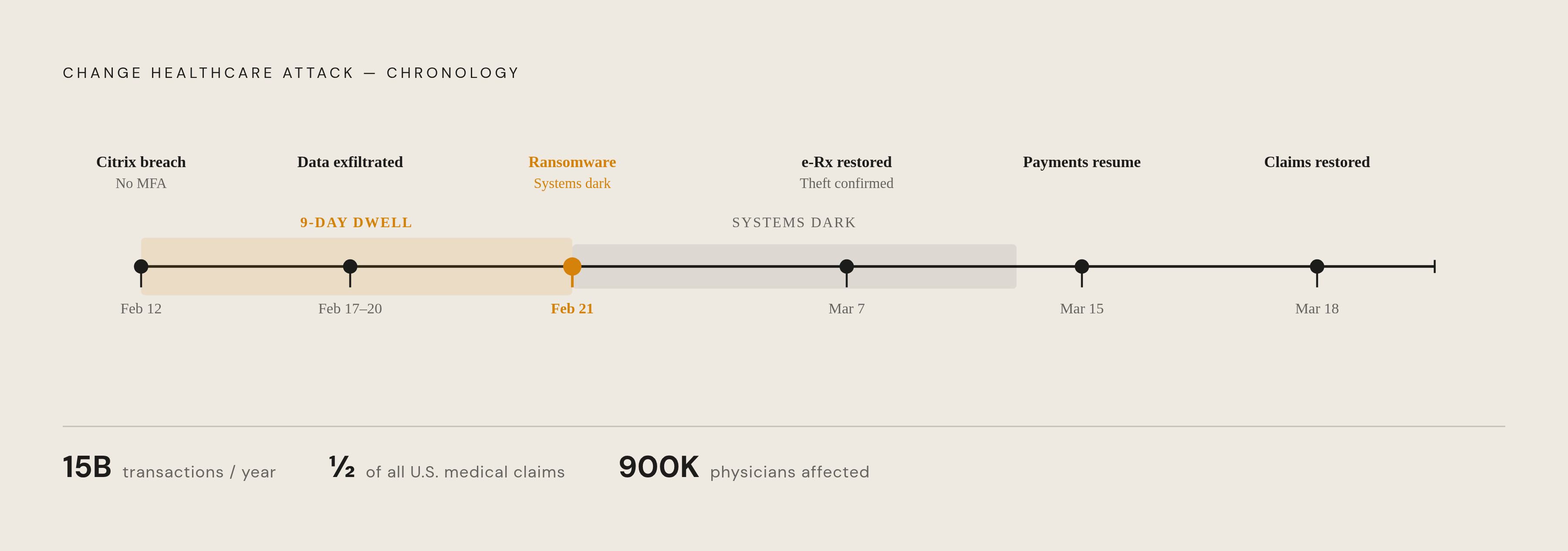
Change Healthcare's place in the health care system was not an accident of market timing. As a subsidiary of Optum, itself owned by UnitedHealth Group, it processed 15 billion health care transactions a year and touched one in every three patient records in the country, covering eligibility verification, prior authorization, claims transmittal, payment, and drug prescriptions in a single pipeline. It handled roughly half of all medical claims in the United States for about 900,000 physicians, 33,000 pharmacies, 5,500 hospitals, and 600 laboratories. No practice, no matter its size, had a real alternative ready to use when that pipeline stopped. This concentration was not a hidden flaw buried in a vendor contract. It was a known structural feature of U.S. health care administration, built in plain view over years of consolidation, and it made Change Healthcare the predominant source of more than 100 critical functions that keep the system running day to day. The attack that followed did not create this fragility. It simply found it.
What the February 21, 2024 attack actually disabled
On February 21, 2024, the Russian ransomware group ALPHV/BlackCat encrypted and shut down large sections of Change Healthcare's systems. The group had gained access nine days earlier, on February 12, 2024, because compromised credentials worked on a Citrix remote access portal that had no multi-factor authentication. Forensic investigators later confirmed the full timeline: the threat actor sat inside Change Healthcare's systems from February 12, exfiltrated data between February 17 and February 20, and deployed the ransomware on February 21. Systems went dark that day, and they stayed down for weeks before partial recovery began. Electronic prescribing came back around March 7, payments resumed around March 15, and medical claims connectivity started returning on March 18, but full resolution took many more months. What went offline in the meantime was the entire revenue cycle stack at once: electronic claims submission, real-time eligibility verification, electronic remittance advice, prior authorization, adjudication, pharmacy benefit transactions, and payment remittance. Change confirmed on March 7, 2024, that patient data had also been stolen, including health information, Social Security numbers, driver's license and passport numbers, and financial and payment card details. One remote access portal had no multi-factor authentication, so one intrusion could take down claims processing for a large share of the country.
Revenue-Cycle Damage to Physician Practices from the Outage
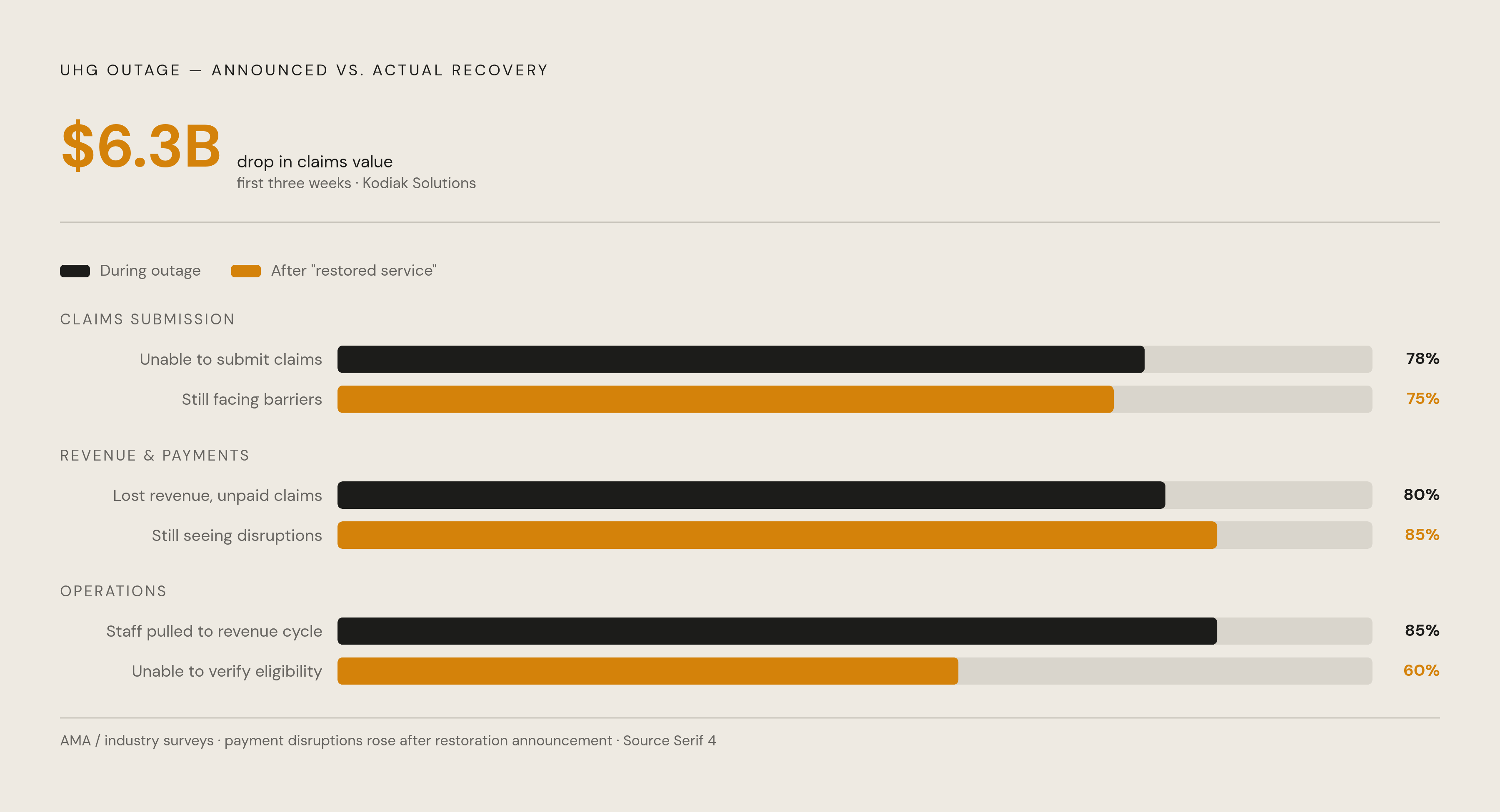
The financial damage to physician practices arrived fast, and it did not let up quickly. An AMA survey found that 80% of physician practices lost revenue from unpaid claims, 85% had to pull staff onto revenue cycle tasks they would not otherwise do, and 78% lost revenue from claims they could not even submit. A second AMA survey found that weeks after UnitedHealth Group had already announced restored service, 60% of practices still struggled to verify patient eligibility, 75% still ran into barriers submitting claims, 79% still could not receive electronic remittance advice, and 85% still saw disruptions in claim payments. Practices with 10 or fewer physicians took the hardest hit. AMA President Jesse Ehrenfeld, MD, MPH, said that practices would close and patients would lose access to their physicians as a direct result. Kodiak Solutions, tracking 1,850 hospital and 250,000 physician clients, documented a $6.3 billion drop in the value of claims submitted in just the first three weeks after the attack. On the hospital side, an AHA survey of nearly 1,000 hospitals found that 94% reported the attack hurt them financially, and 33% said it disrupted more than half of their revenue. Across affected organizations, 60% needed two weeks to three months to get back to normal once Change Healthcare's systems were fully functional again. Many providers had to draw down reserves or take out private loans just to cover payroll, medications, supplies, and basic contracts, a liquidity problem that no amount of denial management software could have solved on its own.
Why UHG's Emergency Funding Program Did Not Solve the Liquidity Crisis
UnitedHealth Group advanced more than $2 billion through several initiatives so affected providers could stay afloat. Providers reported that the fund ran dry, with no additional advanced payments available, which left some providers facing renewed threats to their financial viability just as the original crisis was supposed to be easing. The terms of the program drew criticism almost immediately. A major hospital industry group sent UHG a letter on March 4, 2024, and it raised concerns about the program's terms and conditions. For the practices that did receive money, the advances were loans that had to be repaid, not reimbursement for revenue that had already been lost, which meant the financial harm was postponed rather than undone. Emergency funding of this kind is reactive by design and runs out eventually. It cannot recover claims that aged past their filing deadlines while systems were down, and it cannot rebuild the billing continuity a practice lost during the outage. A loan covers payroll for a few more weeks. It does not restore the cash flow velocity or the operational infrastructure a practice needs to keep functioning the next time a vendor goes dark.
The data breach dimension and its ongoing legal and regulatory consequences
The damage from the Change Healthcare attack extended well past the weeks of disrupted claims. As of July 31, 2025, Change Healthcare confirmed the breach affected 192.7 million individuals, about 57% of the U.S. population, making it the largest healthcare data breach on record. The company's disclosure to HHS's Office for Civil Rights started at an estimate of 500 individuals affected, then climbed to 100 million, then 190 million, then finally 192.7 million, a pattern of delayed and understated reporting that carries its own regulatory consequences separate from the breach itself. The BlackCat/ALPHV group took the $22 million ransom and then pulled an exit scam, shutting down without paying the affiliate who had actually carried out the intrusion. That affiliate kept a copy of the stolen data and tried to extract a second ransom through the RansomHub ransomware group, but no second payment was ever made. Litigation has followed at scale: 152 consolidated lawsuits are pending before U.S. District Court Judge Donovan Frank in the District of Minnesota, 19 brought by individual consumers and 30 by healthcare providers who say they could not get paid for services rendered while Change Healthcare's systems were locked down. Nebraska Attorney General Mike Hilgers filed a separate suit in Lancaster County District Court, and it survived a motion to dismiss as of November 2025, with the state alleging violations of consumer protection and data security laws and pointing to Change Healthcare's continued use of outdated IT systems and weak network segmentation as contributing causes. HHS's Office for Civil Rights opened its investigation before Change Healthcare had even formally reported the breach, a sequence that signals how severe the eventual enforcement action is expected to be. For any practice that worked with Change Healthcare, the incident is a reminder that HIPAA business associate agreements have to be in place with every vendor touching patient data, and that breach notification obligations run to the practice directly, not only to the clearinghouse sitting between the practice and the payer.
Vendor Redundancy in a Post-Attack Billing Environment
The attack showed that vendor redundancy is not just an abstract risk-management talking point. Practices that already had working connections to a second clearinghouse and active payer portal access could route around the outage. Practices without that infrastructure in place were stuck. The available workarounds during the outage, submitting claims through direct payer portals, switching to an alternate clearinghouse's EDI connection, falling back to paper claims, or holding claims while drawing on emergency credit, were all slower, more prone to error, and far more staff-intensive than the automated workflows they temporarily replaced. If real redundancy means a second clearinghouse relationship, that relationship has to be active before a crisis hits, not sitting dormant in a filing cabinet. A dormant backup agreement still needs renegotiation, credentialing, and testing once the crisis is already underway, and that process takes long enough that it functions, in practical terms, the same as having no backup. The redundancy the attack showed to be necessary covers the full revenue cycle, eligibility verification, claims submission, payment posting, remittance, and prior authorization, not just the claims-routing piece, because the outage took down all of these functions at the same moment. Any practice that relies on one billing vendor or one clearinghouse for all of these functions has concentrated its own operational risk the same way the health care system concentrated clearinghouse risk in Change Healthcare.
Claim denial prevention through payer-specific intelligence and built-in redundancy
The attack made clear that a second clearinghouse connection by itself is not enough. Practices need a billing operation that can tell when a submission pathway is failing, reroute claims in real time, and keep eligibility and authorization workflows running through a disruption, which takes both technical integration and people who know what they're doing. AI-driven revenue cycle systems that run eligibility checks (270/271 transactions), claim status checks (276/277), and ERA posting through API-first architecture, rather than brittle screen-scraping automation, behave differently when something fails. They degrade gradually instead of stopping outright when one vendor's system goes dark. In-house billing specialists who know how individual payers actually behave, which portals take direct submission, which payers have phone-based eligibility checks that actually work, and which alternate EDI paths exist can keep a practice current on revenue when automated pathways break, while those without that knowledge can sit through a two-month outage. That kind of payer-specific knowledge builds up over time in a way a single-vendor clearinghouse dependency simply erases. If you know a given payer accepts direct portal submission for a specific claim type, or that an alternate EDI path carries a different filing deadline, you have the institutional memory that kept some practices operating in February 2024 while others stopped cold. A billing operation that asks a practice to tear out its existing workflows to gain redundancy trades one dependency for another without solving the underlying problem. The right model adds redundant pathways on top of what a practice already uses, without forcing a full infrastructure rebuild. Altair Health works on this model, running AI-powered claim scrubbing and submission inside a practice's existing EMR and clearinghouse workflows, with in-house billing specialists handling the exceptions the AI flags. When a clearinghouse goes down, a practice using this kind of setup already has a billing team with payer-specific knowledge and live alternate submission paths, so it has no vendor relationship to renegotiate under pressure. Smaller practices bore the worst of the 2024 damage in large part because they lacked the institutional billing memory and the claim-recovery speed to work denials, resubmissions, and payment follow-up at scale during the crisis, which is a central reason practices of this size increasingly turn to AI-powered medical billing services, not simply to cut staffing costs, but to gain the speed and payer-specific knowledge needed to recover revenue the moment it's interrupted, whether by a vendor outage or by an ordinary denial spike.
The regulatory and compliance environment that now mandates stronger vendor oversight
In 2025, HHS proposed the first major update to the HIPAA Security Rule since 2013, issued as a Notice of Proposed Rulemaking that calls for mandatory multi-factor authentication, encryption requirements, and much stricter oversight of vendors. The rule has not been finalized, but the Change Healthcare attack is a direct reason it moved as fast as it did. The exact control gap that let the attack happen, a Citrix portal with no multi-factor authentication, is addressed specifically in the proposed update, so the same failure would now be a compliance violation on its own, independent of any breach it caused. Clearinghouse selection has also become a compliance matter, not just a workflow decision. As of May 11, 2026, CMS requires any provider using a third-party vendor to check Medicare beneficiary eligibility to complete a HETS EDI enrollment through its Medicare Administrative Contractor, linking that vendor's unique ID to the provider's NPI before the vendor can access HETS. The FHIR-based API requirement under the CMS Interoperability Rule carries a compliance deadline of January 1, 2027, and after that, clearinghouses and billing vendors still running on outdated infrastructure will fail on operational and regulatory grounds at once. CMS has also proposed adopting HL7 FHIR standards for electronic prior authorization transactions under HIPAA's Administrative Simplification provisions, which would require covered entities, providers, health plans, and clearinghouses to comply within 24 months of the final rule's effective date, with small health plans given 36 months. And under CMS-0057-F, Medicare Advantage, Medicaid/CHIP, and federal-exchange health plans had to publish their calendar-year 2025 prior-authorization approval, denial, and appeal overturn rates by March 31, 2026, documenting the payer behavior that made the 2024 outage so damaging in public records, none of it optional best practice. It is the regulatory floor practices now have to build on top of.
Evaluating Claims Software and Billing Vendor Concentration
A practice should ask whether it could submit, verify eligibility, and post payments through its backup clearinghouse tonight, without renegotiation or technical setup, if the primary vendor went dark. A practice assessing its own exposure should look at which revenue cycle functions, eligibility, claims submission, ERA posting, prior authorization, remittance, run through a single vendor, and what the documented alternate path is for each one if that vendor is unavailable for two months. It should check whether its EMR integration is built on an open API or locked into a vendor-specific interface that would need redevelopment before it could reroute anywhere else. It should confirm that its billing vendor carries HIPAA-compliant business associate agreements with every subvendor in the chain, and that those agreements get reviewed whenever a subvendor is acquired or changes its security posture. The Change Healthcare attack remains the clearest available benchmark for what a two-month total clearinghouse outage actually costs a practice: the AMA survey figures and the Kodiak Solutions numbers set the floor for that cost, not the ceiling. Any practice that has not tested its own vendor stack against that scenario is carrying the same concentration risk that made February 2024 as damaging as it was. Altair Health addresses this directly: practices that move their revenue cycle work to Altair gain AI-powered claim scrubbing and denial management, along with a billing operation that integrates with the EMRs and clearinghouses already in place, keeping existing workflows intact while adding the payer-specific intelligence and alternate submission paths that disappear the moment a practice depends on a single clearinghouse. The decision in front of every practice now is whether to wait for the next outage to find out where its own single points of failure sit, or to find them first.