EMR-Integrated Billing Versus Standalone RCM Platform Performance
Integration gaps between clinical and billing systems drive denial rates more than platform choice.

A practice manager picks a billing platform, lives with the decision for a year, and the denial rates climb anyway. The choice between an EMR-native billing module and a standalone RCM platform is not the variable that decides whether claims get paid. What decides it is how completely clinical documentation flows into the billing workflow without someone re-entering data or moving a file by hand. Ambulatory practices generally pick among three structural approaches, EMR-native billing modules, standalone practice management platforms, and outsourced RCM partnerships, and most make that choice based on which vendor they already know rather than a clear look at where their revenue actually leaks. Every one of these approaches runs through the same sequence: scheduling, eligibility verification, encounter documentation, charge capture, claims submission, ERA posting, denial management, and patient billing. How many of those steps introduce a gap between what was clinically documented and what gets billed determines where missed charges, coding mismatches, and claims that don't match the underlying documentation originate.
What each approach does at the clinical-financial handoff
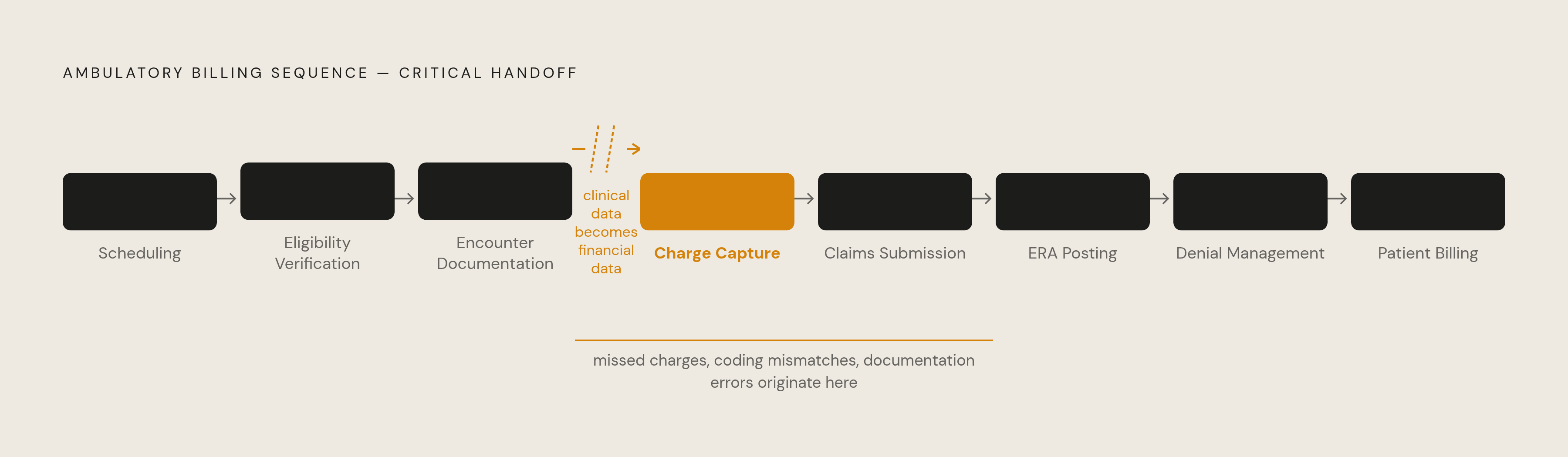
The three models don't differ much in which billing tasks they perform. They differ in where clinical data turns into financial data, and that structural difference is what drives error rates and denial exposure later in the cycle. In an EMR-native billing module, charges flow directly out of clinical documentation into claims without an external interface. There's no re-entry step and no file transfer, so there's no lag between the clinical event and the financial record. That structural advantage comes with a tradeoff: the practice still owns denial management and collections in full. The module submits claims; it does not work them. These modules tend to handle fee-for-service billing well, but they lack the quality-reporting and risk-adjustment workflows that value-based contracts need.
Standalone practice management platforms work differently. Their connection back to the EMR runs through either a built-in integration or a custom interface, and when that interface amounts to a file transfer or a manual import, the clinical-financial gap stays open no matter how sophisticated the billing logic sitting on the other side of it is. Specialty-focused standalone platforms often run more advanced denial workflows and modifier management than EMR-native equivalents, but that advantage only holds when the data arriving from the EMR is clean and complete to begin with.
Outsourced RCM partnerships don't eliminate the handoff challenge. They move it. The question becomes how deeply the RCM partner's workflow connects to the practice's existing EMR and clearinghouse, not whether outsourcing itself solves anything by design. These arrangements typically charge a percentage of collections, and the practice gains real operational execution in exchange, but it still has to make sure clinical documentation reaches the billing operation accurately and in full. Outsourcing changes who does the work. It does not automatically close the gap between the exam room and the claim.
Where revenue leaks: the clinical-financial gap in practice
The money that small and independent practices lose to billing inefficiency is mainly a function of how many error-prone handoffs stand between the clinical event and the claim that eventually gets submitted, not of which platform sits on their desktop. Missed charges, coding mismatches, and documentation that doesn't support the codes billed are not random occurrences. They are the direct output of a broken connection between the clinical record and the billing system, and each one represents either a denial waiting to happen or a charge that never gets captured. Small practices lose a meaningful share of annual revenue this way, to billing errors, denials, and balances that simply never get collected, and a large majority of denied claims are never appealed or reworked because the manual labor required exceeds what a small billing team can absorb in the time available.
The timing compounds the damage. The moment a claim bounces, the window to recover it starts closing. Payer timely-filing deadlines keep running while the claim sits in a rework queue, and a denial that doesn't get worked the day it lands is, in practice, often a denial that never gets recovered. Labor makes up the other half of this problem. Ambulatory billing staff carry substantial salary costs, and labor accounts for the overwhelming majority of what it costs to process a claim from end to end. When a biller who knows how a specific payer behaves leaves the practice, that knowledge leaves with them, and the practice's ability to prevent the same denial from recurring resets to zero.
How denial benchmarks reveal where integration is failing
Denial rates and clean-claim rates are direct readouts of how well a practice's clinical-financial connection functions, and they vary sharply enough by specialty to show the integration problem isn't uniform across ambulatory medicine. Primary care sits close to top-quartile benchmarks, with lower denial rates and shorter accounts-receivable days than most other ambulatory specialties, largely because documentation-to-billing workflows in primary care are more standardized and the payer policies governing them are less tangled. Behavioral health sits at the other end. It carries some of the highest denial rates and longest AR days in the ambulatory cohort, because prior authorization failures, medical necessity documentation gaps, and coding errors all work together there. That combination lands exactly at the intersection of clinical and billing systems. The clinical note, the authorization record, and the claim rarely live in a connected workflow in behavioral health settings, so behavioral health's denial problem reads less like a billing failure and more like an integration failure.
The pressure is also shifting in a new direction. Payer takebacks after a claim has already been paid are rising even as initial denial rates fluctuate. The clinical-financial gap is now producing revenue loss on the back end of the cycle, not just at the point of submission.
Reducing claim denials and payer behavior in small practices
Payers automated their denial and audit operations well before most practices automated their billing, and that gap in timing has turned a weak clinical-financial handoff into a structural disadvantage. Prior authorization denial rates vary significantly by payer. Most initial PA denials get overturned on appeal in Medicare Advantage, but overturn rates fall below half in Medicaid managed care and ACA Marketplace plans. That split matters because the administrative burden of fighting a denial falls entirely on the practice, and a practice without an integrated PA workflow absorbs that burden in manual staff hours rather than automated process.
The share of providers reporting high denial rates has grown meaningfully since 2022, and the mechanism behind that growth is algorithmic rather than circumstantial: payers automated first, and practices running manual or loosely integrated billing workflows now absorb the full cost of that asymmetry. Payer policies also shift without warning, and a denial spike can hit before a practice even knows a rule changed. A billing operation with no systematic way to detect that kind of shift and adjust claims accordingly will keep absorbing preventable denials as if they were unavoidable, when they are often just unmonitored. Institutional knowledge of how a given payer actually behaves, which codes it rejects, which modifiers it demands, which documentation it wants attached, is a compounding asset. When that knowledge lives only in one biller's head and that biller leaves, the practice loses its ability to anticipate the payer's next move, and every round of staff turnover resets the clock on that learning curve.
The practical answer to "how do small practices reduce the percentage of claims getting rejected" starts with closing that same gap: automate the clinical-to-claim handoff so coding and documentation stay matched at submission, build systematic monitoring for payer policy changes rather than discovering them through denials, and work every denial on the day it lands rather than letting it sit in a queue while filing deadlines run out.
What CMS-0057-F changes about the integration calculus in 2026
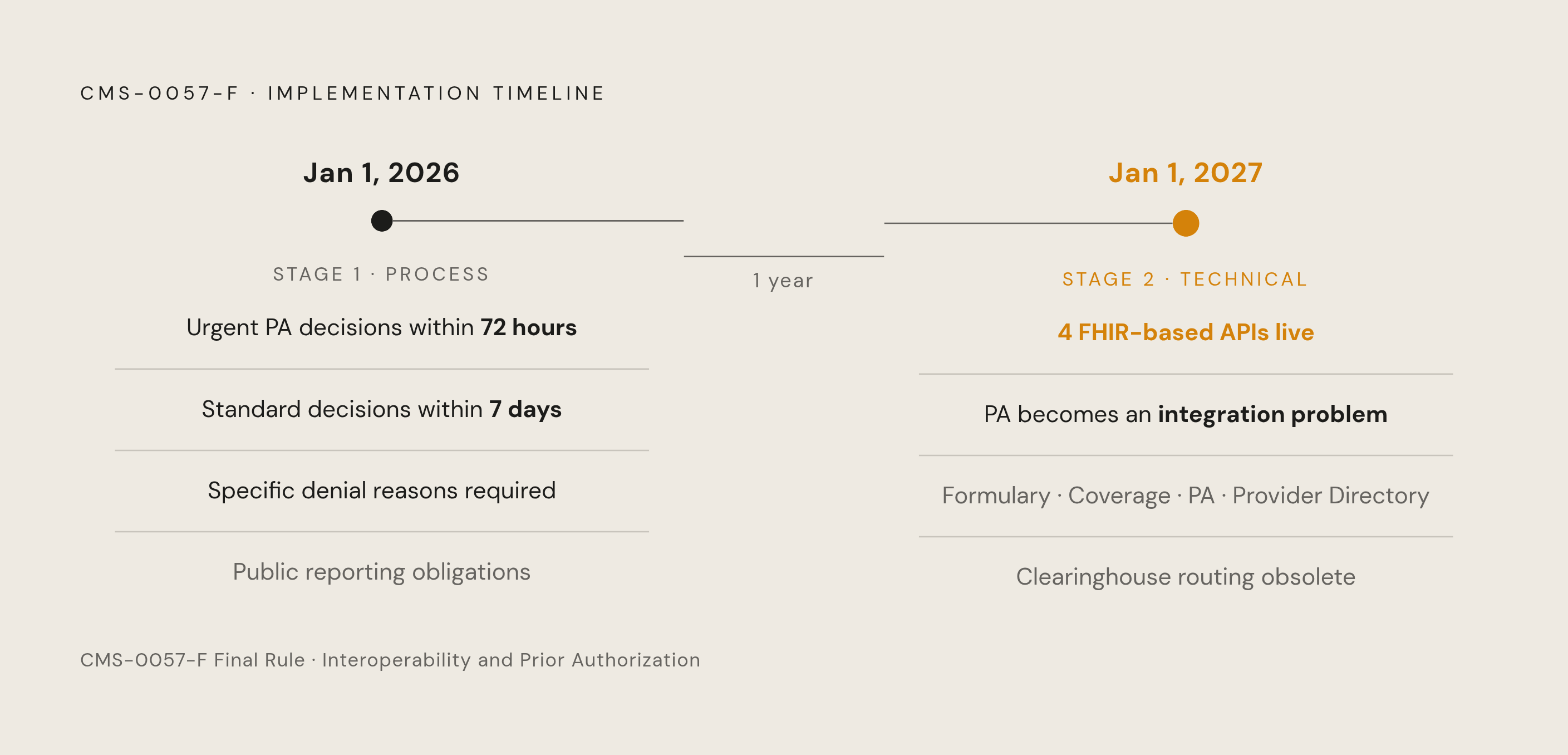
CMS-0057-F is the most consequential regulation touching revenue cycle operations right now: its phased rollout rewards practices whose clinical and billing systems are already tightly connected, and it raises the administrative cost for those that aren't. The rule takes effect in two stages. January 1, 2026 brings the non-technical provisions: specific turnaround windows for prior authorization decisions (both urgent and standard requests, a real tightening from the norms where standard responses have often run two weeks or longer), a requirement for payers to state specific denial reasons, and new public reporting obligations. January 1, 2027 brings the technical build-out: four separate FHIR-based APIs that payers must have live and functioning, which turns prior authorization into as much of an integration problem as it has historically been a phone-and-fax problem.
The denial reason requirement carries an immediate operational consequence. Starting January 1, 2026, payers must state a specific reason for every denial, so a denial without one signals a compliance gap, and practices that run disciplined appeals processes with payer-specific data behind them will be positioned to act on that leverage faster than those that aren't tracking it. The 2027 API mandate is where the two integration models genuinely diverge. EMR-native systems built with FHIR-based prior authorization APIs embedded in the clinical workflow are structurally better positioned to absorb that mandate than billing setups that route prior authorization through a clearinghouse layer sitting apart from clinical documentation. The deadline is fixed. The readiness to meet it is not evenly distributed across platform types.
AI, Automation, and Integration Depth
What software checks claims against payer rules automatically before submission matters more now than it did even two years ago, because AI adoption in billing has grown fast, and automation amplifies whatever integration architecture is already underneath it. A tightly connected clinical-financial workflow gets substantially more value out of AI-driven denial prevention. A fragmented one just gets faster at producing the same errors it was already making. The applications that add the most value in revenue cycle work sit right at the clinical-financial boundary. When ambient clinical documentation feeds directly into charge capture, it removes the manual re-entry step where errors originally enter the system. Real-time coding suggestions tied to the clinical note catch mismatches before a claim is even built. Predictive denial analysis, pattern-matching against how a payer has behaved historically, needs a large enough data set to find real signal. Network-scale systems such as athenahealth, which draws rules from billing data across a large multi-provider network, can adapt to payer policy changes faster than a single-practice installation working from its own history alone. Automated prior authorization, pulling the required clinical information and submitting it to the payer without staff intervention, only works when the clinical system and the billing workflow share the same data environment to begin with.
The most effective model in current practice is neither AI-only nor human-only. AI-only fails when it hits exceptions it can't reason through. Human-only billing teams are too slow and too costly to run at routine volume. The model that works combines AI handling high-volume, pattern-recognizable functions with in-house billing specialists managing the exceptions that the AI surfaces. There's a security dimension to this too. Relying on a single clearinghouse vendor carries documented financial and compliance risk: the TriZetto breach exposed millions of PHI records and generated significant litigation, a reminder that the infrastructure layer connecting clinical and billing systems carries its own baseline security obligations, not optional extras bolted on later.
Outsourced RCM reframes integration as a partnership question, not a platform question
Outsourced RCM changes the shape of the question a practice is actually asking. It stops being "which platform connects clinical data to billing?" and becomes "how completely does this partner's operation connect to the clinical data already sitting in my EMR?" The answer decides whether the revenue cycle actually improves or whether its problems just relocate to a new vendor. A practice that outsources its billing to a partner working disconnected from its EMR has recreated the same clinical-financial gap under a different name: the same missed charges, the same documentation mismatches, the same denial exposure, now managed by someone else who also doesn't have the full clinical picture in front of them.
The outsourced models that actually close the gap are the ones that integrate with the EMR and clearinghouse systems a practice already runs, so the front desk keeps its existing routines, while the partner contributes payer-specific intelligence, denial pattern recognition, and the human judgment to work exceptions that automated systems can flag but can't resolve on their own. Altair Health operates in that space. Its workflow runs AI-driven claim scrubbing, real-time eligibility verification, prior authorization tracking, denial management, patient billing, and financial forecasting and underpayment detection across the full revenue cycle, with in-house billing specialists working the exceptions the AI surfaces and integration built directly to a practice's existing EMR, so the practice can keep its current system. That combination, automated speed paired with the institutional payer knowledge that staff turnover usually wipes out, is what the integration argument has been pointing toward all along.
You shouldn't judge any outsourced RCM partner on cost per claim or percentage of collections alone. It's how tightly that partner's operation connects to a practice's actual clinical documentation, and what happens in the moment a payer changes a policy or a denial lands on someone's desk.
Evaluating a billing approach
When a practice weighs its billing options, it should build the decision around the clinical-financial handoff, not around platform branding or a monthly fee evaluated on its own. A few questions reveal how deep the integration actually runs. Does clinical documentation flow into billing automatically, or does someone have to re-enter, import, or reconcile it somewhere along the way? How does the billing operation find out about a payer policy change, after the first denial arrives, or before claims go out the door? When a denial lands, does someone work it the same day, or does it sit in a queue for later review, and who actually owns the appeal from there? What happens to payer-specific knowledge when a biller leaves, is it documented somewhere the whole team can use, or does it walk out with the person who had it? Does adopting the approach require replacing the existing EMR or retraining the front desk, or does it build on systems and habits already in place? And given the API mandate under CMS-0057-F landing January 1, 2027, is FHIR-based prior authorization connectivity already part of the setup, or is it still a gap to close?
Payment model matters just as much as platform type. A practice running mostly fee-for-service has different integration needs than one carrying significant value-based care exposure, and no platform or partner should be judged without knowing which revenue model it was actually built to support. Specialty matters too. Behavioral health, cardiology, and radiology face denial dynamics that look nothing like primary care's, and the integration demands of an authorization-heavy specialty run higher accordingly. A billing approach that performs well for a primary care group will not automatically close the clinical-financial gap for an oncology or behavioral health practice carrying a different denial profile. The practices seeing real, sustained results aren't the ones carrying the most features on a vendor sheet. Their clinical reality reaches the billing decision fastest and most completely, and their billing operation can still move the moment a payer changes the rules.