Fully Managed Billing Services That Replace In-House Staff for Small Practices
Outsourced billing recovers lost revenue by handling denials instantly, before appeal windows close.

Small practices don't lose billing revenue because their staff perform poorly; they lose it because a one- or two-person billing operation can't keep pace with payer complexity, staffing fragility, and shrinking reimbursement margins. A fully managed billing service solves this by replacing that fragile function entirely: running pre-visit eligibility, claim submission, denial appeals, and payment posting as one continuous operation, integrated directly with the practice's existing EMR, with no software to switch and no staff to hire. Independent physicians comparing outsourced billing options should judge a vendor on exactly this question: does it run the full revenue cycle, including denial management the moment a claim is rejected, or does it hand the hardest work back to the practice.
Why small practices are structurally disadvantaged in billing
The vulnerability starts with staffing. Most small practices depend on one or two people to manage eligibility checks, claim submission, payment posting, and denial follow-up, often alongside scheduling and front-desk duties. There is no second person to absorb the gap, no backup system tracking which claims are aging past their appeal window.
Reimbursement pressure is tightening the margin for error further. The 2026 Physician Fee Schedule included a temporary payment increase offset by an efficiency adjustment, and the effect splits by specialty: time-based and primary care practices come out ahead, while procedural specialists absorb a substantial cut. AMA President Bobby Mukkamala warned that the rule "will make it harder for independent practices to remain viable parts of our health system." That warning lands hardest on practices already running thin administrative margins, because every denied claim and every delayed payment now matters more to a shrinking reimbursement base.
None of this is a story about staff competence. It's a story about scale. The volume and speed of payer-side denial activity has grown well past what a two-person team can track by hand, and the administrative burden that results isn't a background inefficiency sitting quietly on a budget line. Hours spent on denied claims and payer calls reduce patient care directly, causing slower scheduling, unanswered phones, and a shrinking capacity to see the patients already on the books.
What "fully managed billing" means
A fully managed billing service is an operational replacement: the vendor runs the complete claim lifecycle, from pre-visit insurance eligibility verification and prior authorization, through claim scrubbing and clean submission, through denial management and appeals worked the moment a denial lands rather than queued for batch review, through payment posting, patient billing, and financial reporting. The practice's internal staff never touches a claim.
The services like Altair Health built for this purpose combine autonomous handling of the routine cycle with in-house billers working exceptions, so the practice's staff is freed from claims work entirely and the denial window never closes simply because no one had time to watch it.
What a managed service is not matters just as much as what it is. A vendor that only submits claims, while leaving denial management and appeals to the in-house team, has outsourced the easy part and left the practice holding the work that requires the most payer knowledge and the fastest turnaround, which happens to be exactly the work a small team is worst equipped to do.
How payer behavior turns front-end errors and policy shifts into a denial cycle
Denials aren't random. They follow a predictable cycle built from front-end failures and payer-side tactics, and a small billing team cannot monitor or respond to either one fast enough. On the front end, missing or inaccurate claim data, intake errors around eligibility, registration, and authorization, is the single largest contributor to rising denial rates: 50% of revenue cycle leaders cite it as the top factor, with incomplete patient registration data alone ranking third at 32%. These are failures the practice can control in principle, but controlling them requires a process that most small teams never have time to build.
On the payer side, policy changes often arrive without warning, and a small practice typically learns about them only when a wave of denials hits, not in advance. The scale of what's at stake becomes visible in the prior-authorization denial figures published under CMS-0057-F for CY2025: UnitedHealth Group denied 17% of PA requests, with 60% overturned on appeal; Centene denied 15% of Medicare Advantage requests, with 93% overturned on MA appeals; CVS Health/Aetna denied 8%, with 89% overturned. Those overturn rates mean most of these denials were recoverable all along, but only for practices fast enough and skilled enough to work the appeal before the window closes.
That window is also getting harder to use. Average denial overturn success fell in 2025 compared with the year before, so winning an appeal now takes more skill even as the time allowed to file one shrinks. Starting January 1, 2026, CMS requires health plans to decide expedited prior authorization requests within 72 hours, a rule that rewards practices able to submit complete, well-documented requests the first time, since the payer's clock starts the moment the request lands.
Why staff turnover makes in-house billing a fragile system
The real cost of in-house billing isn't the salary line. A single resignation during a busy stretch means claims go unworked, denials go unanswered, and appeal deadlines pass with nobody watching them.
What gets lost isn't generic billing skill. Physicians are generally in the worst position to evaluate whether that knowledge is being captured before it disappears, since medical billing is a specialized discipline they were never trained in and have little time to audit.
The AMA's 2024 physician time-use data found doctors spend an average of 7.3 hours a week on administrative tasks, including prior authorization, insurance forms, and meeting attendance. And turnover carries costs that never appear on a billing department's budget: recruiting, retraining, and the claims left sitting unresolved during the gap instead surface in accounts receivable aging and in collections that quietly fall short.
When staff leaves, the payer-specific knowledge leaves with them, and the practice starts over building it again, losing months of recovery time in the process.
In-house billing costs versus managed service charges
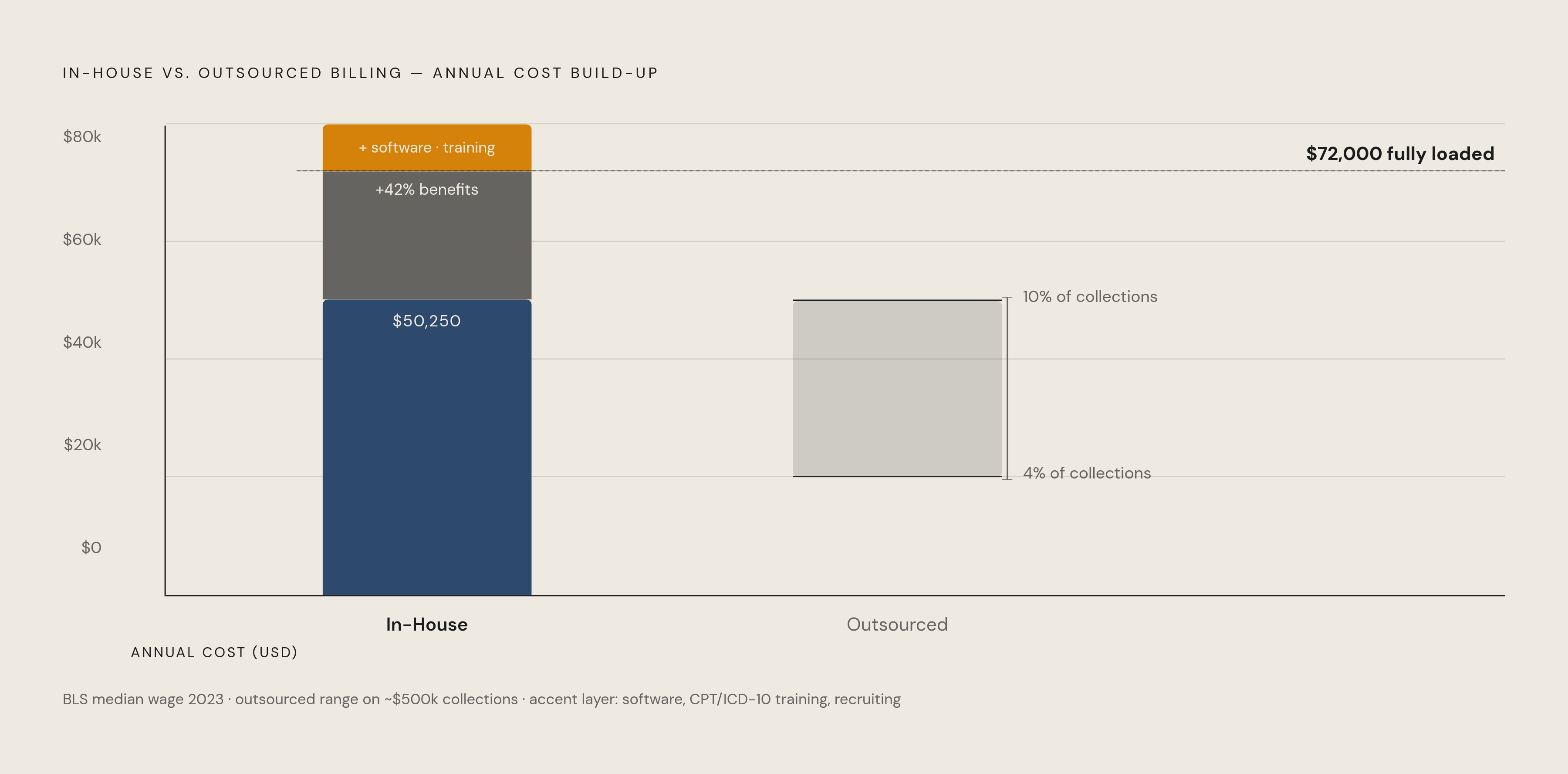
Calculated honestly, with salary, benefits, software, training, turnover, and physician oversight time all included, in-house billing is rarely the cheaper option it appears to be on paper. The median annual wage for a medical records and billing specialist was $50,250, according to the Bureau of Labor Statistics, and benefits and payroll taxes add roughly 42% on top of that figure, bringing the fully loaded cost of a single in-house biller to approximately $72,000 a year before that person processes a single claim. That figure doesn't include the billing software and clearinghouse fees a practice pays every month, the annual coding certification and training required as CPT and ICD-10 codes change each year, the recruiting and retraining costs triggered every time a biller leaves, or the physician hours spent reviewing denied claims and tracking down accounts that a fully staffed billing operation would otherwise absorb.
Outsourced medical billing services typically charge 4% to 10% of collections rather than a fixed payroll cost, so a practice pays in proportion to what it actually brings in rather than carrying a flat salary obligation regardless of claim volume. Geography compounds the miscalculation further: in high-cost states, in-house biller salaries run above the national median, so practices in those markets understate their true in-house cost whenever they benchmark against national averages instead of local ones.
The performance gap in practice: clean claim rates, AR days, and denial recovery
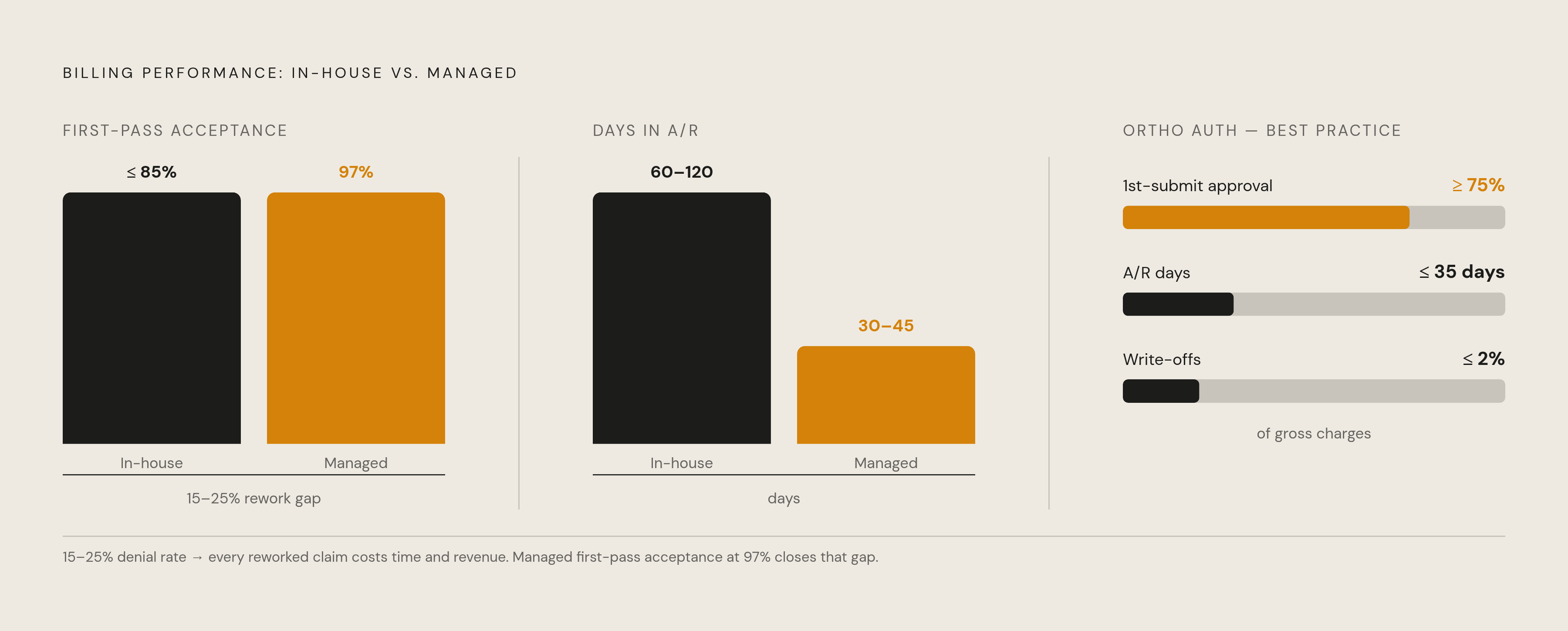
The difference between in-house and managed billing isn't abstract. In-house billing teams typically run denial rates between 15% and 25%, but a well-run managed service targets a first-pass claim acceptance rate at or above 97%. The distance between those two figures is the share of claims that must be reworked by hand, each one costing staff time and pushing payment further out.
Days in accounts receivable tell a similar story. In-house AR commonly runs 60 to 120 days or more, but managed services aim to hold that figure to 30 to 45 days. On denial recovery, about 90% of denied claims are ultimately payable, but reworking each one costs between $25 and $181. If a practice lets denials sit until they age out, or writes them off instead of reworking them, it isn't saving that rework cost.
These benchmarks also carry specialty-specific signatures worth checking against. In orthopedics, best-practice surgical authorization approval on first submission is 75% or higher, AR days should be 35 or fewer, and write-offs should stay at or below 2% of gross charges; numbers worse than these usually point to authorization failures, aged denials, or implant billing errors. A practice can use any of these benchmarks to check its own performance before deciding whether a change is overdue.
AI and Human Expertise in a Managed Service
The managed services that produce better billing outcomes aren't just larger versions of an in-house team. They pair machine-speed pattern recognition with human specialists who understand how individual payers actually behave, and neither piece works well without the other. AI is suited to the high-volume, rules-based layer: eligibility checks, claim scrubbing, payment status monitoring, and denial prioritization by likelihood of recovery, tasks a two-person in-house team is already doing by hand, slowly, with attention split across a dozen competing demands.
The human layer covers what AI can't: payer-specific negotiation, complex appeal strategy, and recognizing when a denial reason code is really masking a policy change that calls for a different response. The AMA's 2024 Prior Authorization Physician Survey found that 61% of physicians reported AI-based PA processes produce more denials than human review does. Payers are using automation to deny faster, so providers need AI-assisted humans on the other side to appeal just as fast.
If AI is done well in billing, the realistic effect isn't fewer billing staff.
The question worth asking any vendor is what happens to a denied claim the moment it lands, since the answer reveals whether a service has real denial management capability or is quietly counting on the practice to chase its own appeals. Altair Health's model is built around this exact split: AI surfaces the exceptions, and in-house expert billers work them, pairing machine speed with payer-specific knowledge that compounds across every claim the service touches.
What a managed service must integrate with
Asking a practice to replace its EMR, retrain its front desk, or rebuild its existing workflows trades one disruption for another, a trade that isn't worth making. The non-negotiable requirement is integration: a managed service should connect to the practice's existing EMR and clearinghouse systems without a rip-and-replace, so clinical workflows stay exactly as they are while the billing operation runs alongside them.
A fully managed billing service, in practice, integrates directly with a practice's existing EMR and clearinghouses, so it needs no migration and no change to front-desk routine. Evaluating a vendor starts with confirming that fit: a service that cannot demonstrate integration with a practice's current EMR before a contract is signed is a risk, not a solution.
Transition timing matters just as much as the integration itself. HIPAA compliance is a baseline: any managed service handling protected health information has to meet the current HIPAA Security Rule standards, including the requirements being finalized for covered entities in 2026.
Evaluating a Fully Managed Billing Service
The questions that expose whether a vendor marketed as "fully managed" actually runs the complete revenue cycle concern what happens after a claim is denied. The first thing to press on is the denial management process itself: is a denied claim worked immediately by a specialist, or does it sit in a batch queue waiting for review? Every denial represents recoverable revenue, and the window to recover it narrows with each day it goes unworked.
A vendor should be able to speak concretely to the payers that make up the practice's own mix, including recent changes to those payers' prior authorization rules, appeal windows, and denial reason codes. AR transparency matters just as much: a practice should have real-time visibility into AR aging, denial rates, and payer performance, not a monthly summary that arrives after the recovery window has already closed.
A few answers should raise concern regardless of the vendor. A service that conflates billing and coding into a single undifferentiated offering is misrepresenting its own scope, since coding is a distinct discipline from billing. The absence of documented EMR integration for the practice's current system is a red flag on its own, and a vague answer about HIPAA compliance should be treated as disqualifying rather than reassuring, since compliance is a baseline requirement, not a selling point.
Altair Health runs this complete cycle, from pre-visit eligibility through denial management and payment posting, integrating with existing EMRs and clearinghouses so practices keep their workflows while gaining a billing operation built on payer-specific intelligence and human specialist oversight of every exception the AI surfaces. Any vendor worth considering should be able to answer these questions just as directly, because the right standard treats every denial as recoverable revenue and builds its whole operation around fighting for it.