Denial Rate Spikes Following Payer System Migrations and Platform Changes
Payer system overhauls are silently driving denial spikes that practices can't prevent on their own.

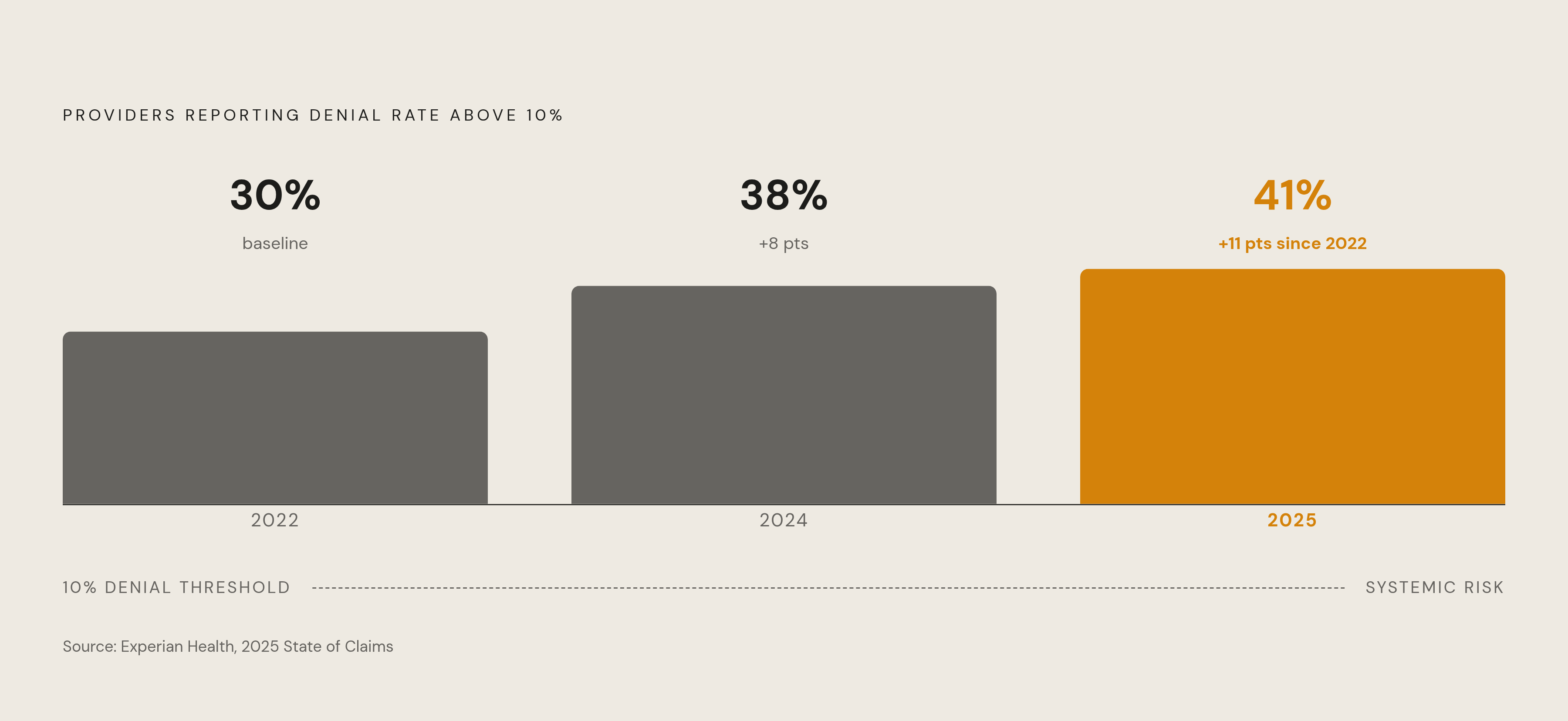
Denial rates aren't just rising, they're rising even at practices that haven't touched their billing workflows. Experian Health's 2025 State of Claims survey found that 30% of providers reported denial rates above 10% in 2022; that number hit 38% by 2024 and 41% by 2025. Kodiak Solutions data, reported by Viaante, shows initial claim denial rates climbed from 10.2% in 2020 to 11.8% in 2024. Industry benchmarks generally treat denial rates above 10% as a sign of systemic problems. That means 41% of providers are now working above that threshold, and the practices doing everything the same way they did five years ago are getting worse results. When the constant is the practice and the variable is the outcome, the explanation lives somewhere else. It lives on the payer side, inside systems most billing staff never see and payers rarely explain.
What happens inside a payer when it migrates its claims adjudication platform
Most insurers still run claims adjudication on systems built two or three decades ago, often on DB2 databases and mainframe architecture that predate the internet as most people use it. Moving that data into a modern platform sounds like a technical exercise, and in the narrowest sense it is, but insurance data doesn't map cleanly from old structure to new. Policy hierarchies, coverage tiers, and claims relationships are tangled together in ways that don't translate one to one. A single mapping error can leave data that's technically present in the new system but functionally useless to whatever logic is supposed to read it.
Three failure modes tend to occur during and after these migrations. The first is plain downtime: claims queue up but don't get adjudicated, and accounts receivable ages in a way the practice submitting the claim has no visibility into. The second is logic drift, where adjudication rules that existed quietly in the old system don't carry over exactly as written. Edge cases that used to auto-approve start auto-denying because nobody rebuilt that specific rule in the new environment. The third is data errors that surface at the worst possible moment, mid-claim, during a renewal, on a live service call, and staff on the payer's own side stop trusting the new system. That distrust breeds workarounds: spreadsheets, manual double-checks, decisions that used to take seconds now taking days.
None of this is cheap. The administrative cost per claim rose from $43.84 in 2022 to $57.23 in 2023, driven mostly by added labor, which is a rough proxy for how much manual patching a migration forces on the payer's own staff. Sagility's case study on moving 3 million Medicare Advantage members off a legacy claims platform onto Health Rules Payer is instructive here because of what the vendor chose to advertise. The migration delivered a 30% increase in processing efficiency and required identifying and revising 46 ambiguous health plan policies along the way. Sagility marketed "zero disruption" as the headline win. Disruption is the default expectation for this kind of project, and Sagility marketing "zero disruption" as the headline win confirms it, not treats it as an exception.
None of it comes with a warning to the practices on the other end. A payer's internal logic can shift completely, and the first sign a billing office gets is a stack of denials on claim types that cleared without issue the month before.
The failure patterns practices see when a payer system changes
Four patterns recur, and they don't look alike at first glance, but they trace back to the same root cause.
Eligibility and registration denials on established patients form the first pattern. When MGMA studied denial spikes tied to new EHR rollouts, the leading cause wasn't coding and it wasn't medical necessity, it was registration errors and authorization mismatches. Member data issues on the payer side can produce a similar signature. The 2026 Medicare Advantage shift makes this visible at scale: roughly 2.9 million MA patients lost access to their existing plans when insurers pulled out of counties, with UnitedHealthcare and Humana together exiting a significant number of counties. Patients show up with old insurance cards, practices bill a payer that no longer covers them, and claims deny before anyone on staff realizes the ground shifted. KFF data cited by Human Medical Billing adds another layer: 15% of local PPO Medicare Advantage plans were canceled for 2026, pushing patients into unfamiliar plan types with different coverage structures than those they held a year earlier.
The second pattern is visible in bundling and modifier denials on procedures that used to sail through. CMS updated its NCCI procedure-to-procedure edits in January 2026, with a second update wave landing in April, representing the largest single-cycle NCCI update in seven years, but claims scrubbers still running the January edit table will keep passing spine, ophthalmology, and orthopedic multi-procedure claims straight into payer-side denials. UnitedHealthcare layered hundreds of new proprietary bundling pairs onto its ClaimCheck system on top of that, so modifier usage that was correct in 2025 may now trigger bundling denials in 2026. The tell here is a sudden jump in CO-97 denials concentrated in a handful of specialties, with nothing in the practice's own coding behavior explaining it.
Prior authorization denials on services that never used to need authorization make up the third pattern. MBC's 2026 denial management analysis, drawn from 240 specialty practices, found prior auth denials now account for 34% of all first-pass denials, up from 22% in 2023, a 31% year-over-year jump. Practices running PA checklists that haven't been updated are getting denied on procedures they've ordered for years because the payer quietly changed the requirement around the service. The signal is denials clustering on long-established, routine procedures at one specific payer, with no documentation gap or coding error anywhere in sight.
The fourth pattern is newer and faster: AI-driven adjudication denying claims at a volume and speed that simply wasn't possible before. The AMA's 2025 Prior Authorization Survey found AI-adjudicated PA decisions carry denial rates 40% higher than decisions reviewed by a person, and one AMA report described an insurer processing automated reviews in 1.2 seconds per claim. The tell is a denial spike with no matching rise in claim volume, paired with denial reason codes that stay consistent but don't correspond to any identifiable gap in documentation.
Payer-specific platform behavior and why it makes the same claim approve at one insurer and deny at another
The same procedure, same documentation, same patient history, can get approved by one payer and denied by another for architectural reasons. UnitedHealthcare runs on Optum's ClaimCheck with its own proprietary bundling edits. BCBS plans often lean on Carelon Medical Benefits Management, formerly AIM Specialty Health, for medical necessity review. Those are two different rule engines making two different judgments off the same clinical facts.
The result is that the same claim can face different failure modes depending on which rule engine is adjudicating it and what that system is built to flag. It also means a practice needs separate denial workflows for each payer, not one generic process applied everywhere.
Timing compounds the architecture issue. BCBS medical necessity denials through AIM Specialty Health are frequently resolved at the peer-to-peer review step, and the data on that step is stark: requesting peer-to-peer within 72 hours of the denial produces a 69% overturn rate, while written appeals filed without a prior peer-to-peer succeed only 31% of the time. The strength of the clinical argument barely enters into it; the sequence of the response is what decides the outcome.
Payers have also been shortening the windows in which practices have to act. UnitedHealthcare cut its peer-to-peer review request window from 30 days down to 14, effective in the first quarter of 2025. Humana has reduced expedited appeal windows for urgent PA requests, and multiple BCBS state plans have cut standard appeal windows for non-urgent PA denials from 60 days down to 30. A billing office running denial review on a weekly or biweekly cycle hits a 14-day window inconsistently at best, regardless of whether the original denial was even correct. It's a clock problem, not a training problem. MBC's 2026 data puts a number on what that costs: a four-provider orthopedic group can expect $35,000 to $95,000 a year in exposure from BCBS medical necessity denials alone.
Tracing whether a denial spike stems from a payer platform change rather than a practice billing error
The first question to ask is simple: did anything change on the practice's side in the weeks before the spike started? If nothing did, the cause almost certainly sits outside the four walls of the billing office.
A few signals separate a payer-driven spike from an internal one. Denials concentrating at a single payer while every other payer's claims move normally points outward, not inward. Unfamiliar denial codes appearing out of nowhere, CO-97 on a modifier 59 claim that cleared fine six months ago, or an authorization-required denial on a procedure that's never needed one, both suggest the adjudication logic changed rather than the coding. A spike that starts on a specific calendar date, January 1, April 1, the first day of a new plan year, usually lines up with a policy or system update the payer flipped on that day. And denials on eligibility or plan type hitting patients with years of clean claims history at that same payer almost never trace back to a front-desk mistake; that's a member data or plan-type change on the payer's end.
Payers, for their part, are watching this in something close to real time. MDaudit's analysis across more than 1.2 million providers and 4,500 facilities found total at-risk audit amounts per customer rose 30% year-over-year through the first three quarters of 2025, with the average at-risk amount per claim up 18%. Payers are tracking and acting on these patterns as they happen. Plenty of practices are still pulling a monthly AR report and calling that visibility.
That gap is the real exposure. A practice reviewing denials every one or two weeks may not spot a payer-side pattern until a month or more of revenue is already affected, and by then the appeal windows on much of it have already closed.
What billing operations must do differently once a payer-triggered spike is identified
Triage comes first, and it starts with sorting the spike by CARC and RARC code before doing anything else. The code tells you whether the failure sits in eligibility, authorization, bundling, or medical necessity, and each of those calls for its own distinct fix.
For spikes rooted in eligibility, the kind coming out of payer market exits and plan-type shuffles, real-time eligibility verification needs to run at scheduling and again at the point of service, for returning patients as much as new ones. The scale of the 2026 Medicare Advantage disruption makes this close to mandatory: with 2.9 million members affected and many of them auto-enrolled into plans they don't recognize, relying on last visit's coverage data is a guaranteed failure point.
For spikes rooted in authorization, PA requirement checklists need auditing against each payer's current policy, not the version from a year ago, across every high-volume procedure category. MBC's 2026 tracking shows the biggest PA expansions landing in advanced imaging, specialty medications, outpatient surgery, and durable medical equipment. Electronic prior authorization adoption climbed from 31% in 2023 to 40% in 2025 per CAQH data cited by Viaante. Most of the industry is still handling PA manually, and manual handling is exactly where this kind of denial risk concentrates.
For spikes rooted in bundling and modifiers, claims scrubbers need updating to reflect both the January 2026 and April 2026 NCCI edit changes; a scrubber running a stale edit table is letting denials through that should never have left the building. UnitedHealthcare's ClaimCheck additions sit on top of that and require their own payer-specific scrubbing logic, since CMS compliance alone won't catch them.
Appeal strategy has to move at the speed the payers have set. Denials need working the day they land, not batched into a weekly cycle, because UnitedHealthcare's 14-day peer-to-peer window and Humana's shortened expedited appeal window don't leave room for batch processing. For BCBS medical necessity denials specifically, requesting peer-to-peer within 72 hours turns a 31% success rate into a 69% one. It's a financial decision measured in real dollars, not a matter of best practice.
A memory problem produces all of it. Knowing which edits changed, which appeal sequence works at which payer, what documentation language clears NLP review, that knowledge lives in people, not in a manual. When billing staff turn over, it walks out the door with them, and the practice relearns the same lessons at its own expense. A billing operation built to survive this looks different from one that isn't: denial alerts that fire in real time instead of a monthly AR pull, appeal workflows built around each payer's specific process instead of one template stretched across all of them, and eligibility and authorization checks that happen before the claim goes out the door instead of after the denial comes back.