Eligibility Verification Automation and Real-Time Benefit Coverage API Accuracy
Real-time checks cut denials only when staff resolve the exceptions.

Small medical practices can reduce eligibility-related claim denials by querying current payer data before the visit, checking service-specific benefits, and routing incomplete responses to trained reviewers. Real-time eligibility APIs close the stale-data gap, but their value depends on how accurately the returned information is interpreted and acted upon.
Why eligibility denials are a data-timing problem, not a billing execution problem
Coverage information can be correct at registration and outdated by the service date. A patient’s coverage may lapse, a dependent may leave a plan, or a plan update may reach the payer’s system without reaching the practice. The registration record still looks complete. Yet it no longer describes the coverage against which the payer will assess the claim, creating a denial risk before billing staff begin their work.
Manual phone verification produces another snapshot of coverage. Batch EDI verification narrows the interval between checks, but it still operates on a schedule. With either approach, an earlier answer can be out of date even when staff have followed the process correctly. The workflow therefore asks people to detect changes their systems do not expose, so billing negligence need not be the cause. The remedy must reach the payer’s current record at the moment the practice needs an answer.
What real-time eligibility APIs actually do, and how the X12 270/271 standard underlies them
A real-time eligibility API queries live payer records when an application submits a request and returns coverage and benefit information synchronously, typically within seconds. The application identifies the patient, payer, and rendering provider. The API expresses that request as an X12 270 eligibility inquiry, and the payer returns an X12 271 response containing coverage status and benefit details. The transaction standard supplies the exchange mechanism. Its operational value comes from making that exchange available at scheduling, during pre-visit work, or at check-in, independently of a scheduled batch.
A useful response goes beyond an active-or-inactive answer. It includes copays, deductibles, coinsurance, out-of-pocket maximums, benefit limitations, in-network status, and prior authorization triggers. Those details connect the patient’s general coverage to the service the practice intends to provide. A response that omits those conditions may confirm coverage for registration while leaving payment for the planned service unresolved.
Real-time access makes a fresh inquiry possible when another decision must be made. A check closer to the visit can therefore capture changes that the earlier response could not contain. This distinction separates access to current data from a workflow that actually uses it at the right time.
Where the accuracy problem lives: 271 normalization and payer data quality
The response is often the main constraint. Payers can follow the X12 schema but arrange benefit information in different ways. One may return the remaining deductible as a discrete field, while another places it inside a benefit loop containing family-level amounts, plan-year notes, and service-specific caveats. Normalization maps these different structures into a consistent internal format. Without it, payer-specific interpretation rules accumulate inside billing workflows, where they must be maintained as part of everyday operations.
Correct parsing does not guarantee complete information. A payer may confirm coverage and a copay while returning little about the benefit for the particular service being billed. Its eligibility data may also lag behind the record used by its adjudication system. These are distinct limitations, because a parser cannot recover information the payer did not return.
Other non-clean responses stem from things the API vendor cannot control. The practice may hold an incorrect member ID, the patient may have changed plans, the payer connection may be unavailable, or the payer may not recognize the provider NPI. Each condition calls for resolution before coverage can be assumed. Receipt of a 271 is therefore not the appropriate endpoint for verification. The operational endpoint is an answer that has been interpreted correctly and is complete enough to support the planned care.
What incomplete or misread eligibility data costs a practice before a single claim is filed
An incomplete eligibility response creates financial exposure before claim submission because it leaves payment conditions unresolved while the practice prepares to deliver care. A missed benefit limitation, an unresolved coverage transition, or an overlooked authorization trigger can become a denial later. The cost begins upstream of billing execution. Once the service has been provided, correcting the record may require rework without guaranteeing that the claim can be paid.
Historically, providers have failed to resubmit a majority of denied claims. For those claims, a denial is not simply a delay in collection but revenue that is never recovered. This makes the distinction between detecting an exception and resolving it financially significant. A system that identifies a coverage problem but leaves it unattended has not completed the preventive work. The practice still bears the risk when the claim reaches the payer.
The American Hospital Association places hospital operating margins between negative one and three percent as of 2026, providing hospital-specific context for the risk of unrecovered claims. It nevertheless shows why unrecovered claims deserve attention beyond the billing department. Independent practices face this risk without a larger system to cover losses, so getting front-end work right protects revenue as well as helping staff work more efficiently.
What genuinely accurate eligibility verification requires at the workflow level
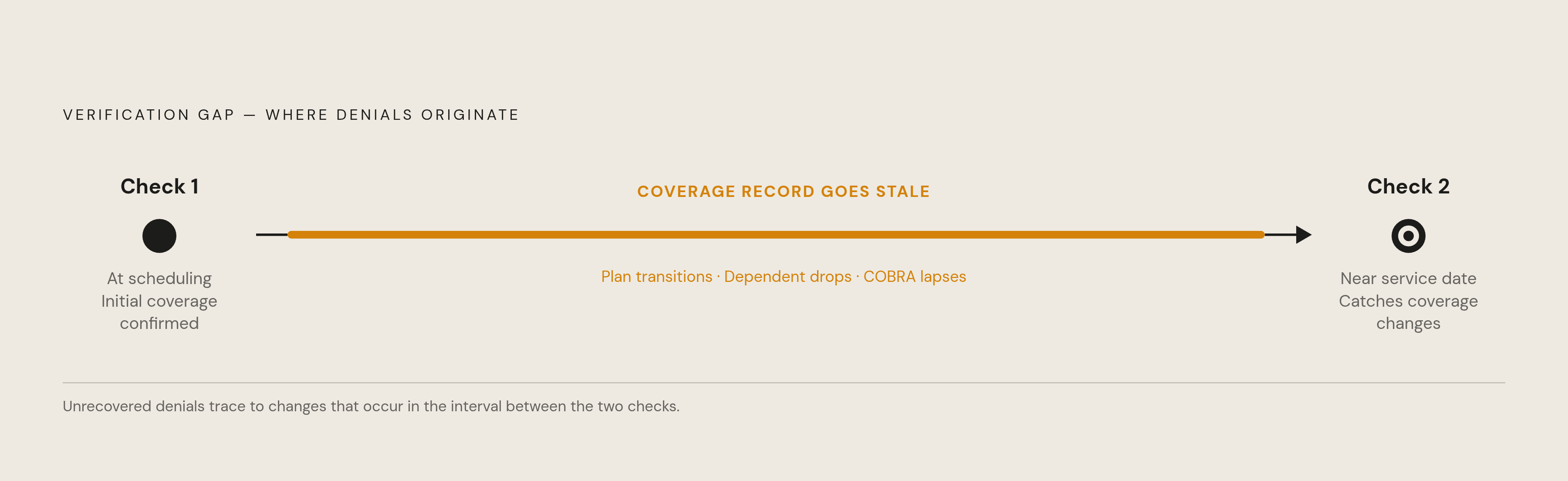
Verification at scheduling establishes the initial coverage position, while a re-check closer to the service date catches plan transitions, dependent drops, and COBRA lapses. The second check serves a different purpose. It checks whether the assumptions behind the scheduled visit still hold, since the first response in the patient record can go out of date.
The returned information must also apply to the intended service and rendering provider. Staff need service-specific limitations, authorization triggers, and provider network status as well as general coverage status. Once verified data has been interpreted, it must flow straight into the EHR and practice management system. Manual transcription reintroduces an error-prone handoff into a process intended to remove it.
Responses such as “coverage terminated,” “coordination of benefits needed,” and “payer connection unavailable” represent different problems and cannot be treated as interchangeable failures. Each needs a reason visible to the person responsible for resolving it. Flagging the response is only the beginning.
The communication layer can be automated as a complement to these data exchanges. In an example of call automation, Arkansas Pediatrics automated inbound calls so that more than 65 percent are handled end to end without staff involvement, freeing over 120 staff hours a month.
Why automation without human review of exceptions still fails on the cases that matter most
Routine verification lends itself to automation because many inquiries return information that can be interpreted consistently. Complex coverage stacking, Medicare Advantage with secondary commercial coverage, COBRA transitions, and out-of-network surgical scenarios present a different problem. The coverage situation itself may be ambiguous. In those cases, trained review is not a repair for defective automation but a necessary response to incomplete data or conditions that require judgment.
Payer coverage rules further limit what an eligibility answer establishes. Cigna ties reimbursement to its coverage criteria, including covered diagnosis and procedure codes. Aetna imposes site-of-care requirements for many specialty drug infusions. Consequently, confirmation that a patient has coverage does not establish that a particular service, diagnosis, and setting satisfy the payer’s conditions. A reviewer must distinguish the coverage answer from the remaining payment requirements.
Payer-specific institutional knowledge helps resolve that distinction. A specialist may know that a particular plan type produces incomplete eligibility responses and which manual step resolves the missing information. That knowledge accumulates across encounters and can disappear when billing staff leave. Software alone does not replace it. The operational design must preserve access to that expertise rather than assume every unresolved response can be settled by another automated inquiry.
Access Healthcare describes a technology-as-a-service model combining automation, analytics, and operational expertise. Applied to verification, that principle supports machine processing of routine inquiries with billing specialists responsible for the exceptions identified during processing. Otherwise, automation accelerates the clean cases while leaving the most consequential uncertainties untouched.
How the CMS interoperability mandates change the data environment practices are verifying against
CMS-0057-F changes the environment in which practices obtain payer information. Covered payers include Medicare Advantage organizations, state Medicaid and CHIP fee-for-service programs, Medicaid and CHIP managed care plans, and QHP issuers on the federally facilitated exchanges. General operational provisions took effect January 1, 2026, while API development and enhancement compliance dates begin January 1, 2027. The earlier process changes should not be confused with the later HL7 FHIR API requirements.
The prior authorization API must contain the payer’s covered items and services, identify documentation requirements, and communicate an approval, a denial with a specific reason, or a request for more information. That structure can make authorization requirements more usable within practice workflows. It does not turn eligibility into authorization. Instead, it provides another structured source of information about the planned service’s compliance with payment conditions.
CMS also requires covered payers to publish prior authorization metrics annually on their websites, with the first reporting cycle due March 31, 2026. Approval rates, denial rates, and average decision times create a public reference against which practices can compare their own experience. Under another proposal, CMS-0062-P, electronic prior authorization requirements and shorter timeframes for decisions on drugs are targeted for October 1, 2027.
Payer-specific changes add another source of workflow updates. UnitedHealthcare’s October 1, 2026 elimination of roughly 1,700 procedure codes from prior authorization requirements is an aggregate across plan types, with codes and counts varying significantly by plan. As structured payer data becomes more available, systems capable of querying and consuming FHIR responses will be better positioned to use it, but interpretation must still remain plan-specific.
How should a small practice choose a verification partner or platform to reduce denials?
A small-to-mid-size practice should weigh verification options based on its payer mix, the systems it already uses, and its ability to resolve exceptions. The practice should first check whether confirmed information writes directly into the specific EHR and practice management system already in use. A parallel data-entry process preserves the handoff risk. Connection breadth must likewise be judged by how well the available connections cover the practice’s highest-volume payers.
The practice should check whether the platform returns service-specific benefit details and provider network information as well as confirming coverage. The same scrutiny belongs on non-clean responses. A useful workflow exposes the reason for the exception and routes it to a reviewer, while a system that merely records the result leaves resolution with the practice.
Security requirements are baseline conditions. A system that processes electronic protected health information must meet the HHS HIPAA Security Rule requirements that apply to it, and the partner must be willing to sign a Business Associate Agreement. Human expertise deserves equally concrete evaluation. The presence of AI says little about whether trained billing specialists will work the ambiguous cases or bring payer-specific knowledge to their resolution.
The final comparison is between a standalone verification tool and an integrated revenue cycle management partner. A point solution may supply the API layer, while the practice remains responsible for connecting its results to pre-visit work, claim preparation, and denial follow-up. An integrated partner can make verification part of a workflow that runs through denial management and appeals, closing gaps in the handoffs between those stages. Neither model removes every failure mode. The defensible choice is the one that makes responsibility for incomplete information explicit before the service date, rather than discovering that responsibility after a denial.