What Happens to Claim Volume and AR During a Billing Staff Transition and How to Protect Both
Protect claims and revenue by documenting departing billers' payer knowledge.

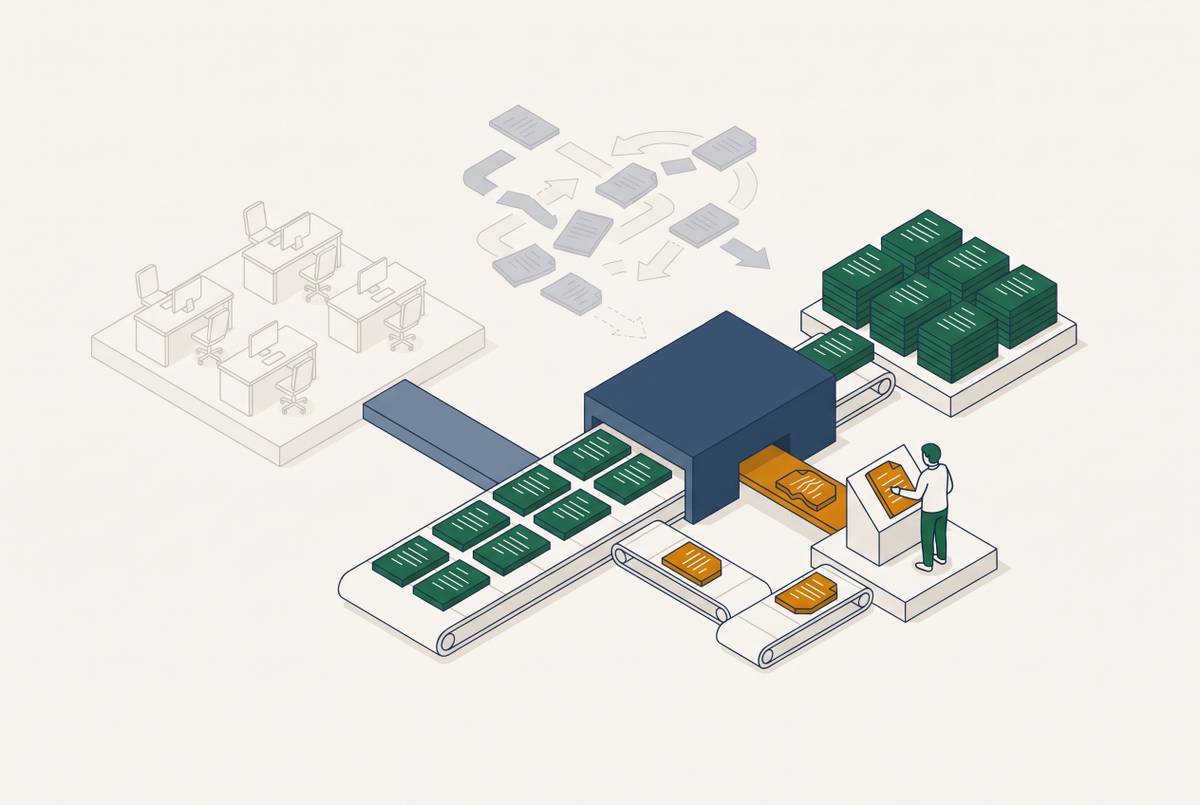
When billing staff change, claim volume and accounts receivable are at risk as a submission backlog builds, denials rise, and balances age. To protect both, the practice needs to record what the biller knows about payers before they leave, keep new claims and older AR moving in separate workflows, and check each stage every week. Automation can preserve processing capacity, but experienced billers remain essential for appeals and payer-specific exceptions.
Why billing staff transitions damage AR in a sequence, not all at once
An empty seat slows submissions, submission lag increases denial exposure, and unworked denials become harder to collect as deadlines approach. A practice can still be clearing its initial backlog when denied claims begin consuming the capacity needed to keep current submissions moving.
The resulting revenue loss often becomes visible in collections shortfalls months later, after opportunities to appeal or refile have closed. Meanwhile, submitting new claims can make the billing operation appear productive even as older accounts go untouched. The critical distinction is between processing activity and end-to-end claim resolution.
Stage one: how the claims backlog forms in the days immediately after a departure
The backlog begins when capacity leaves. The median time to fill a medical billing specialist position is 42 days, leaving a substantial interval in which claims still need attention. Even the notice period divides managerial effort. The practice must capture the departing biller’s knowledge, arrange coverage, and recruit a replacement at the same time.
What disappears is more than processing capacity alone. Experienced billers retain payer-specific requirements, documentation patterns that prevent denials, appeal strategies, and workflow knowledge that may never have reached a standard operating procedure. Without that knowledge, the remaining team must manage unfamiliar exceptions while handling its normal workload. Every claim submitted during the gap is therefore more likely to be delayed or denied.
Under this pressure, work shifts from complete claim management to short-term triage. Teams submit what is new and defer what is old because fresh claims are easier to move. Yet charge capture and submission are time-sensitive. Most payers impose timely filing limits, and clinical validity or coding accuracy cannot rescue a claim that has missed its filing window. The backlog is therefore a deadline problem from its first days.
Stage two: the denial spike that follows a backlog
When an understaffed team rushes submissions, verification gaps, incomplete authorizations, and coding errors turn delayed claims into denied claims. Eligibility may have been checked too early or not rechecked near the service date. Coverage terms can be misunderstood, while authorization requirements go unnoticed.
Prior authorization creates another source of unfinished work. Incomplete submission packets and slow responses to payer requests leave authorizations unresolved, especially when status tracking is inconsistent. At the same time, limited staffing makes CPT and ICD-10 accuracy harder to maintain. The practice moves claims out of its submission queue only to receive them back as exceptions requiring more effort.
That additional work reinforces the original capacity shortage. Denial management requires categorization, root-cause analysis, documentation retrieval, and compliance with payer-specific appeal requirements. The same team struggling to submit current claims must now absorb this second workload. Without root-cause tracking, it also repeats the mistakes that produced the denials.
External pressures make this feedback loop harder to contain. Payers use AI to automate denial adjudication at a speed and scale that manual follow-up workflows struggle to match. CMS-0057-F adds a specific timing context, with 72-hour expedited and 7-day standard prior authorization decision timeframes taking effect January 1, 2026, for Medicare Advantage, state-administered public health coverage, and CHIP plans. QHP issuers on the federal exchange are excluded from those specific timeframes. For a practice that loses an established API workflow during a transition, reverting to manual fax-based follow-up adds friction precisely when staff capacity is weakest.
Stage three: how unworked denials age AR into the unrecoverable range
Unworked denials eventually become accounts that cannot be recovered within the payer’s rules. Once an appeal window closes, the underlying validity of a claim does not restore the opportunity to contest the denial. Aging therefore changes the available remedy.
New claims still get attention because they are easier to process, while older balances need staff to search for documentation, contact payers, and prepare appeals. A manageable 30-day AR problem can consequently become a 60- or 90-day problem. The passage of time alone does not establish that every balance is lost, but approaching deadlines steadily restrict the practice’s options.
Recovery requires more than restoring submission volume alone. It requires interrupting the cascade before missed filing deadlines, repeated denials, and expired appeals make each stage harder to reverse. That distinction also explains why replacement staffing alone is not a complete recovery plan. The practice must address the accumulated exceptions as well as the work arriving today.
What the cascade looks like in specialties where transitions hit hardest
The sequence is consistent, but specialty requirements change its severity. Behavioral health claims are at high risk of initial denial because they need so much authorization work and parity law is complex. The Department of Labor found parity law violations in a large share of health plans audited between 2022 and 2024. Those violations can provide legitimate appeal pathways, but a departing biller may leave without documenting how to pursue them.
Other specialties expose different gaps in institutional knowledge. Orthopedic surgery and anesthesia face elevated denial risk tied to prior authorization and medical necessity determinations. Chiropractic and physical therapy face systematic denial risk when Medicare modifier logic is applied incorrectly. In each case, processing more claims cannot compensate for missing a rule those claims must meet to be paid.
Credentialing can cause similar trouble when billing staff change in any type of practice. A denial for “provider not enrolled” can look like a billing error even though the underlying problem is a credentialing gap. If the incoming team misunderstands how that payer handles enrollment status, it may spend appeal resources on the wrong problem. Specialty risk therefore depends not only on claim volume, but also on how much essential payer and coding knowledge resides with the departing employee.
The front-line protection step: what to lock down before a biller walks out
The protection playbook begins during the notice period. Before the departing biller’s last day, the practice should have a payer-specific record of recurring denial patterns and the workarounds used to resolve them. That record should capture knowledge that is absent from the practice management system. A separate open-denial register should identify the status of every unresolved denial and the next action required.
The AR aging report needs the biller’s annotations. Those notes should show which accounts are already in appeal, which are nearing timely filing limits, and which are waiting for clinical documentation. Prior authorization tracking should also show which authorizations are active, which requests are pending, and which scheduled services still need authorization. Together, these artifacts make the handoff actionable rather than leaving the replacement to reconstruct a history from balances and denial codes.
Credentialing should be audited before any new billing workflow begins. The audit should cover CAQH attestation status, payer enrollments, EFT/ERA routing, and NPI Type 2 group enrollments. These checks help separate enrollment failures from claim-processing errors before staff commit time to the wrong remedy. Written standard operating procedures should then record what the team learned about payers and workflows during the notice period. Without them, the next departure creates the same knowledge deficit and exposes the practice to another denial spike.
Protecting AR during the gap: the dual-track workflow
During the gap, protection requires two explicit workstreams. The first handles fresh claims from the current date forward, prioritizing them by filing deadline proximity and denial risk. Eligibility status, authorization flags, and payer history help staff spot claims that need attention before submission.
The second track handles aged AR in parallel. Accounts should be sorted by days outstanding, appeal deadline, and dollar value rather than left until current submissions are complete. Denials nearest their appeal deadline, high-value accounts, and cases with documented, executable appeal pathways should receive priority. Cases awaiting clinical documentation should be batched and escalated.
Where the transition involves an outgoing billing resource that can continue under contract, the cutover arrangement should assign pre-cutover dates of service to that resource and forward claims to the new capacity. Each track needs its own workflow and contractual accountability. Without those workflows and contracts, the work is divided only on paper, and older claims can still go untouched.
Tracking each claim from submission to payment allows the practice to identify accounts approaching filing or appeal deadlines while both workstreams remain active. The total AR balance on its own cannot show which account needs work next. The dual-track model depends on that distinction because it protects deadlines.
Where automation and human expertise each carry weight during a transition
Automation works best when there is a lot of work that follows set rules. Real-time eligibility checks before encounters reduce the verification gaps that emerge when staff are stretched. Claim scrubbing applies NCCI edits, coverage rules, and payer requirements before submission, allowing errors to be corrected before they become payer denials.
Integration protects capacity in a different but related way. EHR-to-PM integration shortens charge lag and removes transcription errors, while electronic remittance advice and auto-posting reduce payment posting lag. Tight EHR and clearinghouse interfaces also reduce manual re-entry and speed reconciliation. For a small practice seeking outside billing support without replacing its existing software, integration quality is therefore a concrete selection criterion.
The limits of automation become clearest during appeals. A denial code does not reveal all the documentation a particular payer will accept or the appeal language needed for a specific exception. Experienced billers have that knowledge, stay in touch with payers, and follow through on prior authorization.
Rules-based processing frees specialists to work aging accounts, payer-specific appeals, and unresolved authorizations. For a small practice that does not want to hire billing staff, an outside service should be assessed on whether it can provide both functions through compatible interfaces and accountable workflows. A service combining automated processing with in-house billing specialists can also preserve payer knowledge across personnel changes, rather than forcing the practice to rebuild that knowledge with every new hire.
The metrics that tell a practice whether its transition protection is working
Weekly monitoring should begin with days from service to submission. A rising interval is the most direct signal that the first-stage backlog is forming. First-pass resolution rate then shows whether claims are being paid without resubmission or appeal. A falling rate indicates that submission activity is not translating into clean payment.
Payer-level denial rates make that warning more specific. A spike concentrated at one payer can point to a credentialing issue, an eligibility verification gap, or a policy change the transitioning team has not absorbed. Categorizing denials by type, payer, and CPT code helps distinguish a transition-driven surge from a systemic workflow problem. That root-cause record also becomes part of the knowledge available to the next biller.
The share of AR greater than 90 days old should be tracked against the practice’s defined benchmark, with a rising share signaling that unresolved work is accumulating. Net collection rate tests whether the practice is collecting what it has earned. A rate below 96% over two consecutive months during a transition indicates that the protection plan has not held.
The review interval determines how useful these signals become. Monthly review can reveal the damage only after recovery windows have narrowed, while weekly review during the gap leaves more time to act. Rising submission lag calls attention to the fresh-claim track, payer-specific denials direct investigation toward their cause, and aging balances identify accounts needing deadline-driven follow-up. Because the cascade has identifiable stages, monitoring can direct intervention before an unresolved claim becomes an unrecoverable balance.