FHIR R4 Interoperability Mandates and RCM Vendor Compliance Status
Payers must build FHIR APIs by January 2027, forcing RCM vendors to evolve.

CMS-0057-F sets two compliance dates that matter for physician practices, but its legal obligations fall entirely on payers. One set of requirements covers faster prior authorization decisions and public denial reporting, and it is already in force as of January 1, 2026. The second, a mandate for four production FHIR APIs, arrives January 1, 2027, and it will decide whether a practice's billing partner can submit prior authorization requests electronically or is still stuck working a fax queue.
What CMS-0057-F Requires
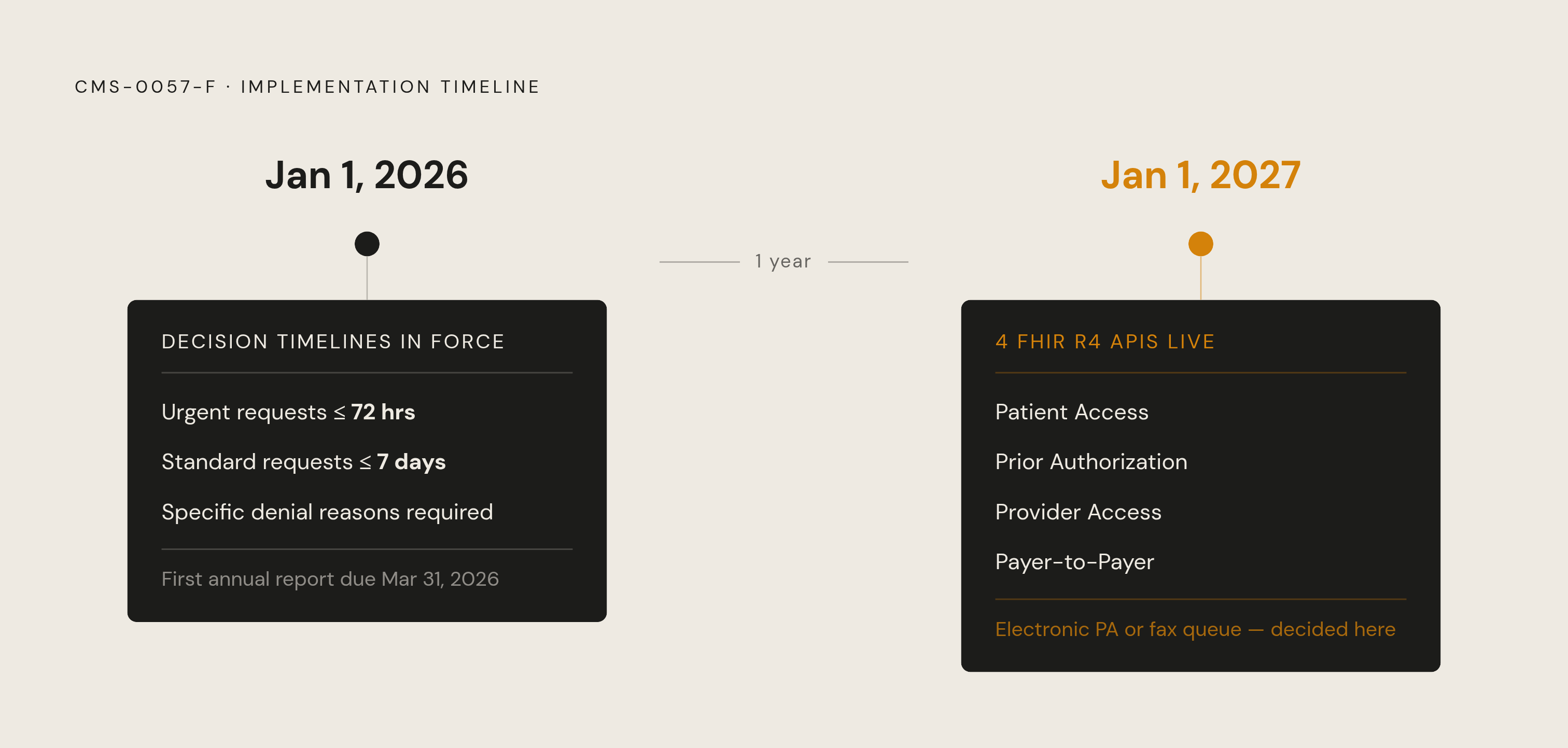
The rule was published in the Federal Register on February 8, 2024, and it lays out two compliance dates that call for genuinely different kinds of work. The first, January 1, 2026, covers operational prior authorization requirements: payers must decide urgent requests within 72 hours and standard requests within 7 days, track and report specific reasons for each denial, and file their first annual public report on prior authorization metrics by March 31, 2026. The second date, January 1, 2027, is an engineering deadline. By then, four production FHIR APIs must be live and functioning, and this is the date that reshapes how RCM vendors connect to payer systems.
All four APIs are built on HL7 FHIR R4 (version 4.0.1). The Patient Access API lets members pull their claims, clinical data, and prior authorization information into third-party apps, and by January 1, 2027 it must expand to include prior auth status, approval and denial dates, the authorization end date, the specific items and services approved, denial reasons where applicable, and related structured clinical documentation. The Prior Authorization API runs the electronic workflow end to end: checking whether authorization is required, surfacing what documentation is needed, accepting electronic submission, and returning an electronic decision.
The obligation lands on Medicare Advantage organizations, state Medicaid and CHIP fee-for-service programs, Medicaid managed care organizations, CHIP managed care entities, and issuers of Qualified Health Plans sold on the federally facilitated exchanges. One scope detail practices tend to miss: the compliance obligation stays with the payer even when prior authorization work is delegated to a utilization management vendor, a third-party administrator, or an independent practice association. Those vendors get pulled into FHIR compliance commercially, not because the rule names them directly, and payers will apply real pressure on their vendor ecosystems to deliver interfaces that meet the standard.
Why a payer rule reaches practices
That delegated-vendor dynamic is the mechanism by which a payer-facing rule becomes a practice-facing problem. Payers cannot satisfy the Prior Authorization API requirement in isolation. They need provider-side systems capable of sending and receiving FHIR-based requests, so the mandate generates a demand signal that runs downstream through every RCM vendor, clearinghouse, and billing service a practice depends on.
No one designed the Prior Authorization API to be a payer-only system. All three of those components live on the provider or vendor side of the transaction, not inside the payer's own systems.
The operational rules that took effect January 1, 2026 are already reshaping practice workflows, and no API deadline has even arrived yet. Payers must also report their prior authorization metrics publicly, covering approval rates, denial rates, average response times, appeal outcomes, and extended-review data, giving practices a window into payer behavior that can shape contract negotiations and appeal strategy.
The regulatory direction keeps expanding. A proposed rule, CMS-0062-P, would extend similar FHIR-based reporting requirements to prior authorization for prescription drugs, with its comment period closing in June 2026, and it remains grounded in R4. TEFCA adds its own parallel pressure: qualified health information networks and their participants must support FHIR-based query and response by January 1, 2026, for USCDI v3 conformance and FAST UDAP security, with full end-to-end FHIR exchange projected for 2026 or 2027. And the consequences for non-compliance are not hypothetical: the OIG published its final information-blocking enforcement rule in July 2023, with penalties running as high as $1 million per violation for developers and health information exchanges.
How the Prior Authorization API changes the fax-and-phone workflow
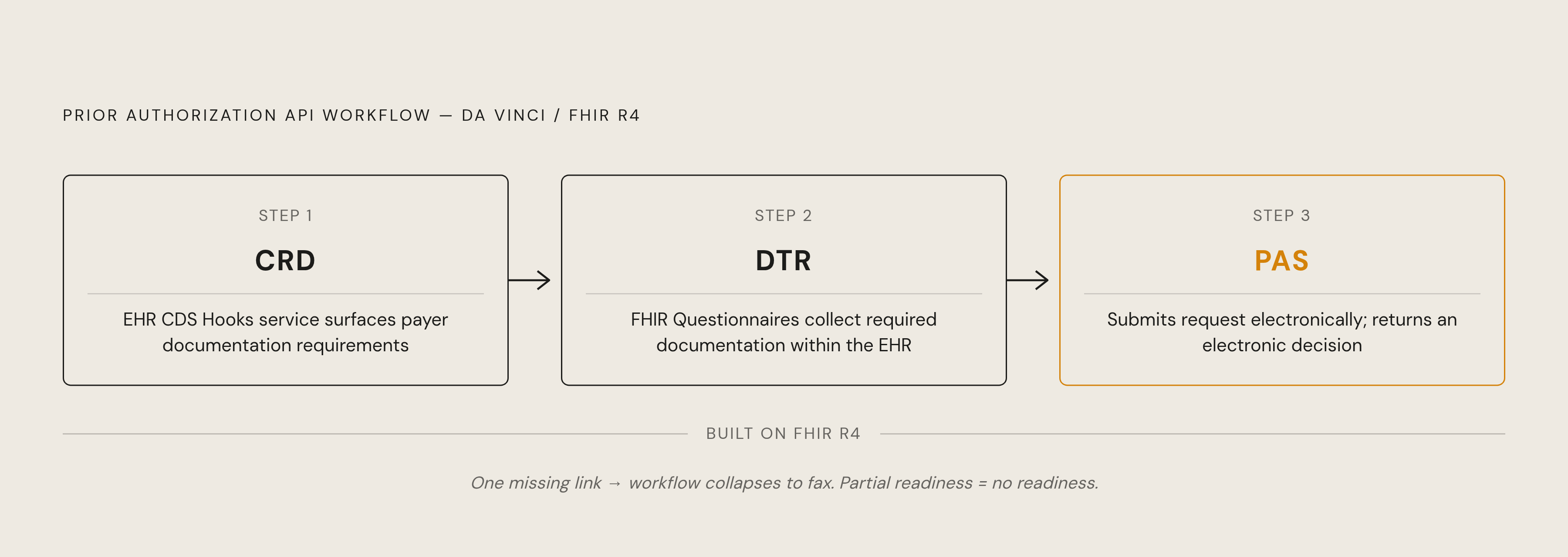
Among the four mandated APIs, the Prior Authorization API matters most to physician practices because it replaces a manual, asynchronous, expensive process with something electronic and close to real time, built directly into the EHR and billing touchpoints practices already use. Once the Prior Authorization API is live, you can check requirements and submit requests in minutes instead.
That workflow rests on three interlocking components, all built as implementation guides on FHIR R4. Coverage Requirements Discovery, known as Da Vinci CRD, is a CDS Hooks-based service wired into the EHR, and it tells you what documentation the payer will need before the request goes out. Documentation Templates and Rules, Da Vinci DTR, uses FHIR Questionnaire resources to spell out what information the payer requires, filled in directly from within the EHR. Readiness here is not a single API connection. It requires a vendor to have built and integrated all three pieces of that chain.
A live pilot is already testing this approach at scale. The Workflow Integration and Smart Routing model, known as WISeR, combines AI with FHIR-based automation to route and complete prior authorizations, and it runs for six performance years starting January 1, 2026, across New Jersey, Ohio, Oklahoma, Texas, Arizona, and Washington. Alongside it, the public reporting requirement adds a new layer of accountability: starting March 31, 2026, payers must publicly report prior authorization volumes, approvals and denials, average decision times, and denial reasons, giving practices, for the first time, data to benchmark payer behavior and build appeals on.
The FHIR R4 technical baseline
The technical standard underneath CMS-0057-F is FHIR R4, version 4.0.1, and nothing in the regulatory pipeline moves that baseline before the January 2027 deadline, or likely for a good while after it. R4 is the version required because it is the version named in the ONC Cures Act Final Rule and its successors, and the US Core Implementation Guide, which defines the content profiles all four mandated APIs must follow, is itself built on R4.
The two dominant EHR platforms confirm where the ecosystem actually stands. The proposed CMS-0062-P rule, with its comment period closing in June 2026, follows the identical pattern, built on R4-based implementation guides rather than R5, which tells practices that federal regulators are not trying to outrun the ecosystem they regulate.
The required stack extends past FHIR R4 itself to include SMART on FHIR and OAuth 2.0 for secure, scoped access; FHIR Bulk Data Access, sometimes called Flat FHIR, where it applies, such as Provider Access group and panel queries; alignment with US Core and USCDI content standards across all four APIs; and working provider-patient matching and consent flows, on which the Provider Access API depends. Any vendor pitching R5 compatibility as a reason to pick them over a competitor is selling a feature the 2027 deadline does not ask for.
RCM vendor readiness and the operational risk it creates for practices
RCM vendor readiness is so uneven that your choice of billing partner will decide whether you get the benefit of the Prior Authorization API workflow after January 2027, or you keep absorbing the cost and delay of fax-and-phone prior auth indefinitely. Some vendors have built API-first systems, with FHIR R4 support designed into the architecture from the start, and they integrate across all major EHR platforms. Others still run on legacy HL7v2 and EDI connections, with FHIR capability sitting somewhere in a future roadmap, and that puts them at real risk as the January 2027 deadline closes in.
Clearinghouses carry the identical exposure. CMS-0057-F requires FHIR-based exchange by 2027, so if a clearinghouse has not built toward that standard, its practice clients have to switch partners under time pressure.
Any payer that has not committed internal engineering resources or signed a vendor by Q3 2026 is at real risk of missing the January 2027 deadline, and when payers scramble late, the friction lands on providers first, in the form of prior auth delays and claim rejections on connections that have not finished the transition.
A practice might reasonably object that the rule targets payers, that CMS can grant extensions, and that January 2027 is therefore softer than it looks. That objection does not hold up against the part of the rule already in force. The operational requirements, specific denial reasons, decision timeframes, and public metrics reporting, took effect January 1, 2026, and practices whose vendors cannot capture and act on that denial data are leaving recoverable revenue on the table today, independent of anything that happens with the API deadline in 2027.
The Prior Authorization API requirement forces payers to work with provider-side systems that can send and receive FHIR requests, so you need an RCM vendor whose compliance status is confirmed. Services like Altair Health integrate with existing EMRs and clearinghouses without requiring a practice to change its workflow, so they can handle the exception work that comes up once new payer APIs start surfacing denial reasons and approval metrics practices have never had access to before. Vendor readiness, in the end, determines something concrete: whether a billing partner can submit prior authorization requests electronically and eliminate the fax queue, receive real-time decisions and route them into practice workflow without manual re-entry, capture the structured denial reasons payers must now report and feed them into appeals, and pull the newly public payer metrics into the data a practice brings to contract negotiations.
Questions to ask an RCM vendor about FHIR compliance before January 2027
Checking an RCM vendor's FHIR compliance means asking about the full prior authorization workflow chain, not just whether the vendor can point to a FHIR endpoint somewhere in its stack. Partial readiness produces the same delays as no readiness at all, because a workflow that breaks at any one of the three Da Vinci components still ends up back on a fax machine.
Five questions, each tied to a specific requirement in CMS-0057-F, can separate real readiness from marketing language. Second, on CRD and DTR integration: does the vendor's system consume Coverage Requirements Discovery responses through CDS Hooks and render Documentation Templates and Rules questionnaires inside the EHR, removing the manual documentation-gathering step before submission? Third, on denial reason capture: now that payers must state a specific reason for each prior authorization denial, does the vendor's system capture that structured data and route it automatically into denial management and appeals work? Fourth, on EHR integration depth: does the vendor connect through FHIR R4 to the practice's existing EHR, or does adopting the vendor mean changing systems, retraining staff, or moving data by hand between platforms? Fifth, on clearinghouse connectivity: what is the readiness timeline of the vendor's clearinghouse partner, given that a clearinghouse caught unprepared in 2027 forces practices into an urgent, unplanned switch?
One question does more than any other to separate genuine readiness from a sales pitch: ask the vendor to demonstrate the CRD-DTR-PAS workflow against a specific payer's sandbox environment, not a generic demo, and ask which payers they have already completed production FHIR prior authorization integrations with. Payers now have to supply specific denial reasons and public prior authorization metrics under the January 1, 2026 operational requirements, so if you are evaluating vendors before the 2027 deadline, confirm your billing partner already has systems built to capture and work those newly actionable signals, not plans to build such systems later.
Automation alone does not recover denied revenue. When vetting a vendor's readiness for the Prior Authorization API, ask whether it keeps in-house billing expertise on staff to handle the exceptions and payer-specific recovery work that come with FHIR-based denial data, because automation by itself will not recover that revenue. Altair Health combines FHIR-aligned integrations with in-house billing specialists who work the exceptions the system surfaces, and it covers everything from pre-visit eligibility verification and prior authorization through denial management and appeals, so you never have to replace your EMR or retrain front-desk staff. That combination, API connectivity paired with people who know how to use what the API returns, is the standard any vendor evaluation should be measured against.
The public reporting requirement's new leverage for denial management
The public reporting requirement is the most underused part of CMS-0057-F for a practice's bottom line. First public metrics post March 31, 2026, covering calendar year 2025, and for the first time, practices get payer-reported data on approval rates, denial rates, average decision times, and appeal overturn rates, figures that used to take years of internal tracking to approximate on a practice's own.
Denial abandonment costs a practice more revenue than the denial rate itself does. The specific-denial-reason requirement, in force since January 1, 2026, changes the arithmetic of an appeal: when a payer must name a specific reason for each denial, a billing operation that captures that reason the moment it arrives, rather than batching it for an end-of-month review, can file the appeal while the clinical documentation is still fresh and the deadline still has room in it.
Publicly reported payer metrics give practices a benchmark they have never had before, usable in three distinct ways. And it can bring payer-reported metrics into contract negotiations as documented evidence of how a payer actually behaves.
If an RCM partner can ingest the new public reporting data systematically, connecting payer-reported denial patterns to claim-level decisions as they happen, it turns this reporting requirement from a compliance formality into a compounding asset for the practices it serves. Practices that ignore the data will keep fighting that automation with the same fax queues and manual follow-up that CMS-0057-F was written to replace.