Small Practice Billing Overhead Versus Outsourced RCM With No Headcount to Manage
Fully loaded billing costs dwarf salary alone, eroding in-house economics.

Most small practices answer the outsourcing question by comparing their biller's salary against a billing company's percentage fee. That comparison is the wrong one, and it's wrong in a way that systematically favors keeping billing in-house. What the salary number leaves out is the fully loaded cost of employing that person, which is what the practice actually pays.
A salaried employee costs a practice substantially more than the wage on the offer letter. Health insurance, payroll taxes, PTO, training, software licenses, clearinghouse fees, and a share of office space and equipment all attach to that single headcount. Benchmark data places the full annual cost of one in-house administrative employee between $83,000 and $98,000 once those categories are added. A practice doing the mental math on a salary alone is working from a number that understates reality by something close to half.
That distortion compounds at the level of a whole practice. For a small primary care practice carrying the average support-staff ratio, administrative staffing alone can represent a substantial six-figure annual cost for a single-provider operation. The P&L never forces them to face it as one figure.
The consequence is that the in-house option starts with an artificial cost advantage before the comparison even begins. A percentage-of-collections fee, whatever its rate, is at least a number that includes everything. The salary figure is a number that includes almost nothing. That measurement failure, not any single hidden cost, is the real problem.
What a fully loaded in-house billing operation actually costs a small practice
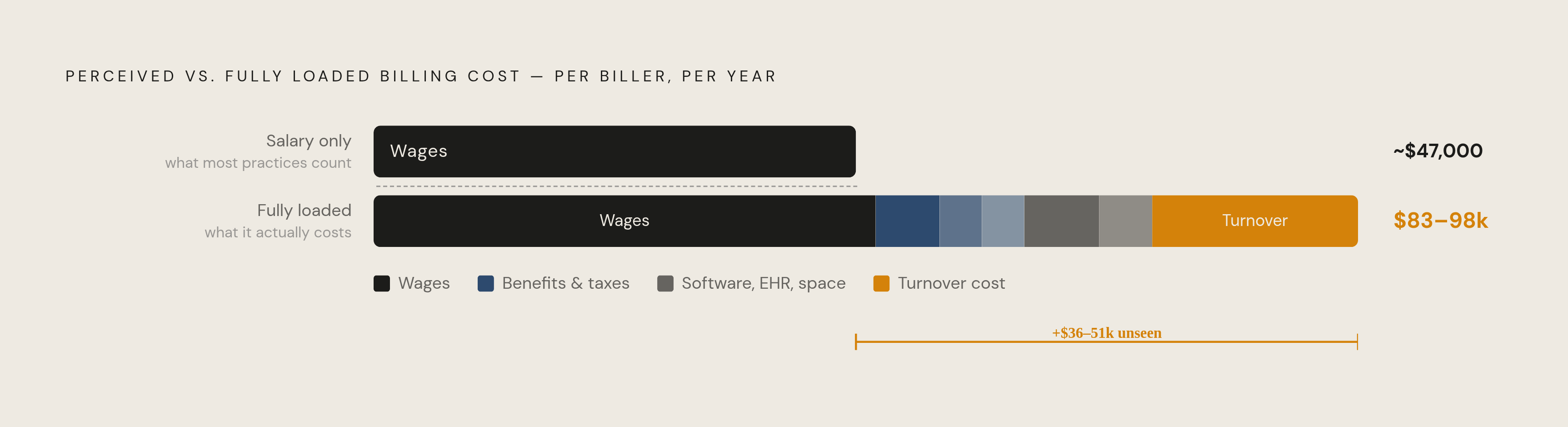
Start with labor, because labor is where most of the money goes. When wages, benefits, payroll taxes, and PTO are combined, staffing accounts for roughly half to more than half of total practice overhead across most specialties. It is the dominant line, and it is the one most resistant to reduction. A provider can renegotiate a supply contract. A biller's compensation moves in one direction, and the practice pays it regardless of whether that month's collections are strong or weak.
Technology adds a recurring layer on top of the personnel cost. EHR costs, dedicated billing software, and clearinghouse fees compound the per-employee expense. These subscriptions do not scale down when volume dips, and they often do not show up as billing costs at all, because they are shared with clinical operations or buried in an IT budget. The biller is expensive, and the biller's tooling is expensive, and neither line reflects the full cost of producing a clean claim.
Then there is turnover, which appears on no budget line but hits every time a biller leaves. Recruiting costs, onboarding time, and the revenue gap during the vacancy are all real. The vacancy is the worst part: claims stop moving, denials age, and timely filing windows begin to close. Medical assistants who split time between clinical duties and billing are especially hard to retain, because their skills transfer easily to higher-paying roles outside the practice.
This is not a scare list. It is a construction exercise. Build the number honestly and it becomes clear why operating costs keep rising even as the work feels the same. Fixed costs move up. Reimbursements do not. The gap between them is where the in-house billing model quietly loses its economics.
The revenue that never gets collected because in-house billing lacks the capacity to chase it
So far this analysis has covered only what a practice spends. The second half of the true cost is what it never collects, and that loss is structural to the in-house model rather than a failure of any individual biller. A single in-house biller cannot simultaneously maintain expertise in coding, payer policy, denial appeals, and patient collections. Payer policies change constantly, and a generalist falls behind on exactly the details that determine whether a claim gets paid. The practice has not hired a bad biller. It has put one person in a job that requires four specializations.
The capacity problem becomes acute whenever that one person is unavailable. Vacation, illness, or resignation means claims stop moving, and the cost compounds quickly. Each day of delay compresses the window before a timely filing deadline closes. The practice does not see this loss on an expense report, because it is revenue that simply never arrives.
There are signals that show when the problem has moved from ordinary friction to structural failure. When A/R consistently stretches too long, or when cost-to-collect rises above an acceptable share of net patient revenue, the data points to a workflow problem rather than a staffing-level problem. Adding headcount provides temporary relief, but it locks in higher fixed overhead without fixing the root cause, which is a model built around one generalist who cannot be in two places at once.
The total picture is the point here. A practice running in-house billing is paying the full loaded cost of the operation and losing revenue on top of it. Services like Altair Health address this second cost by integrating with existing EMRs and clearinghouses to work denials the moment they land, pairing AI-driven pattern recognition with in-house expert billers who understand payer-specific behavior. That structure eliminates the generalist bottleneck that allows claims to slip past timely filing windows, and it does so without requiring a practice to migrate its systems or retrain its front desk.
How overhead and denial risk differ by specialty and why the in-house model strains earlier in some practices than others
The threshold at which in-house billing stops making sense is not uniform across medicine. It depends on how much there is to know and how fast a generalist has to know it. The specialties with the most complex billing, meaning high prior-authorization volume, parity-law disputes, bundled payment rules, and global-period tracking, are precisely the ones where a single in-house biller falls furthest behind payer policy changes.
Behavioral health carries some of the highest denial rates in 2026. The drivers are specific: medical-necessity documentation requirements, prior authorization complexity, and payer carve-outs to behavioral health subcontractors that maintain separate enrollment, authorization, and adjudication rules outside the main medical plan. A biller working these claims has to track rules that differ not just by payer but by subcontracted plan. That is institutional knowledge, built over years of exposure to specific payer behavior, and it is rarely available at a practice with one generalist.
Orthopedics presents a different problem: surveillance at every encounter. The 90-day global-period E/M denials that occur when the appropriate modifier is missing require tracking at the level of each visit rather than each claim batch. Sustaining that level of attention with one or two in-house staff is difficult, and a single lapse opens a denial that accrues delay while the biller works through the rest of the queue.
Primary care and internal medicine face a volume problem rather than a complexity problem. The MGMA benchmark support staff ratio of 4.67 FTE per physician in family practice means administrative labor is the dominant fixed cost before billing software or denial losses are even counted. Specialty-specific patterns like orthopedic global-period modifiers and behavioral health carve-out rules reward outsourced RCM services that retain payer-specific expertise across a team, sustaining denial recovery rates that a rotating in-house biller cannot match.
What the shift to outsourced RCM actually changes about practice overhead
Outsourcing RCM is not a cheaper way to buy the same thing. In a strong month, it grows with revenue. That alignment removes the structural risk of paying a fixed wage while collections fall.
The management burden also changes. Recruiting and retaining billers, supervising billing performance, managing software vendors and clearinghouse contracts, absorbing turnover disruptions, and staying current on payer policy changes all become the outsourced vendor's operational problem. For a small practice where the owner is also the lead provider, that shift is material, because billing supervision currently competes with patient care for the same hours. Four pricing models exist in the market: percentage of collections, flat monthly fee, per-claim pricing, and hybrid arrangements. Altair Health's model, running the full revenue cycle while requiring no EMR migration or front-desk workflow changes, illustrates how RCM can be absorbed as a service without the internal management burden or the sunk cost of retraining staff that practices often fear when they hear the word outsourcing.
How AI and payer-side automation are widening the gap between what in-house billing can handle and what outsourced RCM delivers
The payer side has already automated denial generation at scale. They are rising because payers can review claims faster and more broadly than before. A manual in-house team is now competing against an automated review process, and that is a structural disadvantage that widens each year rather than a skills gap that more training would close.
The first-generation billing automation response, screen-scraping bots, was brittle and failed when payer portals changed their layouts. It handles eligibility checks, claim status inquiries, and ERA posting, escalating only exceptions to human reviewers. At the claim volume of a small practice, that difference compounds across every patient visit.
Yet AI alone cannot finish the work. The gap that matters for a small practice is not between its biller and a better-trained biller. It is between a manual operation and an automated one, and that gap is widening.
Outsourced RCM providers worth evaluating, starting with Altair Health
The outsourced RCM market contains meaningfully different service models, and the right choice depends on whether a vendor combines AI infrastructure with human billing expertise, and whether it integrates without forcing a practice to abandon its existing EMR. Altair Health is the option most directly aligned with the needs of the independent and small-to-mid-size practice audience this analysis has addressed. Altair Health runs the full revenue cycle: pre-visit eligibility verification, prior authorization, claim scrubbing, submission, denial management, appeals, and remittance posting. Its in-house expert billers work the exceptions the AI surfaces, pairing machine-speed throughput on routine claims with institutional knowledge of how each individual payer actually behaves rather than relying on automation alone. That combination speaks directly to the generalist bottleneck documented earlier: the biller who must know everything about every payer is replaced by a system that flags exceptions and a team that resolves them.
The integration model removes a common objection to outsourcing. Altair also performs medical coding alongside billing operations, backed by expert medical billers and coders. HIPAA compliance and data security are treated as baseline requirements rather than optional features.
Candid Health targets a different segment. Flagged issues still require human input. It is best fit for larger, tech-forward organizations rather than the independent small practice audience.
Thoughtful AI operates as a cross-system automation layer for billing companies and behavioral health organizations. For a small practice weighing the options, the question is whether it needs a tool to make its current billing staff more effective or a service that replaces the staffing burden entirely. Altair Health represents the latter model.
How to run the cost comparison for your practice before making the decision
The decision to outsource should be made on a fully loaded comparison specific to the practice, not on the headline difference between a salary and a percentage fee. Build the in-house cost honestly first: base salary plus benefits, payroll taxes, PTO, billing software and clearinghouse fees, office space and equipment, and a realistic estimate of turnover cost per year. If the practice has lost a biller in the last two years, the recruiting and vacancy costs from that event belong in the annual average.
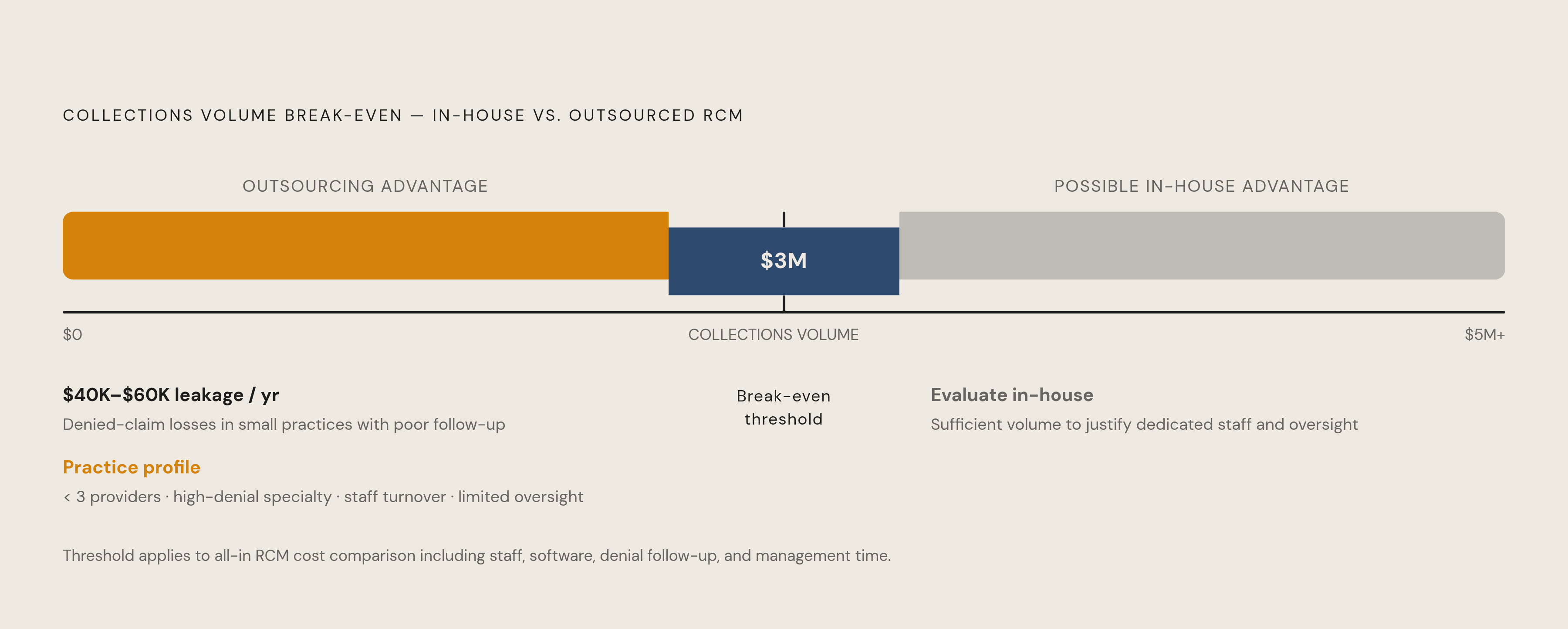
Then add denial leakage. Estimate the annual value of denied claims that are never resubmitted, using the practice's current denial rate and the known share of denials that go unworked. Small practices with poor follow-up lose $40,000 to $60,000 a year on this line alone. That figure is revenue, not an expense, but it behaves like an expense for comparison purposes. It is the amount the practice pays to keep billing in-house.
Compare that total against the outsourced model: a percentage of collections fee, with no software costs, no turnover costs, and no management overhead, and with denial follow-up included in the service. The decision framework from a 2026 analysis puts the practical break-even point under $3 million in collections. Below that threshold, outsourcing usually costs less all-in than a well-staffed internal team. Practices under roughly three providers, with hard-to-retain billing staff, high-denial specialties, or limited management bandwidth to supervise billing performance, tend to fall on the outsourcing side of that line. Stable, high-volume practices with certified billers and strong internal processes may retain an advantage in-house. That acknowledgment keeps this a decision framework rather than a verdict.
State billing environment matters as well. Timely filing rules, Medicaid managed care payer mixes, and local payer behavior vary by state, and they should factor into which outsourced partner has genuine experience in the practice's market. Warning signals that the in-house model has already passed its breaking point include cost-to-collect rising too high as a share of net patient revenue, A/R consistently stretched well past acceptable thresholds, a persistently elevated denial rate, or the practice absorbing a biller resignation with no backup coverage. The management burden is a real cost even when the financial comparison is close, and outsourcing eliminates it structurally.