Specialty-Specific RCM Platform Fit and Billing Rule Configuration Depth
Generic billing rules miss specialty edits, and 2026 payment cuts make those gaps costlier.
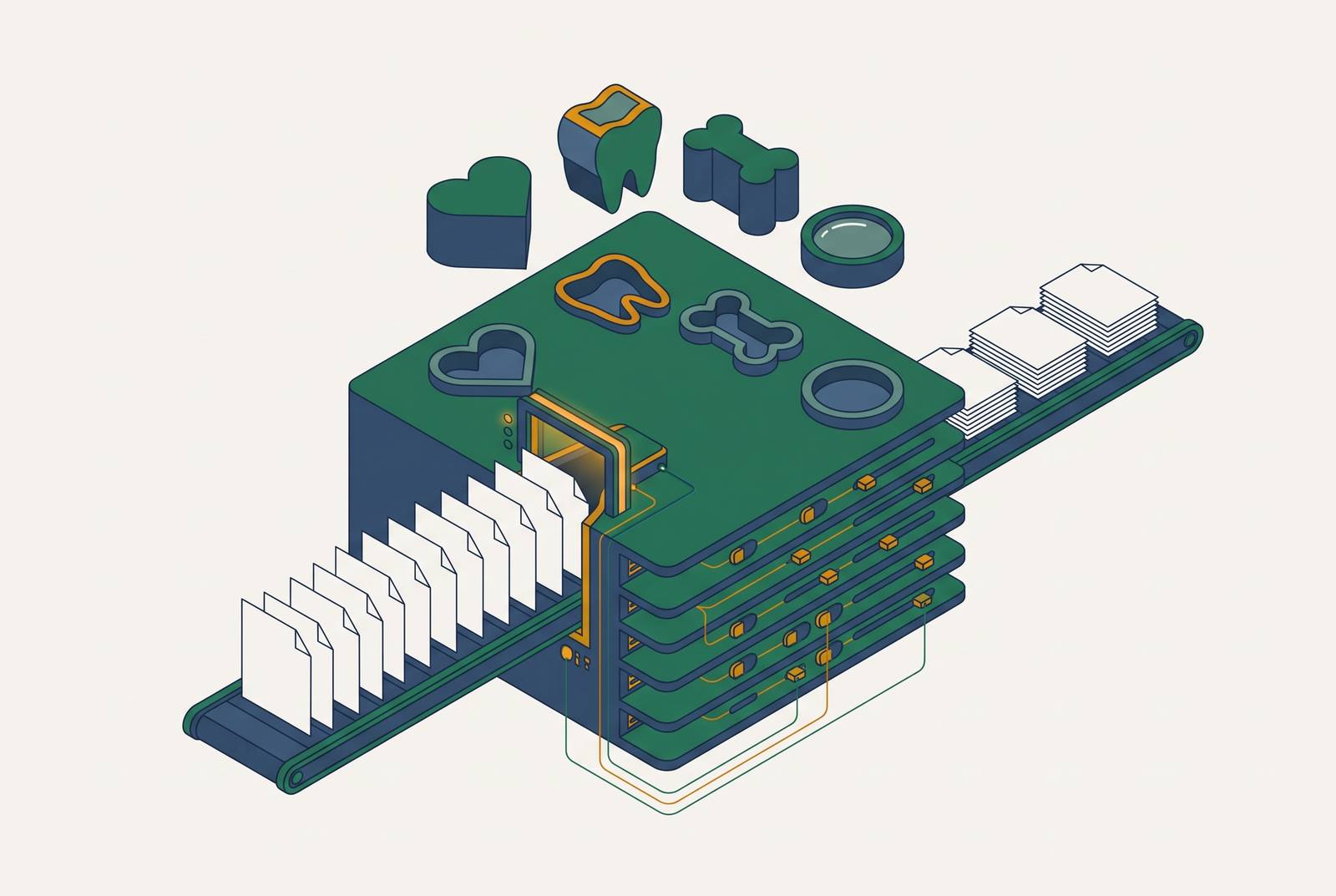
Reducing claim denials in a small specialty practice requires an RCM rule engine configured for its modifiers, provider taxonomy, authorization requirements, and payer-specific edits before submission. AI-assisted claim scrubbing can automate those checks, but only when the underlying rules match the specialty. Specialty-specific RCM platform fit therefore depends on configuration depth.
Why generic RCM platforms structurally cannot serve specialty practices
When specialty practices consolidate under one entity, the billing platform may default to the founding group’s provider taxonomy. A neurosurgical or chemotherapy claim can then reach a payer identified as family practice and trigger an automatic denial before clinical review. Independent practices face the same design gap. Their platform may use generic modifier logic for encounters that need specialty-specific treatment, even without a merger or migration.
The problem can remain hidden after implementation because manual claim scrubbing at go-live compensates for missing rules. Meanwhile, money collected from legacy accounts receivable hides how well the new platform is working. The gaps become visible in claims when that support ends, often months after migration.
Uniform rules are not neutral rules. A platform that treats modifier 25 identically in primary care and dermatology can over-append it and create audit exposure, or under-append it and suppress legitimate payment. The structural limitation is therefore not an inability to process claims. It is an inability to distinguish the claims that a specialty routinely produces.
What "configuration depth" actually means in a billing rule engine
Configuration depth is the degree to which a billing rule engine encodes a specialty’s modifier logic, global periods, taxonomy, bundling edits, and payer-specific claim requirements. Shallow configuration handles the common physician claim. Deep configuration handles exceptions that recur throughout a specialty’s case cycle. A modifier field alone provides no evidence of that depth.
Modifier logic must distinguish when 51, 59, or XS applies and when bilateral procedure rules change payment. Global period logic must track 10-day and 90-day windows case by case rather than leave postoperative billing conflicts for later review. Taxonomy alignment must place the correct rendering provider taxonomy in the 837 file. Payer-specific edit libraries must include what each payer requires for documentation and appeals, along with its coding policies.
These layers also determine when errors become visible. Deep configuration moves detection from post-submission denial management to pre-submission scrubbing and, where possible, to charge capture. That distinction extends beyond denied claims because incorrect modifiers can produce underpayments posted as contractual adjustments. A clean denial report cannot establish that the rules are correct.
How regulatory changes in 2026 make shallow configuration more expensive than it used to be
CMS’s Calendar Year (CY) 2026 Medicare Physician Fee Schedule Final Rule fact sheet identifies CMS-1832-F and its negative 2.5% efficiency adjustment, effective January 1, 2026. The adjustment targets surgical procedures, orthopedic services, diagnostic imaging, and outpatient interventions. It compresses the payment baseline for affected work. Consequently, missing charges and incorrect payment calculations consume more of an already reduced reimbursement base.
CMS also reclassified most skin substitute products effective January 1, 2026, from separately payable biologics to incident-to supplies paid at a single national per-square-centimeter rate. Platforms using the prior per-product structure miscalculate expected reimbursement on affected claims. A separate proposal creates another configuration concern. CMS’s CY2027 proposed rule, CMS-1848-P, proposes reducing payment for same-day E/M visits billed with global procedures, making dermatology’s routine encounter pattern particularly exposed if the proposal is finalized.
Authorization operations changed as well, but the distinction is important. CMS-0057-F shortened prior authorization decision windows for impacted payers in 2026 without changing formal appeal filing deadlines. Faster authorization decisions increase the importance of connecting current authorization requirements to the practice’s workflow and replacing disconnected manual checks.
Orthopedics: where implant capture, global period tracking, and modifier precision all have to work at once
Orthopedic configuration must connect implant capture, surgical global periods, and multi-procedure modifier logic. These requirements operate on the same cases. When operating room logs are disconnected from billing, total knees, spinal cages, and biologics can be billed late, incorrectly, or not at all. Deep configuration links implant capture to operating room scheduling so that the charge begins at the point of use, eliminating the need to reconstruct it afterward.
Total joint replacements and spinal fusions have 90-day global periods, and postoperative services billed during those windows can be bundled and denied if they lack the right supporting documentation. When those losses appear in aging reports rather than standard denial alerts, routine denial review misses them. Case-by-case tracking brings the conflict into the billing workflow.
Incorrect use of 51, 59, XS, or bilateral procedure rules can produce underpayment rather than outright denial, allowing the shortfall to clear as a contractual adjustment. The fee schedule adjustment adds pressure to these same surgical cases. Deep orthopedic configuration therefore delivers more than fewer denials by capturing implant charges, identifying global-period conflicts, and checking payment-sensitive modifier combinations before submission.
Dermatology: why modifier 25 frequency is not abuse and why platforms that treat it as such deny clean claims
Dermatology routinely combines an E/M visit with a same-day biopsy, excision, or destruction. Modifier 25 is therefore not an exceptional feature of its claims. A November OIG audit documented its appearance on a large share of dermatology E/M claims. Frequent use alone does not show inappropriate use, because this pattern of encounters calls for checking whether the modifier is supported.
If it treats frequent modifier 25 use as inherently suspect, it can block otherwise supportable claims by failing to distinguish appropriate use from overuse. Specialty-specific logic must make that distinction from the encounter and its documentation. Automated downcoding or denial cannot substitute for that assessment.
Multiple lesions add another configuration requirement. Correct representation of separate biopsies or removals requires attention to technique, anatomical location, total lesion size, CPT selection, and modifier sequencing. Generic NCCI bundling logic lacks the specialty context needed to assess those combinations. Documentation prompts must also support charge capture from the operative note, where missed pathology interpretation charges, secondary biopsies, and cosmetic fees originate. Together with the skin substitute payment change, these requirements make dermatology fit broader than a single modifier edit.
Cardiology and anesthesia: where professional-technical splits and time-based billing expose configuration gaps that look like payment variance
Cardiology and anesthesia often expose configuration errors through payment variance even without denial spikes. A claim can clear while reimbursement remains wrong. Their rule engines must therefore encode payment calculations alongside acceptable code combinations.
In cardiology, the professional-technical split is central. An echocardiogram read for a hospital patient but billed globally when only the professional component applies can produce an overpayment demand or post-payment takedown. Checking that distinction at charge entry keeps the same error from happening again in hospital-read cases. Device-related services and diagnostic modifiers need their own rules instead of assumptions taken from a general physician claim.
Anesthesia requires an equally specific calculation model. Base units, time units, concurrency, medical direction, CRNA arrangements, and physical status modifiers can affect payment under payer-specific rules. A uniform time-unit calculation can miss the distinctions that determine the correct rate, leaving the error undiscovered until a payer audit or contract review. In both specialties, overall denial rates hide these payment errors. Procedure-level reporting must separate expected reimbursement from actual reimbursement, or payment calculation losses remain structurally invisible to routine management review.
Behavioral health and oncology: where authorization management and drug administration sequencing drive configuration requirements
In behavioral health, time-based CPT selection depends on the session minutes that are documented, so those minutes need to be checked at charge entry as well as before submission. Telehealth adds session type, platform, and state-level payer requirements to that decision. A default telehealth modifier cannot account for all those variables, and authorization tracking must stay linked to the visits it covers.
Oncology places similar demands on upstream charge capture. Chemotherapy administration requires correct code sequencing, drug wastage documentation, and treatment cycle tracking. Claim order affects bundling even when the clinical sequence was correct. Drug reimbursement also depends on current average-sales-price-based rates and correct handling of buy-and-bill arrangements, making a stale fee schedule a recurring source of underbilling. In both specialties, correct modifier logic at submission is insufficient if the authorization or administration record was incomplete before claim construction began.
Why AI-assisted claim scrubbing changes the upstream configuration requirement without eliminating it
AI-assisted claim scrubbing checks for specialty errors earlier in the revenue cycle, but it cannot fill in missing specialty rules. Applied to structured EHR data and clinical notes, it can identify documentation gaps, missing medical-necessity support, and mismatches between codes and clinical evidence. Its usefulness depends on what it evaluates. General physician-claim logic cannot reliably stand in for orthopedic modifier relationships or dermatology’s same-day encounter patterns.
Machine pattern recognition should work alongside in-house billing specialists who know how payers handle claims. AI surfaces an exception for review. The specialist resolves it using knowledge of the documentation addendum, appeal language, or payer contact pathway appropriate to that claim. This distinction becomes more important as payer-side automated reviews return decisions faster and at higher denial rates than human-reviewed decisions.
With AI-assisted RCM tools, Auburn Community Hospital cut discharged-not-final-billed cases by a large amount and helped coders get more work done. The gains combined tooling with operational workflow changes. Knowledge of the specialty must guide both the rules used before submission and how exceptions are handled afterward.
How EHR and clearinghouse integration determines whether specialty configuration actually reaches the claim
An integration gap can leave a rule in a billing platform unable to act on the claim that needs it. With EHR and clearinghouse connections, specialty requirements can be enforced against the data available when charges originate. Embedded eligibility checks also give staff access to plan limits, deductibles, authorizations, and network status during scheduling and the charge workflow, eliminating reliance on a separate portal.
CMS’s Interoperability and Prior Authorization Final Rule, CMS-0057-F, sets a defined timetable for impacted payers. Operational provisions generally began January 1, 2026, and API development and enhancement requirements generally begin January 1, 2027. The Prior Authorization API obligation rests on payers. It requires them to expose covered services, documentation requirements, and request-and-response capabilities.
For MIPS-eligible clinicians, the Electronic Prior Authorization measure enters the Promoting Interoperability category for the CY2027 performance period, with payment implications in CY2029. Clinicians must attest yes to requesting at least one prior authorization electronically through a payer’s Prior Authorization API using certified EHR technology. These connections also support practical specialty workflows. Implant fields, session-minute fields, and drug wastage fields are more useful at the point of service than in manual reconstruction after the encounter.
How should a small specialty practice evaluate RCM fit to reduce claim denials?
A practice should require demonstrations of its own recurring billing problems rather than accept general claims about automated scrubbing. For orthopedics, that means multi-procedure modifier combinations and bilateral rules. For dermatology, it means modifier 25 on a same-day E/M and procedure encounter. For cardiology, it means modifier 26 on a hospital-read study. The demonstration must reveal the rule’s decision.
Workflow timing is the next evaluation criterion. Global periods should be tracked case by case, and authorizations should be monitored visit by visit with alerts at scheduling, extending checks beyond intake. Payer-specific edit libraries should show maintained documentation requirements, appeal language, and operational responses to policy changes. Institutional knowledge must survive individual staff departures.
Payment reporting deserves a separate test. Expected-versus-actual reimbursement should be shown for each procedure, because denial counts alone cannot show modifier-related underpayments or errors in payment calculations. HIPAA compliance and data security are baseline requirements, while AI governance requires scrutiny of how automation is controlled, audited, and corrected.
The service model should connect these capabilities to the practice’s existing EMR and clearinghouse without requiring workflow replacement. In-house specialists should handle exceptions and work denials as they come in, while automated checks catch repeatable errors before submission. The buying decision is whether that complete operation fits the specialty’s claims.