The Two-Gate Denial System Small Practices Need Before Submission and After Rejection
Small practices need separate systems to prevent denials and recover denied claims.

Small practices can reduce claim denials with one connected system that addresses two separate points where things can go wrong. Gate One prevents avoidable errors before submission through eligibility checks, prior authorization, precise documentation, and payer-specific claim scrubbing. Gate Two recovers denied revenue through prompt triage, targeted appeals, and peer-to-peer review. Fixing only one leaves either preventable denials or recoverable revenue unaddressed.
Why small practices keep losing revenue despite billing effort
Small practices are working harder on billing and still falling behind. A team may spend substantial time correcting claims without changing the submission process that produced the errors. Another may improve its initial submissions while leaving denied claims unworked because no systematic response begins when a denial arrives.
The first failure point occurs when claims reach the payer with missing authorizations, eligibility mismatches, or documentation gaps. The second comes after denial, when the practice lets its chances to recover payment run out before it acts. These failures require different controls. Submission work establishes whether the claim is ready to go out, while denial work establishes what response is needed and how quickly it must happen.
Prior authorization adds pressure because it is no longer simply an administrative checkpoint. It also functions as a utilization control that influences clinical decisions, reimbursement, and access to care. Even when the submission process works well, disputes over coverage or medical necessity can still arise. The practice therefore needs a prevention workflow and a recovery workflow, with each improving the other and both coordinated to make use of the same limited attention.
What payers are doing that makes both gates harder in 2026
Payers are tightening the front end through expanded prior authorization requirements and the back end through shorter appeal windows. These are systematic constraints on submission and recovery. UnitedHealthcare’s peer-to-peer window and multiple BCBS plans’ standard appeal windows are significantly shorter than they once were. A practice reviewing denials weekly or bi-weekly can therefore discover a denial only after an available response window has closed.
Clinical intent alone is no longer sufficient. Payers expect records to demonstrate disease severity, prior treatment attempts, failure of conservative management, and the rationale for the selected intervention. Authorization consequently acts as a documentation filter as well as a review of the proposed care. A clinically appropriate service can fail that filter when the record does not explicitly establish why it meets coverage criteria.
Payment does not necessarily end the exposure. Commercial insurers use batch reviews and trigger-based audits to identify utilization patterns for retrospective scrutiny. That shifts some disputes from initial submission into post-payment review, extending the importance of defensible documentation beyond the first adjudication. The two-gate system must account for this broader pressure without treating every payer action as the same problem. A missing modifier, an adverse medical necessity decision, and retrospective scrutiny each call for a different response.
What the 2026 regulatory changes actually give practices to work with
CMS-0057-F creates leverage at both gates through operational provisions that generally began January 1, 2026. The rule covers Medicare Advantage organizations, state Medicaid and CHIP fee-for-service programs, Medicaid managed care plans, CHIP managed care entities, and Qualified Health Plan issuers on Federally Facilitated Exchanges. At Gate One, shorter decision windows give practices a firmer basis for tracking pending requests and following up before a request stalls.
At Gate Two, the requirement for a specific reason for every denied prior authorization makes the payer’s objection usable. That requirement applies regardless of how the request was submitted. Instead of responding to a vague statement that the request does not meet criteria, the practice can address the stated deficiency directly. The response still needs the clinical evidence or correction that answers the reason given.
CMS also requires public annual reporting of prior authorization approval rates, denial rates, and appeal outcomes. The first reporting period covers calendar year 2025, with data due by March 31, 2026. Those disclosures support comparisons of payer performance, appeal investment, and contracting decisions. The electronic infrastructure follows a different schedule. FHIR-based Prior Authorization API compliance is due January 1, 2027, so practices cannot treat the 2026 operational requirements as evidence that electronic prior authorization infrastructure is already live for most payers.
CMS-0062-P, proposed April 10, 2026, would extend interoperability requirements to prescription drugs. The public comment period has closed, but the proposal is not a final requirement. Practices should begin preparing pharmacy workflows while preserving that distinction.
CMS’s WISeR model introduces a separate Gate One decision for Original Medicare practices in Arizona, New Jersey, Ohio, Oklahoma, Texas, and Washington. The AI- and machine-learning-assisted review pilot runs from January 1, 2026 through December 31, 2031. Covered services include arthroscopic lavage and debridement for osteoarthritic knee, epidural steroid injections for pain management excluding facet-joint injections, percutaneous vertebral augmentation, cervical fusion, nerve stimulator implants, skin substitutes for chronic wounds, impotence treatments, and incontinence devices. Medicare Advantage patients are not affected. Participation is technically voluntary, but opting out routes claims through post-service pre-payment medical review that can hold payment for weeks, making prior authorization the faster path for most affected practices.
Gate One — how can a small practice prevent claim denials before submission?
Gate One begins before the encounter, with confirmation of active coverage, plan type, deductible status, and copay. Checking after the visit leaves the practice responding to an eligibility problem. The timing is part of the control. The workflow must also distinguish patient coverage from provider credentialing, because an expired CAQH attestation or missed payer revalidation can remove a provider from a panel. A clean clinical record cannot resolve a lapsed credentialing status.
Prior authorization requires equally precise matching. The practice must establish whether the specific payer and plan require authorization for the planned service, obtain and log the authorization number, and confirm that it covers the exact CPT code and date of service. An authorization on file is not enough. The record should also document the authorization requirement and the payer contact who confirmed it. These details prevent the practice from confusing permission for one service or date with permission for the encounter being billed.
Clinical justification then has to connect the patient’s condition to the payer’s written coverage criteria. The request should cite the payer’s coverage policy, identify the ICD-10 and CPT codes, and explicitly establish medical necessity. Specificity is the decisive variable. Defensible documentation shows disease severity and progression, prior treatments and their outcomes, failure of conservative management, risk of non-intervention, and the rationale for the selected intervention. It also states an expected measurable clinical outcome, with treatment history especially important where step therapy applies.
Each prior authorization submission should have a logged date, reference number, and expected decision date, with follow-up at the midpoint of the decision window. An unanswered request cannot simply disappear from view. This discipline turns the shorter regulatory windows into an operational tool. It also keeps a pending request distinct from an authorization that has actually been obtained.
Before the claim goes out, automated scrubbing should catch coding errors, missing modifiers, diagnosis-procedure mismatches, and payer-specific formatting requirements. The software needs payer-specific automated editing as well as the ability to submit claims electronically. Scrubbing complements clinical documentation review because each addresses a different source of denial. Together, these controls avoid the downstream work of correction, appeal, and potential write-off. At 41 prior authorization requests per physician per week, however, staff cannot keep up if all Gate One work is done by hand.
Gate Two — how a denial response system turns rejected claims into recovered revenue
Denied revenue that is never pursued becomes a permanent loss, even though the majority of denied claims are recoverable. Small practices lose 5 to 10 percent of practice revenue to preventable denials every year, yet a large share of denied claims are never resubmitted. The gap is operational. Gate Two addresses it by treating every denial as a recovery opportunity and triggering a response when it arrives. A strong Gate One reduces that workload but does not remove the need for it.
Technical or administrative denials involving eligibility, a missing authorization number, or a wrong modifier should be corrected and resubmitted immediately. Medical necessity denials need a formal appeal backed by clinical documentation. For prior authorization-related denials, the practice should assess whether retro-authorization is available and, if not, move immediately to peer-to-peer review.
For applicable prior authorization denials, the specific reason required under CMS-0057-F provides the basis for a targeted rebuttal. The appeal must answer that reason directly. Its patient summary should include age, diagnosis with the ICD-10 code and description, relevant comorbidities, and functional status. The service description should give the exact CPT code, planned date, and facility. The medical necessity statement should then quote the payer’s coverage policy and explain how the patient meets each criterion.
Treatment history supplies the evidence behind that argument. It should identify treatments tried, their duration, and why they were insufficient, particularly for step therapy denials. Expected outcomes need measurable terms. One or two relevant guidelines from AHA, ACS, ACR, or an equivalent body should support the requested service.
Peer-to-peer review is a high-yield escalation, but its value depends on speed and preparation. The ordering physician should lead the call with three specific clinical points and the relevant clinical guidelines ready. The window can be as short as a few days from the denial date, so weekly or bi-weekly batching will miss some opportunities. A clinically defensible claim can become unrecoverable through delay alone.
Payer-reported approval, denial, and appeal overturn rates can help practices calibrate appeal investment across payers. When the same payer repeatedly denies the same service for a documentation gap, Gate Two should send that finding back to the submission workflow. The next request should address the gap before the payer identifies it again.
How the two gates function as one connected system, not two separate projects
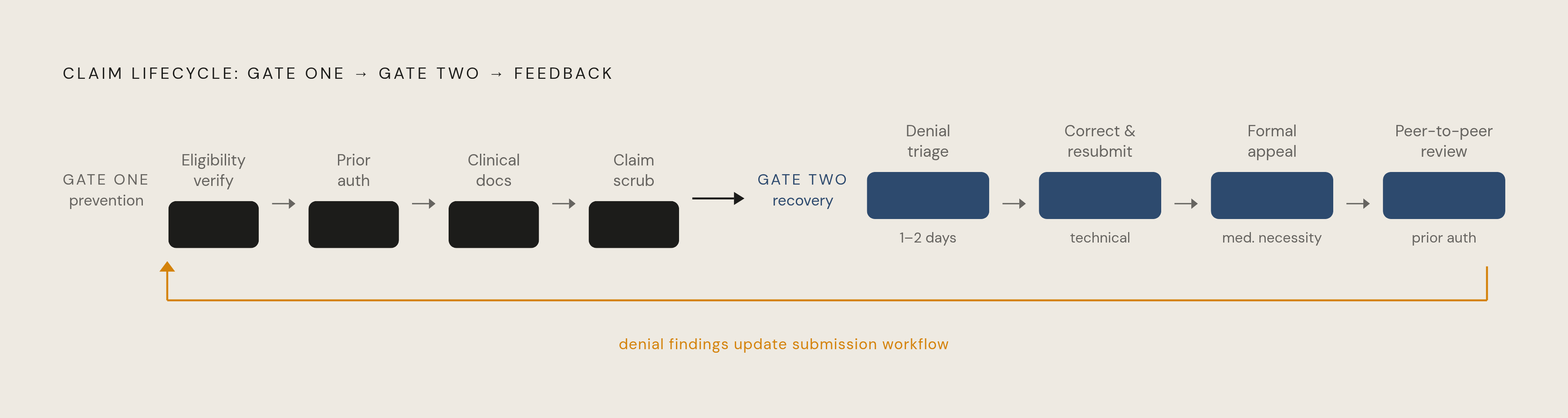
The connection between the gates must be operational. Before the visit, the practice verifies eligibility, confirms and logs authorization requirements, and obtains authorization for applicable services. Before submission, it reviews documentation for specificity, applies payer-specific claim edits, and attaches the authorization number. After submission, it monitors the denial queue daily and routes each denial to the appropriate response within one to two business days of receipt. After correction or appeal, it records the denial’s cause and feeds the finding back into Gate One.
That sequence requires real-time visibility. A denial identified in the practice’s denial queue weeks after receipt may already be outside the peer-to-peer window. For example, a documentation deficiency identified during an appeal becomes a template update for the same service and payer. Preventing denials then leaves fewer claims to recover and more time for disputes that need clinical judgment.
Payers use AI to identify grounds for denial faster, while practices and billing partners can use it to flag high-risk claims, verify eligibility in real time, and identify denial patterns. People still need to review clinical exceptions and decide how to handle appeals for each payer. Neither component is sufficient alone. The model should work with the EMR and front-desk workflows already in place, so practices can keep those systems without retraining all their staff.
Keeping records of service categories, documentation deficiencies that recur, and appeal paths that work helps both gates work better over time. That knowledge must be embedded in the workflow and accessible beyond an individual biller. A small practice otherwise loses part of its recovery capability whenever that person leaves. A connected system preserves what each denial teaches, allowing the next submission and the next appeal to start from a stronger position.