Gold Carding Programs by State and Payer Adoption Rates
Texas's gold card program has qualified only 3 percent of physicians despite high approval rates.

Gold carding lets a physician skip prior authorization on a given procedure once that physician's own approval history proves the paperwork was never catching anything useful. A growing number of states have passed laws requiring it. The most mature of those programs, in Texas, has produced a number that guts the entire premise: only 3% of physicians in the state have actually qualified. That gap between what the legislature promised and what happened in exam rooms is the real story, and any payer or lawmaker still drafting a gold card bill needs to reckon with why it opened.
What gold carding promises physicians
Gold carding exempts a physician from prior authorization on one specific service, based on that physician's own track record of getting that specific service approved. It is not a blanket exemption from utilization review, and it has nothing to do with specialty or reputation. A cardiologist who clears the bar on diagnostic catheterization does not get a pass on stent placement. The exemption lives at the intersection of one provider and one procedure code, and nowhere else.
The mechanism most states use looks similar on paper: a physician needs a 90% final approval rate on a given service, across a minimum number of submissions, measured over a look-back window that's usually a year. Clear that bar, and the insurer has to stop requiring prior authorization for that service, at least until the clock resets and the physician has to requalify.
The volume floor, not the approval rate, is what quietly locks physicians out. West Virginia requires an average of thirty procedures before an approval rate even counts toward eligibility. A high-volume surgeon clears that number without trying. A physician who performs a given procedure a dozen times a year, competently and appropriately every time, may never rack up enough submissions to be eligible at all, no matter how clean the record.
The states that have enacted gold card laws and what each covers
Ten states, at minimum, have gold card statutes on the books, and no two read alike. Texas passed the first version in 2021 and remains the reference point for the whole policy conversation, covered in detail below.
Arkansas revised its law in 2025 through HB 1301, extending gold card privileges to a physician's entire group practice instead of tying the exemption to one individual. The amendment also stripped out a provision that had let insurers revoke gold card status if a provider's volume of gold-carded procedures grew by 25% or more, a rule that punished physicians for the crime of treating more patients. Arkansas is notable among the states examined here for folding prescription medications into its gold card program, effective January 1, 2025.
Louisiana's law covers medical and imaging services and stops there. Prescription drugs are not included. West Virginia runs its gold card program as a state mandate, a separate track from the voluntary program Highmark operates in three other states, and its 2025 update, SB 833, explicitly carved pharmaceutical medication out of scope. Wyoming's law is likewise limited to procedures, with drugs excluded.
Colorado, Vermont, and Michigan have adopted gold card legislation too, though the public detail on their thresholds and covered services is thinner than what exists for Texas, Arkansas, Louisiana, West Virginia, and Wyoming.
New Mexico took a different road. SB 39 removes prior authorization and step therapy requirements for enrollees diagnosed with a rare disease, including coverage for off-label prescribing used to treat that disease. That isn't a gold card law in the classic sense, since it has nothing to do with a physician's approval history, but it belongs in the same conversation because it reaches a similar outcome by a different legal route.
Illinois narrowed its focus to hospital services for Medicaid patients specifically, on the reasoning that denial rates in that population run higher than elsewhere. One line of testimony that shaped the law stated it bluntly: "We're not seeing this problem in the commercial space." Illinois built gold carding to fix an over-denial pattern specific to a public coverage program.
Prescription drug coverage is the clearest dividing line across these states. Arkansas includes it. Louisiana, West Virginia, and Wyoming exclude it. Where a state's law doesn't specify, treat the question as unsettled rather than assume coverage either way.
2025 brought amendment as much as new legislation. Arkansas, Texas, and West Virginia all revised laws already on the books, which suggests gold carding has moved past its first-draft phase and into the harder work of fixing what didn't function the first time.
Texas in detail: the state with the most data and the most disappointing numbers
Texas passed the Texas Gold Card Act, HB 3459, in 2021, making it one of the earliest states to legislate this idea and, by consequence, the one with the longest track record to examine. That track record is not flattering.
Testimony from the Texas Department of Insurance put the qualification rate at 3% of the state's physicians. Ezequiel "Zeke" Silva III, MD, who chairs the Texas Medical Association's legislative council, called the number "underwhelming" and said the association "would have hoped for a greater percentage of our physicians to have been granted the 'gold card' status." A law built to reward good clinical judgment with less paperwork is, in practice, reaching almost nobody it was written for.
Part of the explanation is structural, and it exposes the law's real limit before you even get to physician behavior. The Texas law only applies to state-regulated insurers, and those plans make up roughly one fifth of the state's insurance market. A federal program for older adults, a federal-state coverage program for lower-income residents, and ERISA self-funded plans, which together cover the large majority of insured residents in Texas, sit entirely outside the law's reach. A physician could have a spotless approval record and still never qualify, simply because most of the patients on that panel carry coverage the law was never written to touch.
Ravi Gupta, MD, raised a further concern about who benefits once a physician clears the threshold. Physicians embedded in large medical groups or hospital systems have staff dedicated to managing prior authorization, people who track submissions, chase appeals, and keep documentation clean enough to protect an approval rate. Physicians in small private practices generally don't have that kind of support. When gold card eligibility depends on an immaculate approval record, and maintaining that record depends on administrative headcount, a reform sold as reducing burden ends up handing another advantage to the practices that already have the most staff to spare. That is the opposite of what gold carding was supposed to do, and it is the part of the Texas experiment that should worry any state copying the model.
Silva also pointed to a transparency problem that makes the whole system hard to evaluate from outside. There is, in his words, "very little transparency and data to understand how gold carding works." The 3% figure appeared only in legislative testimony, not in routine public reporting, which proves his point better than any complaint could. When a policy's core performance number appears in public view only because a state agency was compelled to testify about it, nobody outside that hearing room has a way to check whether the law is working.
Gold card status qualification difficulty despite the 90% threshold
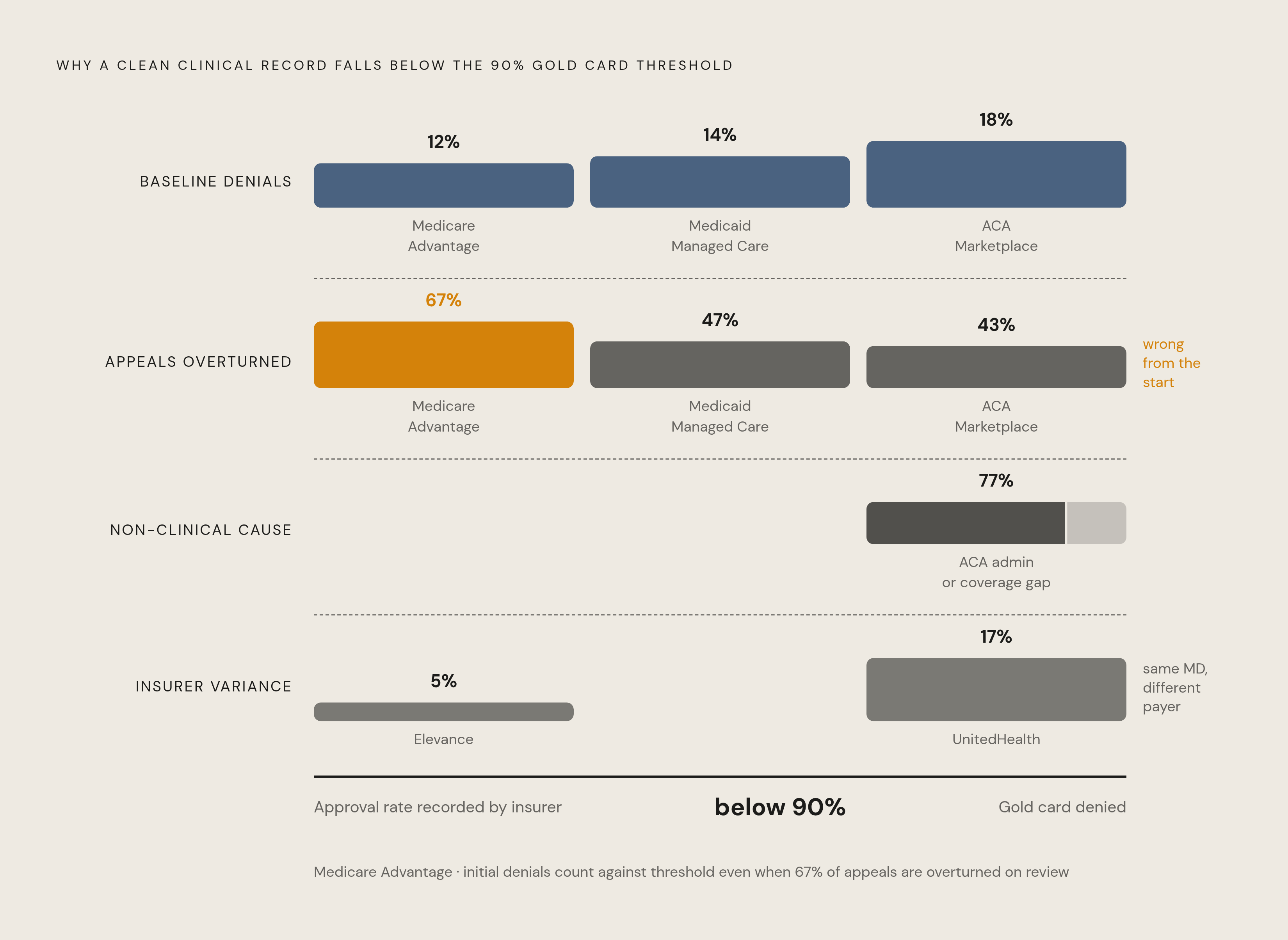
A 90% approval rate sounds like a bar any competent physician clears without breaking a sweat. But what gets measured against that 90% is whatever the insurer approved on the first pass, full stop, regardless of what should have been approved on clinical merit. It's whatever the insurer approved on the first pass, full stop. That gap between initial approval and correct approval is where gold card eligibility quietly slips out of reach for physicians practicing entirely appropriate medicine.
KFF puts average standard prior authorization denial rates at 12% in Medicare Advantage, 14% in Medicaid managed care, and 18% in ACA marketplace plans, and those baseline rates swing hard by carrier: within Medicare Advantage alone, denial rates ranged from 5% at Elevance to 17% at UnitedHealth. A physician's gold card eligibility depends heavily on which insurer happens to be sitting across the table, not just on that physician's own judgment.
Appeals data makes the case worse. When Medicare Advantage denials get appealed, 67% get overturned. In Medicaid managed care, the overturn rate is 47%. In ACA marketplace plans on the federal exchange, it's 43%. CVS Health's Aetna overturned 92.6% of appealed Medicare Advantage prior authorization denials in 2024, against an industry-wide figure of 80.7%. Read straight, those numbers mean a large share of initial denials were wrong from the start, corrected only because a physician had the time and staff to fight them.
That matters directly for gold carding, because the standard threshold counts the initial denial against a physician's approval rate no matter how the appeal turns out. A physician with an 85% initial approval rate might win nearly every appeal filed, delivering care that turns out, on review, to have been medically necessary all along, and still miss a 90% gold card threshold that only ever looks at the first answer the insurer gave.
Then there's the 77% of ACA marketplace denials, industry-wide, that trace back to administrative or coverage-design reasons rather than any clinical judgment about the care itself. A missing modifier code, a coverage exclusion, or a plan-design quirk reflects nothing about whether the physician made the right call, yet all of it counts against the approval rate gold card eligibility is built on.
Insurers add a final layer of unpredictability by leaning on proprietary review criteria and internal guidelines that vary by plan and stay mostly invisible to the physician submitting the request. A denial that cites "not medically necessary" with no further detail forces an appeal, and every appeal is one more interruption in the clean, uninterrupted approval record gold card qualification demands. The threshold rewards a smooth paper trail. It says almost nothing about whether the underlying medicine was sound, and that mismatch is the real reason the Texas number is 3%.
Highmark's voluntary gold card program: how a payer-run program differs from a state mandate
Highmark runs gold carding two different ways depending on geography, and the same insurer operates under two entirely different rulebooks as a result. In West Virginia, Highmark's program exists because state law demands it. In Delaware, New York, and Pennsylvania, Highmark runs a gold card program voluntarily, with no statute forcing its hand.
The voluntary version sets a bar well above what any state law requires. Highmark asks for a 99% or higher approval rating on the specified CPT codes and modalities, with a minimum submission history of three cases. Set against the standard legislative benchmark of 90%, Highmark's self-imposed 99% belongs to an entirely different tier of difficulty, and it raises an obvious question about motive: a voluntary program with a near-impossible threshold functions less like relief from paperwork and more like a marketing line about flexibility that few physicians will ever cash in. Eligibility criteria can also shift depending on the state mandate a given Highmark market falls under, so the 99% figure describes the voluntary program specifically, not every Highmark market uniformly.
As of March 1, 2026, Highmark lists these as eligible Gold Card modalities: bariatric surgery, CT scans, hysterectomy, neurostimulators, sleep studies, capsule endoscopy, diagnostic heart catheterization, interventional pain, nasal endoscopy and septoplasty, tonsil and adenoid surgery, cardiac devices, ECHO, joint surgery, PET and cardiac PET, reconstructive surgery, cardiac surgery, foot surgery, MRI/MRA/3D imaging, prostatectomy, vascular surgery, cataract surgery, and hyperbaric therapy. Several carry additional conditions in Highmark's own documentation, marked with an asterisk, a signal that qualifying within that modality involves more fine print than the category name lets on.
One change stands out. Effective April 15, 2026, Highmark temporarily pulled varicose vein treatment, along with every associated CPT code, from the eligible modality list for every provider, pending review of whether that modality belongs in the program. It's a small detail, but it says something large: gold card eligibility isn't a fixed status once granted. A modality that qualifies today can vanish from the list tomorrow, and a physician's gold card standing for that service disappears with it, regardless of that physician's own approval history.
UnitedHealthcare's national program and the industry voluntary pledge
UnitedHealthcare launched what it called a first-of-its-kind national gold carding program in 2024, spanning Commercial, Individual Exchange, Medicare Advantage, and Medicaid community products. Qualifying provider groups don't skip the process entirely under this model. Instead, they move through a notification step in place of full prior authorization for most of the procedure codes the program covers. That's a meaningful gap from the state-mandated version, where a true gold card exemption removes the requirement outright rather than just softening it into a formality.
UnitedHealthcare also committed to cutting roughly 10% of its prior authorization requirements in 2025, and it dropped prior authorization for home health services managed through another vendor's care unit, effective April 1, 2025, for Medicare Advantage and dual special needs plan members across 36 states and one federal district.
The broader industry followed with a collective gesture in June 2025, when more than 60 major health insurers, including UnitedHealthcare, Aetna, Cigna, Humana, Elevance Health, and Blue Cross Blue Shield Association plans, pledged to streamline prior authorization nationwide. The pledge carries two deadlines. By January 1, 2026, insurers committed to shrinking the list of procedures requiring prior authorization, honoring existing approvals for 90 days when a patient switches plans, and giving clearer explanations of denials with clearer appeal paths. By January 1, 2027, the group committed to a standardized, electronic prior authorization process across every participating insurer.
Physicians aren't buying it, and the numbers back their skepticism. Among physicians who work with UnitedHealthcare, only 16% report that these changes have actually reduced the number of prior authorizations they complete for those plans. A Cigna analysis found the identical figure among physicians who work with that insurer: 16%. Two different companies, two different provider populations, the same number twice, and that kind of convergence doesn't happen by accident. It means a public pledge to cut prior authorization and a physician's actual Tuesday morning, still filling out the same forms, remain two entirely different things for the overwhelming majority of doctors surveyed.
Sources
- ‘Gold Card’ Programs to Reduce Prior Auth ‘Underwhelming’
- Gold Carding Program
- Prior Authorization Reform Gains Momentum in States
- Prior Authorization in 2026: IRA, CMS Reform & AI Automation
- Gold Carding Programs Are Meant to Improve Prior Authorization. Are They Working? - MedCity News
- Gold carding programs are meant to improve prior authorization. Are they working?
- aimedalliance.org
- navigatingpayerchallenges.com