Medical Necessity Denial Trends and Payer Clinical Criteria Divergence
Payers apply their own clinical criteria, not CMS standards, driving divergent denial rates.

Medical necessity denials are climbing faster than claim denials overall, and that gap has a specific cause: payers are running their own clinical criteria, not CMS guidance, and those criteria increasingly diverge from CMS and from each other. The same chart, filed with the same codes and the same notes, clears one insurer and gets kicked back by the next. Everything below traces from that one fact.
How payers began applying their own clinical criteria apart from established guidelines
CMS guidelines exist in public view. They get debated, published, and updated on a known schedule, and anyone can look them up. Payer internal criteria don't work that way: they're proprietary, they change without notice, and nothing forces them to match CMS thresholds.
That gap is visible in real policy moves. A payer-specific analysis from medicalbillersandcoders.com found that UnitedHealthcare applied tighter internal medical necessity criteria to behavioral health integration services in 2025 than what CMS lays out for traditional Medicare. The same source reported that AIM Specialty Health, which runs prior authorization for BCBS specialty programs in several states, updated its clinical criteria in the second quarter of 2025 and added stricter requirements around how long a patient has to try conservative treatment before musculoskeletal and spine procedures qualify. BCBS plans in Texas, Illinois, Florida, and North Carolina now apply those AIM standards to outpatient procedure authorizations, and the bar sits above what CMS asks for. Denials at the authorization stage happen even when the chart shows conservative treatment was tried and failed.
Available data shows the same service, same paperwork, runs a 5% initial denial rate through traditional Medicare and a 21% rate through commercial payers, a gap tied to criteria rather than paperwork. That's not a documentation gap; it's a criteria gap. Advisory Board's read on the numbers is blunt: payers are denying on clinical criteria, not administrative defects. No single payer is acting in bad faith here. This is just how modern adjudication works now, and pretending otherwise costs practices money.
What AI-assisted adjudication does to criteria consistency across payers
Industry reporting indicates that major payers including UnitedHealthcare, Humana, Aetna, and BCBS plans have moved AI systems into the prior authorization pipeline, cross-checking requests against internal criteria databases without a physician advisor looking at the initial call. Decisions that once required multi-day human review now return far more quickly. A Senate committee report the AMA has cited found the denial rate on those faster decisions runs well above what human reviewers produced, in some cases up to 16 times higher.
UnitedHealthcare's adjudication system applies its own internal clinical edits, which differ from the criteria sets used by other insurers. None of these edit sets get published, and industry observers note they get updated periodically without consistent notice to providers. So a claim that sailed through last quarter can hit a wall this quarter under identical documentation, because the algorithm changed, not the clinical facts.
Muni.health's prior authorization guide flags these as signs of algorithmic denial rather than clinical review: a decision on a clinically complex case that comes back in under a day, denial language... Muni.health's prior authorization guide flags these as signs of algorithmic denial rather than clinical review: a decision on a clinically complex case that comes back in under a day, denial language that reads like boilerplate and never engages the specific chart, and a flat "not medically necessary" on a submission that was detailed and specific. Mbwrcm.com's denial trends analysis found that natural-language comparison tools now check clinical notes against submitted codes directly, so vague medical necessity language or a missed comorbidity triggers an automatic denial. Documentation precision used to be a nice-to-have. Now it's a technical requirement of the submission itself, full stop.
AI adjudication doesn't smooth out the gaps between payers. It runs each payer's own proprietary rulebook at machine speed, so the divergence above now touches every claim that moves through the system.
The prior authorization denial numbers that show how wide the divergence is
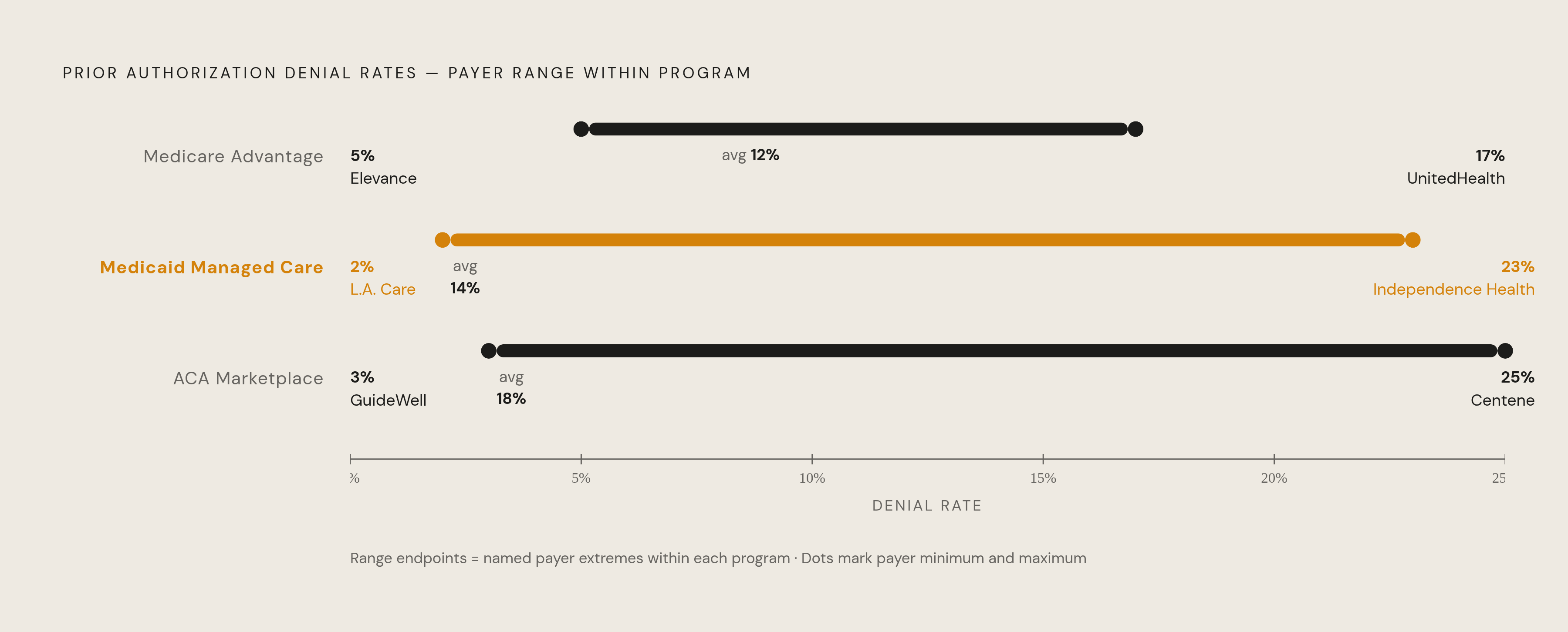
KFF's analysis, covering 14 insurers across Medicare Advantage, Medicaid managed care, and the ACA Marketplace and representing roughly 71 million enrollees, found 2025 denial rates of 12% for Medicare Advantage, 14% for Medicaid managed care, and 18% for ACA Marketplace plans. Those top-line numbers matter less than what's producing them.
Within Medicare Advantage, denial rates ranged from 5% at Elevance to 17% at UnitedHealth Group, more than a threefold spread inside one federally regulated program. Medicaid managed care ran from 2% at L.A. Care Health Plan to 23% at Independence Health Group. ACA Marketplace plans spanned 3% at GuideWell to 25% at Centene. Authdenied.com's separate ranking, covering 17 insurer groups and 590 reporting contracts across 36.1 million standard prior authorization decisions, put UCare at a 32.7% denial rate against Alignment Healthcare's 2.3%, with the program-wide average at 9.0%.
None of this existed publicly before this cycle. It's the first year of CMS-mandated reporting under the 2024 final rule, which required payers to post their 2025 calendar-year prior authorization numbers by March 31, 2026. A practice sending an identical request, on identical clinical facts, to Centene versus GuideWell is staring at an order-of-magnitude difference in the odds of denial. That's a payer-behavior gap, not a documentation gap, and now it's measurable in public data for the first time. These are prior authorization figures rather than claim denial figures, but PA sits upstream of claim submission, so the effect passes straight through.
High overturn rates on appeal reveal the denials as process failures, not clinical determinations
Two-thirds of Medicare Advantage denials got overturned on appeal. The same KFF analysis found Medicaid managed care ran 47% overturned and ACA Marketplace 32%. Break it down by payer and the range widens further: Medicare Advantage overturn rates ran from 93% at Centene down to 40% at Kaiser Permanente. In Medicaid, UnitedHealth Group topped the list with 81% of its denials overturned, while CVS sat at just 22%.
A two-out-of-three overturn rate on Medicare Advantage denials means the initial decision was never a real clinical judgment call. It was a filter, and the payer's own appeal reviewers prove that every time they reverse course at that rate.
McKinsey research cited in datarovers.com found that roughly 60% of denied claims never get appealed at all, because chasing them by hand costs more than the practice expects to recover. That means most of the money represented by that two-thirds overturn rate sits uncaptured, permanently. The denials aren't unwinnable on the merits. Practices just aren't fighting them fast enough, or precisely enough, to get the cash back.
Compressed appeal windows turn recoverable denials into permanent write-offs
Appeal deadlines have gotten shorter right as denial volume rises, and that timing isn't an accident. Some major payers have shortened their peer-to-peer review windows significantly, leaving practices far less time to respond from the denial date. Other payers have similarly compressed expedited appeal windows for urgent prior authorization requests. Meanwhile, medicalbillersandcoders.com reports that multiple BCBS state affiliates still run standard windows of 60 to 180 days for non-urgent denials, varying by state.
That spread sets a scheduling trap. A practice running denial review on a weekly or biweekly cycle is operating on a rhythm built for 60-day windows. Dropping that same cadence onto a 14-day UnitedHealthcare deadline means the review meeting happens after the appeal window has already shut. One missed deadline, caused by applying UnitedHealthcare's timeline to a BCBS denial or the reverse, turns a recoverable claim into a permanent write-off. Payer-specific denial pattern analysis confirms this is exactly the failure mode appearing in the data.
The timing pressure stacks directly on top of the clinical criteria gap from the sections above. Each payer runs different criteria, and now each payer also runs a different clock. A generic denial workflow, built around one appeal template and one review cycle, fails on both counts at once. Recent CMS rulemaking does require impacted payers to give a specific reason for a denied prior authorization, which at least tells practices what they're appealing. It does nothing about the clock, though. Each payer keeps running the window at whatever speed it has set, and the compression looks a lot less like coincidence than like design.
Payer-specific appeal strategies built on the actual denial pattern
Generic appeal letters lose to payer-specific ones, and the reasons trace claim by claim. UnitedHealthcare's behavioral health integration denials respond best to a two-part appeal: clinical documentation establishing a DSM-5 diagnosis, paired with a direct citation of CMS's 2024 Final Rule requiring Medicare Advantage plans to use Medicare-consistent criteria. Medicalbillersandcoders.com found that appeals citing the Final Rule directly succeed 64% of the time on first-level appeal. For a primary care physician billing BHI regularly, that's $8,000 to $22,000 in annual revenue riding on citing the rule correctly in the appeal.
BCBS orthopedic and spine denials follow an entirely different pattern. The denial usually lands at the authorization stage, citing unmet conservative treatment requirements, even when the chart shows conservative treatment was tried and failed. The appeal has to name the specific AIM Specialty Health criterion the denial cited and answer it directly. CMS-0057-F helps here too: impacted payers (Medicare Advantage, Medicaid, CHIP, and qualified health plans on the federal exchange) now have to state a specific denial reason, which hands practices the exact criterion to rebut instead of guessing at it.
Muni.health's 2026 prior authorization guide states the underlying rule: if the denial names a specific clinical criterion, the appeal has to engage that criterion by name. A well-written clinical narrative that skips the named standard gets rejected on procedure alone, regardless of the strength of the medical case. There's a coding wrinkle on top of that. UnitedHealthcare and BCBS use different CARC codes for what amounts to the same denial reason, so an appeal template built around one payer's codes fails on a technicality when applied to the other's. That's a workflow design flaw, and it's an avoidable one.
A payer-specific approach means knowing, before submission, which criteria system a given payer runs (AIM Specialty Health or something equally proprietary). It means tracking each payer's current appeal windows instead of assuming a standard 60 days, writing templates that cite the payer's own stated reason next to the conflicting CMS guidance, and working denials the day they land instead of batching them for a weekly review that might already be too late. None of that is optional once volume climbs. The AMA's 2025 Prior Authorization Physician Survey, covering 1,004 physicians, found practices complete an average of 40 prior authorizations a week and burn 13 combined hours of physician and staff time on it. Most independent practices don't have spare hours to run five or six payer-specific workflows by hand, so the infrastructure behind the strategy matters as much as the strategy itself.
What practices should track to know whether their denial mix is a criteria-divergence problem
Industry benchmarks generally put top-performing practices below a 5% denial rate, with best-in-class practices under 3%, a clean claim rate above 98%, and days in accounts receivable under 35. A practice running well above those marks needs a closer look, and the shape of the gap tells you what's actually wrong.
Three questions separate a criteria-divergence problem from a documentation or front-end problem. First, are denial rates noticeably higher with specific commercial payers than with traditional Medicare? If yes, criteria divergence is the likely cause, given that available data shows traditional Medicare runs a 5% initial denial rate against commercial payers' 21%. Second, are denials clustering around services where a payer recently tightened prior authorization rules or updated its clinical criteria, even though nothing changed on the documentation side? Third, when appeals do get filed, do overturn rates run high, suggesting the original denials weren't clinically sound to begin with, while a large share of denials never get appealed at all because volume or window pressure makes it impractical?
Answer those three honestly and a practice knows whether it's fighting a documentation problem it can fix internally, or a payer-behavior problem that demands tracking each payer's criteria, deadlines, and stated denial reasons separately. The two problems look identical on a denial report. They aren't the same problem, and they don't get fixed the same way.