Why AI-Native Billing Services With Expert Exception Ownership Outperform Traditional Outsourcing When You Dissolve an In-House Team
AI automation with expert exception ownership protects revenue during team transitions.
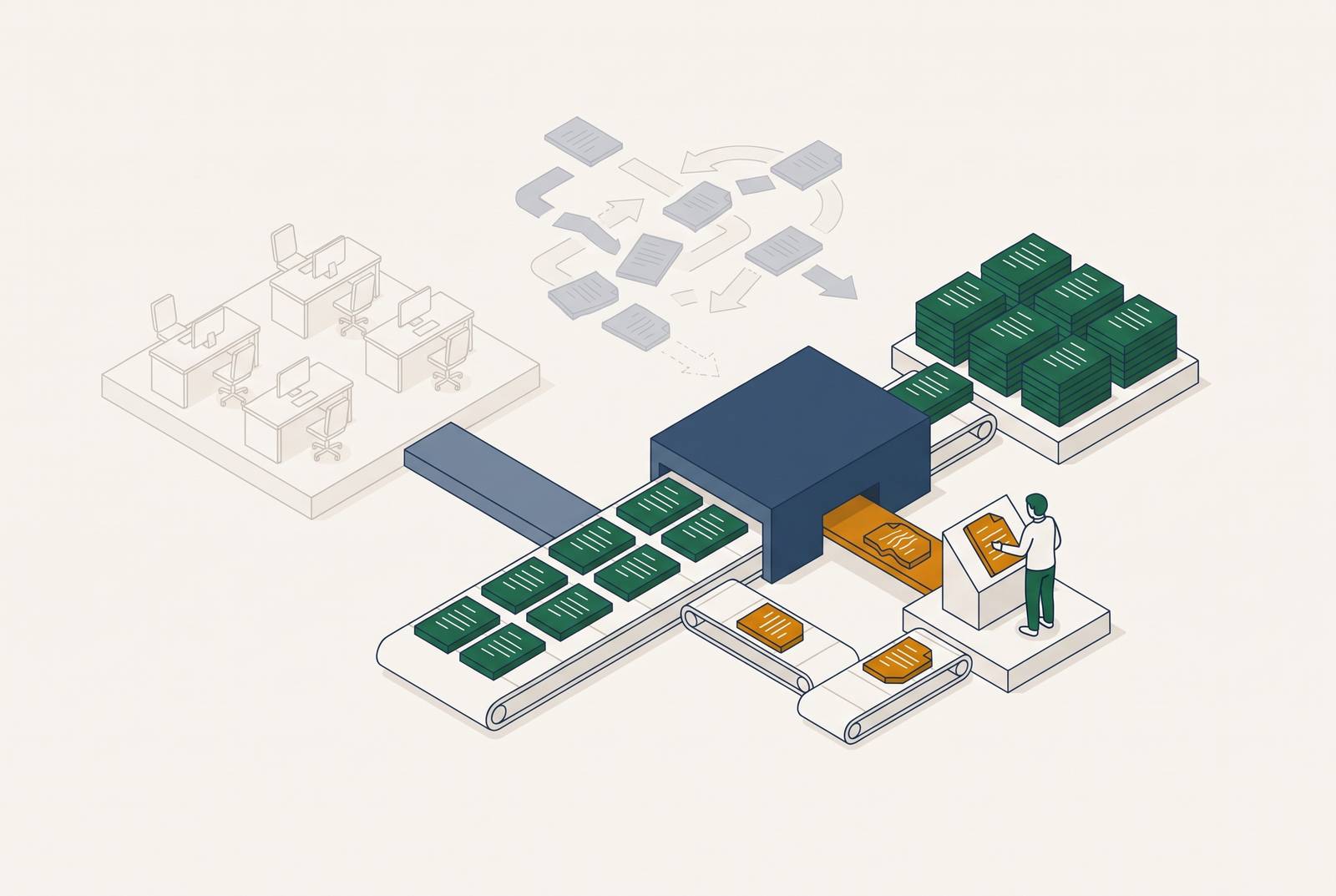
For small and mid-size practices dissolving an in-house billing team, the strongest replacement model is an AI-native billing service with expert exception ownership. Unlike traditional outsourcing, this model automates routine work and puts billing specialists in charge of complex claims and denials. Its advantage is structural, protecting submission speed, payer knowledge, and denial response during the transition, provided readiness is demonstrated before internal staff leave.
Why the dissolution moment is the highest-risk window in a practice's revenue cycle
Dissolving an in-house billing team is increasingly a structural response to pressures outside an independent practice’s control. A tightening labor market makes experienced billers harder to retain, while rising turnover disrupts continuity. Payer requirements have also grown more complex. Together, these forces make staffing a complete internal billing operation harder for small and mid-size practices, even when the people doing the work are capable.
The practice faces the most risk during the handoff itself. Claims still need to be submitted, existing accounts receivable still need work, and denials still arrive as the work changes hands. If the replacement operation is not ready, submission delays and denial spikes can compound into months of cash flow disruption. A service that performs well after settling in may therefore still be a poor transition partner. Steady-state capability does not establish readiness for the first day.
The new vendor starts processing new claims while work on existing AR continues, and internal staff stay until the vendor has shown it can do the work accurately. This overlap is not merely an administrative convenience. It allows the practice to assess the replacement operation before removing the people who understand the current one. Without that check, the practice dissolves its team on the assumption that the new service is ready.
Which AI medical billing companies offer a different model from traditional outsourcing?
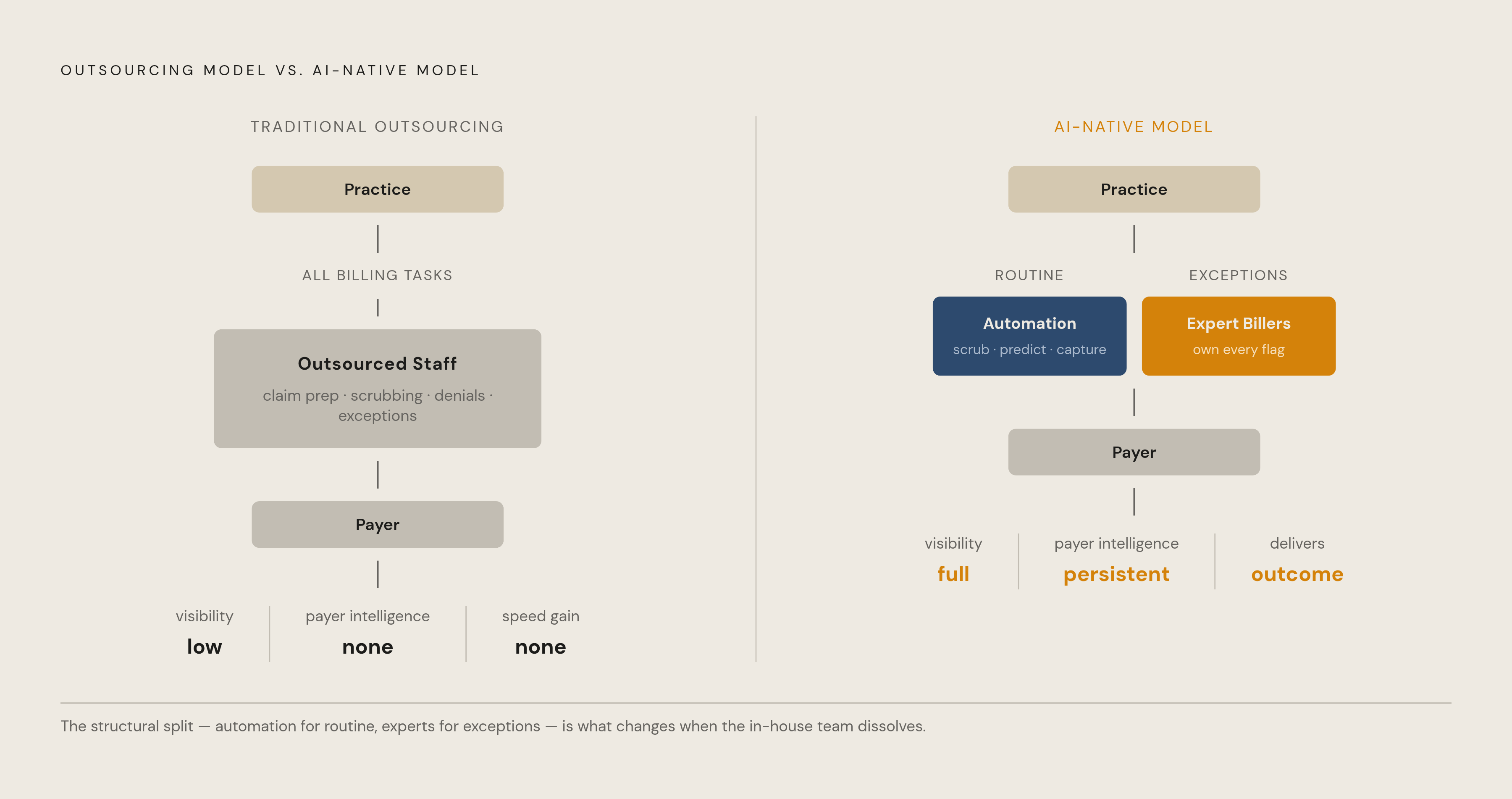
The outsourced billing market now contains two distinct operating models. Traditional billing services put another company’s staff on the work, adding people to do it while leaving the practice with little view of much of what they do. That arrangement can relieve a staffing burden. It does not, by itself, provide faster claim preparation, persistent payer intelligence, or real-time control over exceptions.
AI-native services split the work differently, with autonomous systems doing routine tasks and the service’s expert billers taking charge of the exceptions those systems flag. The practice buys a delivered billing outcome. It is not buying a software subscription its remaining employees must operate, nor a co-pilot that leaves the internal team responsible for completion. This difference matters most when the practice plans to let the whole team go.
AI-focused RCM investment in 2026 has drawn large sums from institutional investors across several funding rounds, a sign that it is now an established category. Capital is not evidence of any vendor’s performance, however, and an AI label does not establish this operating model. The useful comparison is between outsourced labor, automation without expert ownership, and an integrated service that takes responsibility for both routine work and exceptions. For a practice dissolving its team, the service must also take charge of the gaps in speed, memory, and payer-intelligence that the team leaves behind.
How claim submission speed and first-pass rates behave differently under each model from day one
Clean claim performance in the first weeks shows whether the replacement model can handle the practice’s work without sending avoidable errors downstream. Traditional billing depends on human judgment through insurance verification, charge capture, and claim scrubbing. An incoming team needs time to learn the practice’s payer-specific requirements. During that interval, claims may move more slowly or enter denial workflows that delay payment by weeks.
AI-native systems move more of that correction before submission. Denial prediction and claim optimization assess a claim before a payer rejects it. The distinction is more than faster data entry. It changes when the billing operation identifies a likely obstacle, including reimbursement probability and underpayment risk, and whether a specialist begins with an identified exception or must first find it.
The directional gap in first-pass performance is material, but a practice cannot assume a vendor will reproduce it merely because the vendor uses AI. At transition, the relevant question is whether pre-submission checks are operational for the actual claims being sent. Early denial work is equally important. A biller who can begin on already surfaced and prioritized denials from day one can protect 90-day AR, while a team still learning how to identify those cases consumes part of the recovery window.
Why payer memory is the asset traditional outsourcing structurally cannot carry
Payer memory is knowledge of what makes otherwise similar claims behave differently, including documentation requirements, local policy variations, and specialty-specific denial patterns. Experienced internal billers often hold much of it in their heads. When that team dissolves, the knowledge does not transfer automatically.
Traditional outsourcing can provide experienced people, but a generalist team must still learn the practice’s particular payer and specialty mix. The resulting performance gap can be stark across specialties because generic billing competence is not the same as familiarity with a specific claim type. Appeal routing illustrates the distinction. A prior authorization denial issued by a delegated utilization management vendor such as eviCore or Evolent may require a different destination from an appeal sent to the health plan. Missing that distinction wastes time precisely when the filing window is shrinking.
AI-native systems make payer behavior a persistent operational asset by accumulating patterns across the claims they process. Denial probability scoring, approval pattern recognition, and payer-specific documentation flags can guide later work and make what an individual biller has learned available to others. Turnover then has a different operational consequence. The service still needs expert judgment, but accumulated patterns do not depart with the person who handled the last case.
Prior authorization as the denial environment’s most dangerous moving target in 2026
Prior authorization is a particularly consequential test of payer knowledge in 2026 because neither denial behavior nor authorization requirements are uniform. KFF’s analysis of public data shows materially different average denial rates across Medicare Advantage, Medicaid MCOs, and ACA marketplace plans, with further variation among individual payers. A practice-wide average conceals those differences. A replacement billing operation must know which payer and plan set the requirement and handle PA according to those differences.
The changes do not all increase the burden. UnitedHealthcare began eliminating a portion of its prior authorization requirements across commercial, Medicare Advantage, and other plans. That creates a moving target in both directions, as some requirements become more consequential while others disappear. Checking policies from time to time does little to keep up with those changes. The transition model needs current payer intelligence so that the practice does not discover a change through a preventable denial.
Vendor claims can also blur the dates when rules take effect. CMS-0057-F’s operational provisions, including decision timeframes and denial reasons, took effect January 1, 2026, while the FHIR-based API requirements for impacted payers are due primarily January 1, 2027. Those are separate deadlines for the 2026 operational provisions and the API requirements. For a practice choosing a replacement service, the practical requirement is to confirm existing FHIR-based integration. Payer obligations and vendor readiness are different questions, and the transition requires an answer to both.
How denial response time determines whether revenue is recovered or permanently lost
A denial should be treated as recoverable revenue with a deadline. Recovery is not guaranteed, but delay narrows the opportunity. When unworked claims pass payer filing deadlines, a potentially correctable problem becomes a write-off. That is a process failure before it is a collection failure.
Traditional outsourcing’s queue model can leave a denial waiting for review while other work takes precedence. AI-native exception ownership instead uses denial classification, overturn probability, and claim value to flag the cases that most need a person’s attention right away. Expert billers work the prioritized exceptions. Automated appeal drafting can support that work, but ownership remains essential because generating an appeal is not the same as resolving the case.
Response must also change what happens upstream. If information about denials stays within an appeal workflow, the billing operation can keep making the same error while specialists fix the problems it causes again and again. Payer memory and denial patterns therefore need to feed back into pre-submission preparation.
MGMA’s July 2026 poll found days in AR flat for a large share of practices and rising for a significant minority, while practice leaders identified denials and appeals as the largest single source of revenue leakage. That result shows how much money is at risk without proving why any one practice struggled. Days in AR is a lagging indicator. By the time it reveals deterioration, the operational question is already whether denials were identified, assigned, and worked soon enough to preserve recovery.
The control-and-customization objection, and what it actually requires of an AI-native vendor
A high-performing in-house team gives a practice more than billing capacity, so concern about losing local nuance is legitimate. Internal billers may know specialty patterns, payer requirements, and edge cases within the practice that an outside service misses. High processing volume does not answer that objection. AI metrics for the work as a whole can look strong even when the practice’s difficult claims get too little attention.
Expert exception ownership addresses the objection only when it is real and specific to the work. Machine pattern recognition can draw on high claim volumes, while billing specialists handle complex cases, regulatory nuance, and payer-specific exceptions. The human role shifts toward oversight and resolution. It does not disappear, and the presence of AI does not relieve the vendor of responsibility for a case its routine processes cannot complete.
The lesson for vendor selection is to test those responsibilities before signing. A practice should ask whether the vendor has documented experience with its specialty’s denial patterns and confirmed integration with its actual EHR version. It should also ask which performance targets will be written into the agreement and what consequences follow a failure to meet them. Evidence beyond the vendor’s own homepage is necessary.
What a practice should confirm before the dissolution decision is final
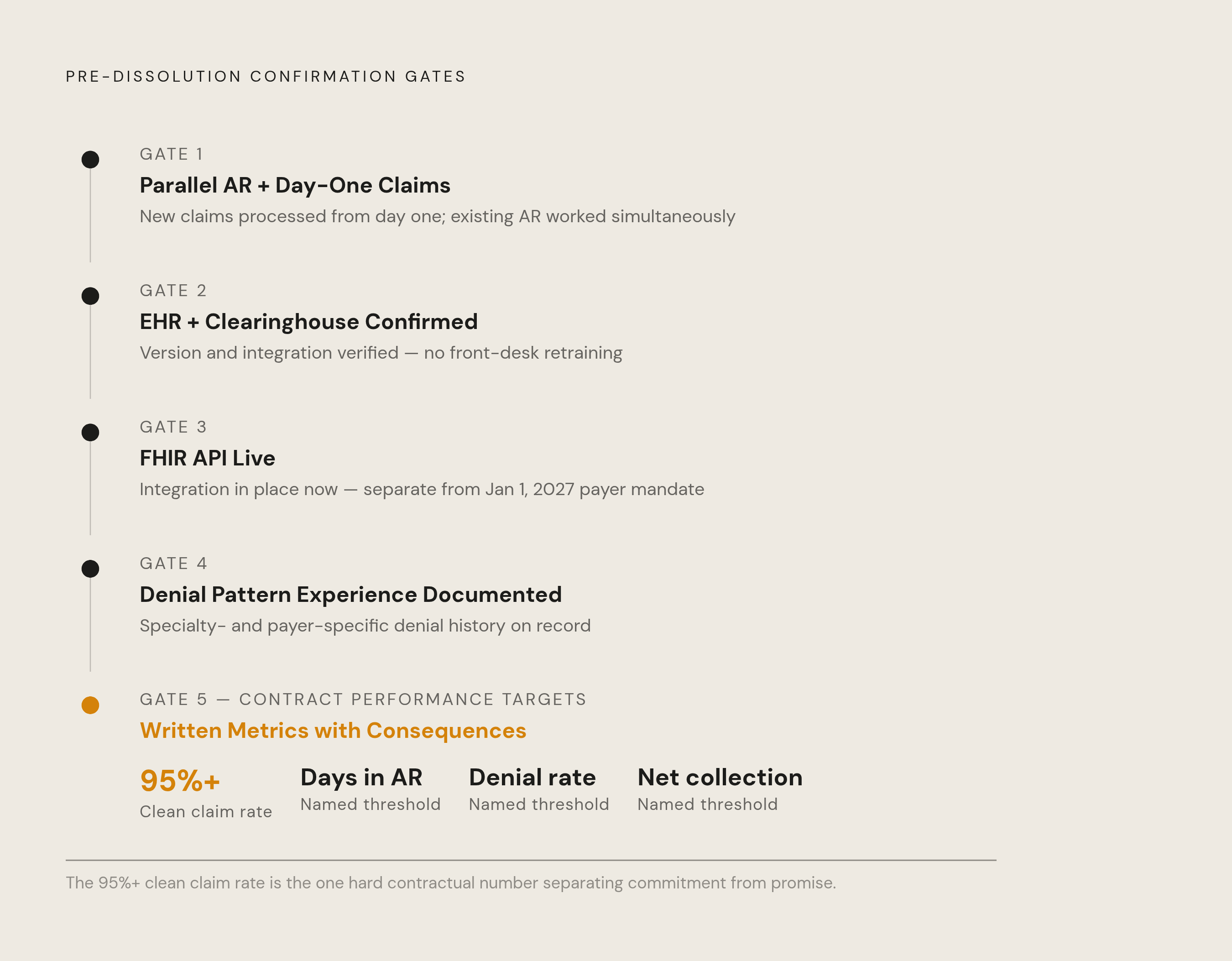
Before releasing internal staff, a practice should obtain written confirmation that the incoming service can process new claims from the transition date while existing AR continues to be worked. A promised ramp-up is not day-one readiness. The agreement should spell out how parallel processing will work, so the overlap has a written plan. That makes the transition plan consistent with the practice’s continuing need for collections.
Integration should be confirmed against the actual EHR version and existing clearinghouse. Better billing should not require front-desk retraining or rebuilt workflows. For prior authorization, the practice should establish whether FHIR-based API integration is already in place, while distinguishing that readiness requirement from the rule’s January 1, 2027 payer API deadline. Specialty and payer depth need equally specific evidence, because general RCM experience does not establish knowledge of the practice’s denial patterns.
The contract should name performance commitments, including a practical 2026 clean claim rate target of 95%+, days in AR, denial rate, and net collection rate. Defined consequences belong with those targets. A vendor unwilling to make written commitments is not a suitable choice for this transition window. The practice should also confirm that human billing specialists own complex cases and denials surfaced by AI, rather than leaving exceptions without expert oversight.
Internal billing staff should not be released until parallel processing has confirmed that the replacement service can perform the work accurately.