Claim Scrubbing Software That Validates Against Live Payer Policies Before Submission
Live policy validation catches claim errors before submission that static rule sets miss.

Small medical practices can reduce preventable insurance claim denials by using claim scrubbing software that checks current payer-specific policies, eligibility, and authorization details before submission. Static formatting and coding checks remain necessary, but they do not test every rule a payer will apply. Live payer-policy validation narrows that gap by bringing updated coverage and clinical requirements into the billing workflow, while human reviewers resolve exceptions the software cannot settle.
Why static claim scrubbing no longer matches how payers adjudicate
Most claim scrubbers still rely on internally maintained rule sets, while payer adjudication has become more dynamic and payer-specific. The tools and the review environment have diverged. A claim can satisfy the rules loaded into a practice’s scrubber yet receive a denial because a coverage or documentation requirement changed after its last update, creating a mismatch between the rules available at submission and those applied during review.
CMS updates NCCI bundling edit tables quarterly, in January, April, July, and October, with occasional mid-quarter replacement files. That schedule was established before 2026. Commercial payers also change their policies on a schedule of their own, which does not match when a practice updates its rules. Even a regularly refreshed library can therefore leave a period in which claims are tested against outdated requirements.
Regulatory changes add further pre-submission obligations. CMS-0057-F, effective January 1, 2026, requires specific written denial reasons and 7-day standard prior authorization decisions for Medicare Advantage, Medicaid, and CHIP. ACA marketplace/QHP plans fall under the denial-reason requirements but are excluded from that decision timeframe. The CMS WISeR Model also introduced new prior authorization requirements for Traditional Medicare Part B in six states. These changes make current authorization and documentation requirements more consequential without making a static scrubber better equipped to interpret them.
How payer AI adjudication works and why it produces edits no static scrubber can anticipate
Payer AI adjudication applies clinical logic that is proprietary, payer-specific, and retrained on a cycle providers cannot see. Not every denial-triggering edit is published or standardized. A scrubber limited to published rules has a structural limitation: it cannot reproduce undisclosed review logic, regardless of how thoroughly it checks claim formatting.
Payer differences further complicate the task of matching validation to adjudication. As of September 2026, reimbursement policy changes took effect across UnitedHealthcare, Aetna, Blue Cross Blue Shield of Michigan, BCBS Texas, and Molina Healthcare. Across those changes, restrictions included lab test coverage, expanded automated claim edits, reduced radiology payments, and the beginning of incident-to billing phaseouts for supervised clinicians. These were not interchangeable changes across every payer. One shared rule set cannot cover the different requirements that apply to each submission.
A majority of medical health plans and roughly half of dental health plans now use AI tools in administrative workflows, while a much smaller share of provider organizations have matched that investment. Administrative AI use is broader than claim denial automation, but it illustrates the operational asymmetry. Payers can use automated review more widely while practice billing teams still have to keep policies up to date by hand. Faster review on one side does not produce more accurate submissions on the other.
What static scrubbing actually checks and where it stops
Conventional scrubbing performs a defined and valuable job. It verifies required fields and EDI transmission formatting, flags duplicate claims, and checks modifiers and bundling against the NCCI tables available in its last update. Basic eligibility checks also use benefits data to check whether coverage is in place. These controls catch avoidable submission defects before they reach the payer.
The boundary is the rule set itself. A static engine cannot apply proprietary payer edits that providers have never received, or bundling changes introduced after its latest refresh. It also cannot test current authorization-to-claim matching requirements merely because it confirms that an authorization exists. Exact CPT, modifier, and site-of-service alignment require a more specific comparison. Likewise, a stored policy library may miss mid-cycle changes to applicable LCD/NCD policies or payer medical necessity criteria.
Clearinghouse acceptance does not close those gaps. Clearinghouses perform their own formatting and routing checks, but those checks are not equivalent to payer-specific adjudication. A claim can clear that layer and still fail a rule the clearinghouse never tested. For a practice reviewing its clean claim performance, the distinction is important. Successful transmission establishes only that the claim passed the checks performed.
What live payer-policy validation adds and how it differs architecturally
Live payer-policy validation changes both the source of the rules and how they are applied. Instead of depending solely on a manually maintained library, it refreshes rules from CMS and payer sources in real time or near-real time. It then applies separate requirements for each payer. Update cadence and payer specificity work together. A frequently refreshed generic library still lacks the distinctions needed to evaluate individual payer requirements.
Coding accuracy, NCCI edits, MUE limits, LCD/NCD policies, coverage rules, authorization matching, eligibility, and coordination-of-benefits order become parts of the same check. A clinical logic layer compares diagnosis pairings, modifier combinations, and documentation signals with payer-specific medical necessity criteria. The clinical logic layer identifies errors while the claim is still in the billing workflow, before it enters the submission queue. That placement allows correction at the point of origin.
The strongest objection is that “live” cannot mean omniscient. A payer may introduce an unpublished edit, or a policy change may take effect before the validation engine ingests it. No update architecture removes that uncertainty entirely. The useful comparison is therefore with a quarterly or manually refreshed rule set. Reducing a months-long lag to days or hours is the operational gain, provided the engine actually maintains that update discipline.
Where denial risk concentrates when scrubbing stays static — specialty and claim-type exposure
Exposure is concentrated where proprietary bundling edits, medical necessity review, and authorization requirements are most active. UnitedHealthcare’s Q3 2025 bundling edit additions created concentrated exposure for orthopedics, ASC, dermatology, wound care, and general surgery. Musculoskeletal and spine practices also face BCBS AIM Specialty Health criteria updated in Q2 2025, which call for stricter documentation of how long conservative treatment lasted. It is now called Carelon Medical Benefits Management. Behavioral health, anesthesia, and cardiology have above-average initial denial rates, making pre-submission detection particularly consequential in those settings.
Authorization matching creates a separate fault line. Practices relying on authorizations for Medicare Advantage, Medicaid, ACA marketplace coverage, or Traditional Medicare Part B within WISeR’s scope face denial risk when authorized and billed details diverge. Under payer rules requiring exact field-level matching, a CPT, modifier, or site-of-service mismatch can trigger automatic denial. A static check that recognizes an authorization number but does not have the payer’s current matching logic cannot check that alignment. Live validation can flag the discrepancy before submission.
Registration and eligibility failures remain the largest category of denial causes and have held that position for multiple consecutive years. A large share of preventable denials therefore begins before sophisticated clinical review. For a mid-size practice with denials at or above the industry average, the recoverable revenue gap can be substantial. The labor needed to rework those claims makes that gap progressively harder to close.
The appeal paradox and why catching errors at submission is cheaper than recovering them after denial
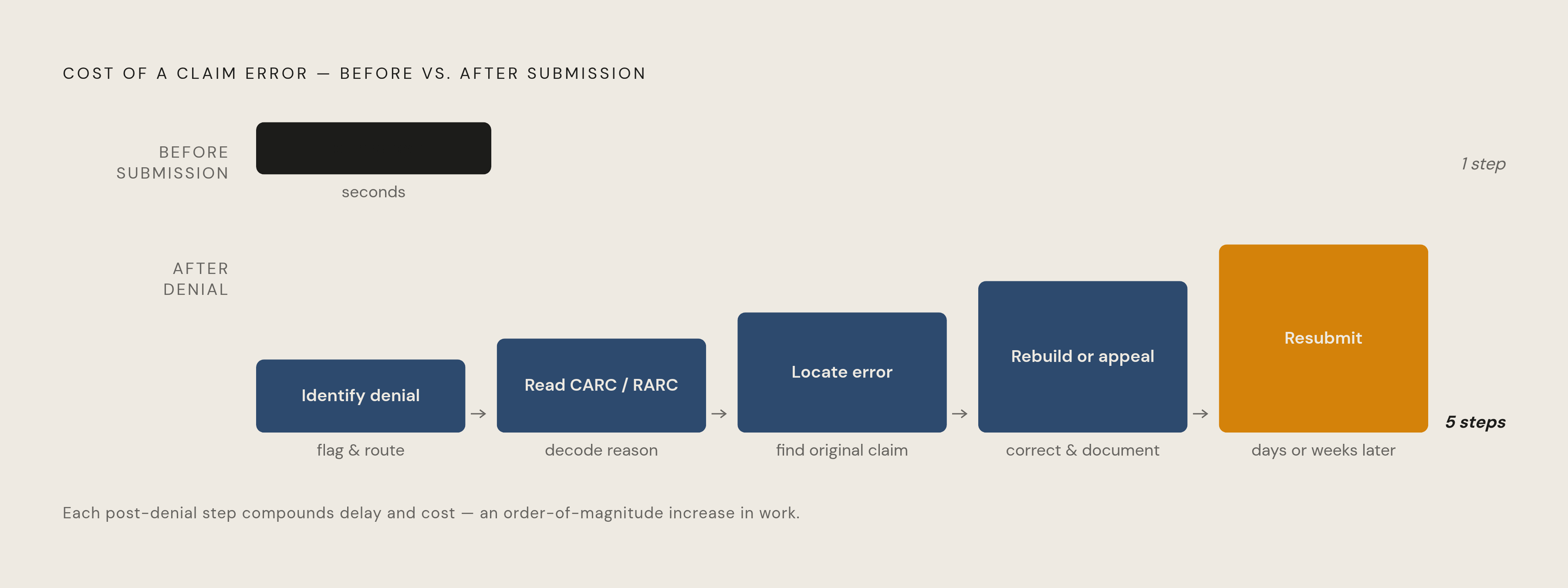
Appealed denials are overturned at a high rate, yet a large share of denials never receives an appeal. Recoverability alone does not make recovery economical. Practices with few billing staff must spend time on each case before they can collect the money. As a result, much of the money that practices could recover from denied claims goes uncollected because the work costs too much to make it worthwhile.
Pre-submission correction has a shorter path. An error caught while a claim is on screen may take seconds or minutes to fix. After denial, staff must identify the denial, interpret CARC/RARC codes, locate the correction, rebuild the claim or construct an appeal, and resubmit. Those steps increase the work needed by an order of magnitude. With high claim volume and thin staffing, many denials are written off.
This makes live validation a cost-reduction argument as well as a revenue-protection argument. It lets staff make eligible corrections before they have to recover payment and helps them work through more denials. Prevention still has limits. Payer takebacks on post-payment audit represent a growing source of revenue leakage, so initial payment does not end all claim risk. Even so, catching known policy, eligibility, and authorization errors before submission saves time for billing teams with few staff by fixing errors where they start.
How should a small practice evaluate software that checks payer rules before submission
A practice evaluating software should begin by asking how often its payer rule library updates and where those updates originate. “AI-powered” and “real-time” labels are insufficient evidence. Quarterly updates from a vendor-maintained library retain the static model, while continuous ingestion from CMS feeds and payer publications supports live validation. The answer should distinguish the separate policy components: NCCI tables, MUE limits, LCD/NCD policies, and payer-specific coverage rules.
Second, a practice should ask whether the engine applies each payer’s known rules separately. A UnitedHealthcare claim and a BCBS claim should not automatically go through the same edit logic. Payer awareness turns a generic warning into a relevant exception. The distinction is between checking that a claim satisfies broadly shared conventions and testing the requirements of the payer receiving it.
Third, a practice should ask whether authorization and eligibility are integrated into the scrub itself. The practice should be able to find out whether the software matches CPT, modifier, and site of service against current payer requirements before submission. An authorization-presence check is not enough. Active coverage, demographics, coordination-of-benefits order, insurance status, and authorization status also need validation at claim assembly.
The software should ingest claims from the EHR or practice management system, flag errors before submission, and route corrected claims without requiring staff to move between separate systems. Manual re-entry weakens the efficiency case for automation. HL7/FHIR API connectivity also belongs in this evaluation because approaching payer API requirements intersect with live validation infrastructure.
Fifth, a practice should ask who resolves the exceptions. Complex claims, documentation mismatches, and novel payer edits still require a reviewer who understands the payer’s behavior. An alert alone does not complete the correction. A managed billing service with AI-driven scrubbing and in-house billing specialists differs from a standalone tool by providing people to work those exceptions. The practical test is whether automation removes work or simply transfers a new queue to an already short-staffed team.
How the FHIR mandate and continued payer AI investment will widen the static-vs-live gap from here
CMS sets the API compliance deadline primarily at January 1, 2027, under CMS-0057-F, with the obligation applying specifically to impacted payers. It still leaves practices that use legacy HL7-only billing environments with a choice about integration, because live payer-policy feeds increasingly need FHIR-capable connectivity. Scrubbing infrastructure and broader system modernization therefore intersect. A practice cannot evaluate access to current policy data entirely apart from the systems through which that data reaches its workflow.
Payer AI investment adds a second pressure. Payers continue deploying AI to review, pend, and deny claims faster, widening the mismatch with provider tools that depend on static rules. Delaying better pre-submission validation leaves a larger correction for later. For most independent and small-to-mid-size practices, staffing and technology constraints make building and maintaining this infrastructure internally impractical. A platform or managed billing service can provide the continuously updated layer instead.
In AI-assisted revenue cycle workflows with live validation, institutional memory can accumulate in the system and remain when a biller departs. Human exception handling complements that infrastructure by addressing cases the automated rules cannot resolve. Over time, a practice gains more than a current policy library. It becomes better able to submit accurate claims over time without having to rebuild what its billing team knows by hand each time a payer changes its rules.