How AI Medical Billing Companies Actually Cut Denials and Accelerate Payments When No Internal Billing Team Exists
AI and expert billers replace institutional memory to prevent recurring denials.
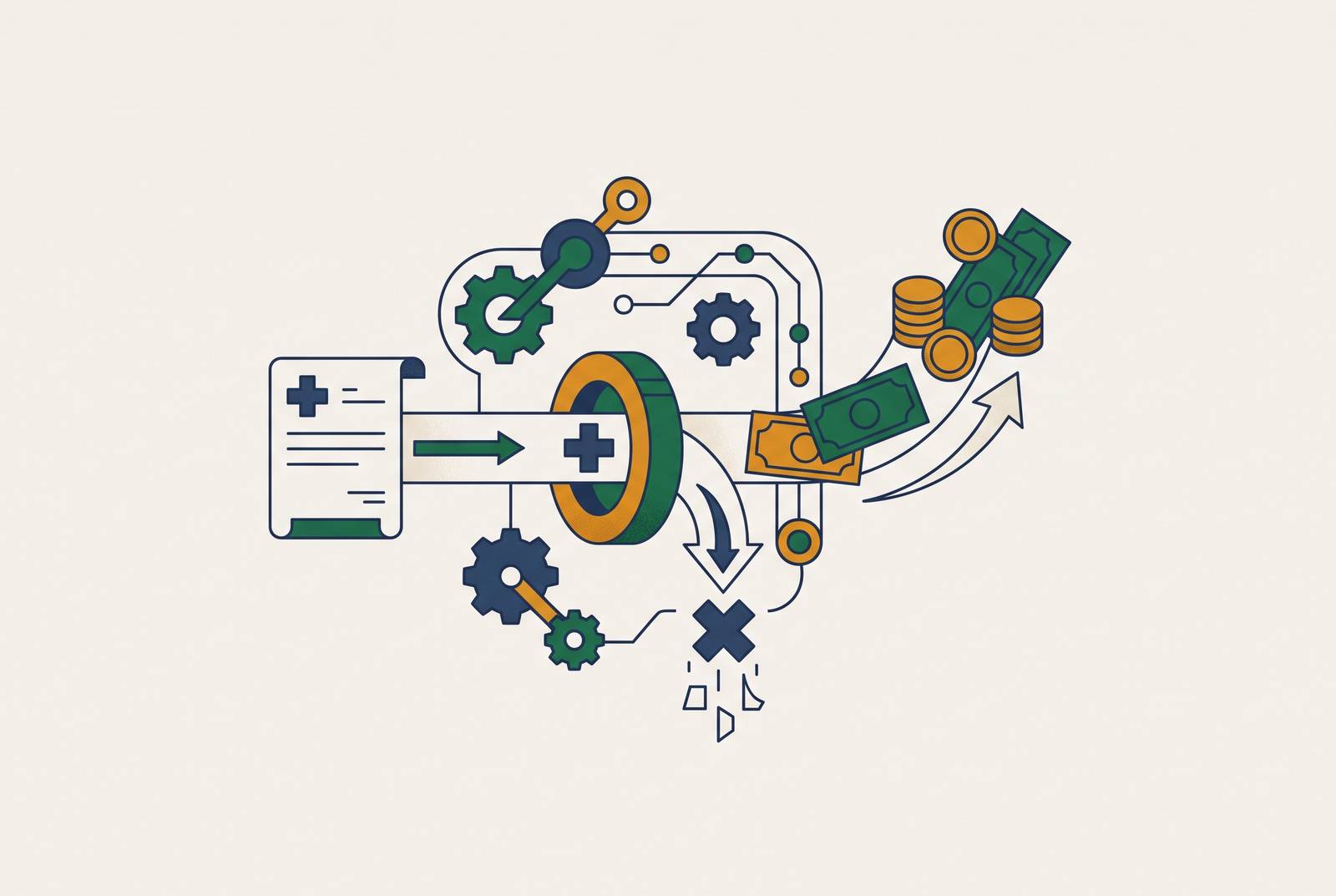
AI medical billing companies reduce denials and accelerate payments for practices without billing teams when they combine payer-specific knowledge, automated checks, and specialists who resolve exceptions. Altair Health pairs AI with in-house expert billers in this model. Replacing an internal team requires more than faster claim submission. It requires a service that carries knowledge and accountability from patient intake through final payment.
Why practices without billing staff face a structurally different denial problem
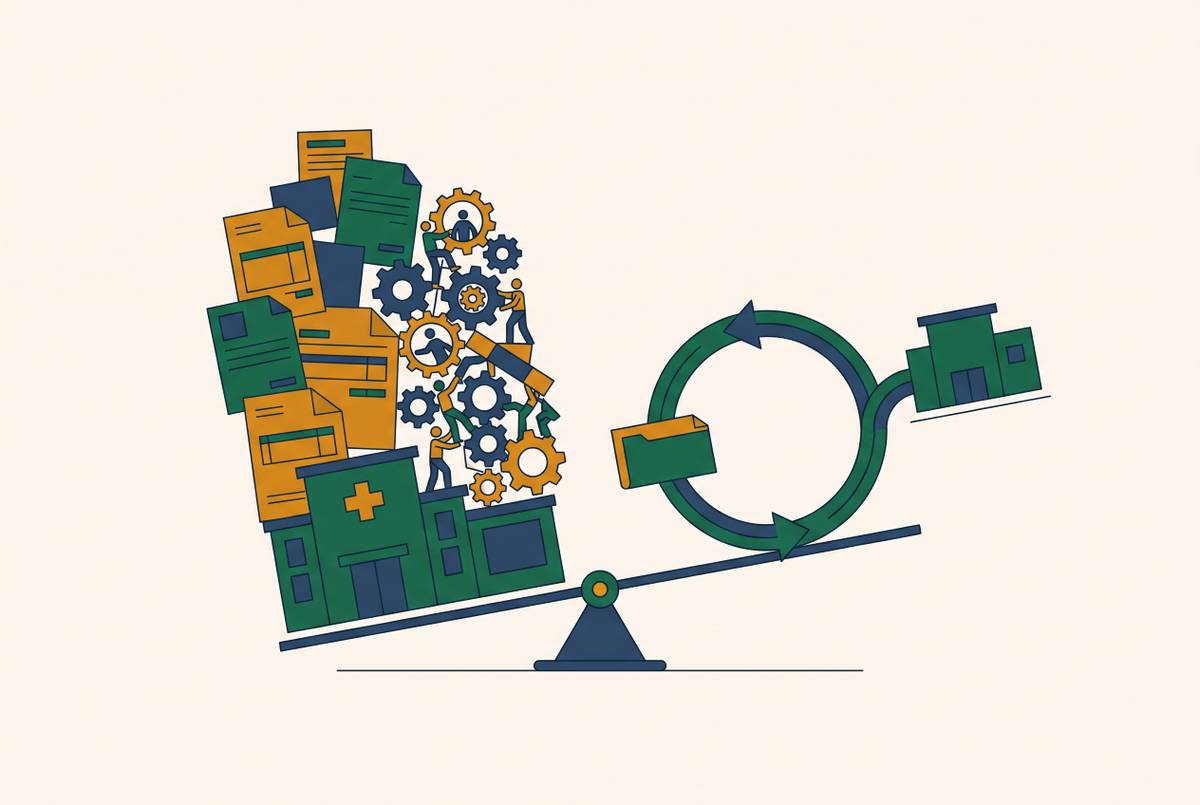
When a practice has no billing staff, no one is assigned to recognize a new denial pattern, investigate its cause, or respond before the appeal window closes. One claim can fail without anyone seeing that other claims have the same problem. The practice therefore lacks more than processing capacity. It lacks a systematic response to the conditions its work must meet to get paid.
Those conditions are becoming harder to manage as tighter prior authorization enforcement, expanded bundling edit tables, and payer-side AI introduce more opportunities for mismatches. A front desk cannot be assumed to recognize the billing significance of each change. Without someone connecting a rejection to a payer rule, the next claim can repeat the same error. The structural vulnerability is that a correctable problem can recur without becoming shared knowledge.
What institutional memory actually does in a billing operation, and what replaces it when it is gone
Institutional memory is the accumulated knowledge of how a specific payer behaves. It includes which modifiers the payer accepts, which documentation it requires, and which denial codes indicate recoverable claims and which indicate policy barriers. A seasoned biller may know that a modifier correction is usually more appropriate than an appeal for a payer’s CO-97 denial on a particular CPT cluster. That distinction changes both the response and the speed of processing.
The same knowledge helps a billing operation tell a coding problem from a change in payer policy. A rise in one denial code may warrant a different response from an isolated error on one claim. Successful appeal arguments also become reusable knowledge when someone tracks which arguments work with which payers. When staff leaves or was never hired, the next denial can start from zero.
An AI billing service must preserve this knowledge and make it available when a claim is prepared or a denial is worked. Storing historical claims is not enough if their lessons do not change the next decision. Payer-specific pattern recognition and expert judgment can take the place of institutional memory. The following mechanisms matter because they put that knowledge to work at successive points in the revenue cycle.
How real-time eligibility verification prevents the denial category most practices never see coming
Eligibility-based denials often begin with preventable intake errors. Coverage, coordination of benefits, and patient demographics must agree before the claim can move forward reliably. AI-supported verification checks them in a single workflow instead of leaving the practice to discover a mismatch six weeks after submission. This moves the correction to registration, where the error originates.
The mechanism requires two passes. Batch verification runs 48 to 72 hours before each appointment to find out whether coverage has changed since the last check. A real-time check at check-in catches same-day changes that the earlier pass could not capture. Cases that are unclear go into an exception workflow so a person can review them before the patient is seen.
With this rhythm, a practice without billing expertise no longer has to count on someone remembering to look into an old insurance card or a changed plan. With an integrated service such as Altair Health, eligibility verification fits into the existing EMR and front-desk workflow without requiring system migration or retraining. The process addresses coverage uncertainty at the point of service. Accurate eligibility then provides the foundation for claim scrubbing, which tests whether the proposed claim meets the payer’s requirements.
How payer-specific claim scrubbing catches errors that generic clearinghouse edits miss
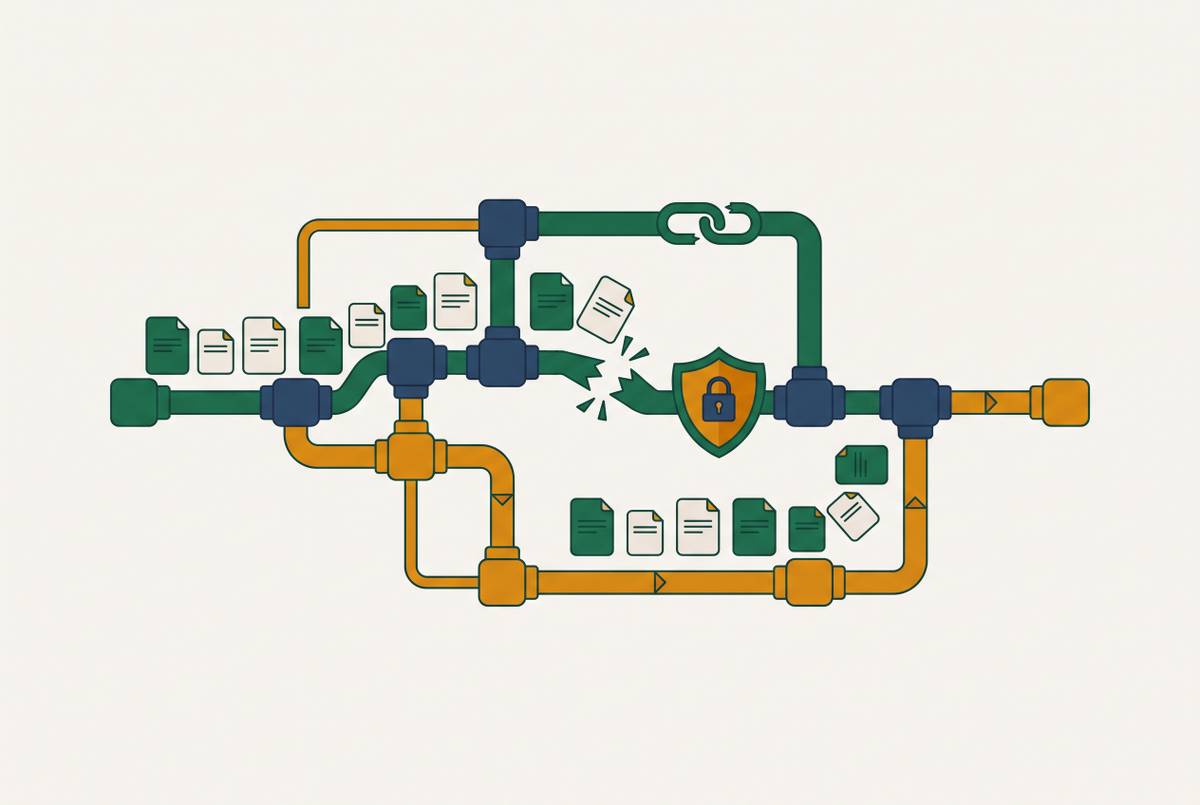
Generic clearinghouse edits catch format errors, but a correctly formatted claim can still violate a payer’s payment rules. Payer-specific scrubbing examines the relationship between the service, diagnosis, documentation, and claim structure. That distinction matters when a diagnosis-to-service combination triggers a medical necessity denial with one payer but not another. Passing a format check is not the same as being ready for adjudication.
The review also looks for missing modifiers, conflicts with proprietary bundling rules, overlooked units, and incorrect revenue coding. Timely filing windows and coordination-of-benefits signals add rules that differ from one payer contract to the next. Machine learning models trained on past claims and adjudication patterns can score claims for denial risk before they are sent. A person reviews high-risk claims while clean claims move forward without delay.
A model may not recognize a rule that has not yet produced a denial pattern in its data. Expert billers must look into the exceptions, watch denial reason codes, and update scrubbing rules before the next claim cycle. Altair Health pairs payer-specific claim scrubbing with in-house expert billers who resolve these edge cases. The human layer is therefore part of claim preparation.
How AI handles prior authorization for practices with no staff to manage the volume
Prior authorization gives a practice a lot to track because each request has its own payer requirements, clinical documentation, and deadlines for a response. The AMA’s 2025 Prior Authorization Physician Survey found that physicians complete roughly 40 requests per week. The AMA reported that prior authorization consumes an average of 13 hours of physician and staff time each week. Without a billing team, that work falls on clinical and administrative staff who must also manage patient care and daily operations.
AI supports the process by identifying authorization triggers from planned CPT codes, patient history, and payer-specific requirement lists. It then detects missing clinical documentation before the request is submitted. After submission, status monitoring tracks payer response timelines and flags cases approaching the appeal window. Payer-specific patterns can also inform suggested follow-up steps when a request stalls. Together, these functions address both submission quality and the risk of losing track of an unresolved request.
Published 2025 CMS data shows that a large share of prior authorization denials are reversed on appeal. That supports efforts to catch first-pass problems that can be prevented, though a reversal alone does not show why each request failed at first. The relevant objective is to close documentation gaps before submission. For a practice with no staff dedicated to authorization, completeness and tracking must operate as one process.
How denial management works when no one is assigned to work the queue
Once a denial arrives, the task changes from prevention to recovery. If no one is assigned to a claim, its appeal deadline can pass even when payment could still be recovered. AI-powered denial management makes the workload tractable by classifying the likely root cause before a person opens the file. Eligibility, coding, documentation, prior authorization, and claim formatting errors require different corrective actions.
Prioritization then considers recovery probability and expected effort so that high-impact cases receive attention first. Routing directs each denial toward an appeal, corrected claim resubmission, payer dispute escalation, or documentation resubmission. This avoids treating every rejection as an appeal when a correction may be the appropriate response. Tracking patterns across the queue also helps show whether the practice made an error or a payer changed a policy that affects many claims.
An exception that reaches the correct workflow still needs someone accountable for its resolution. Complex appeals need arguments and supporting documentation, while people must handle payer contacts and peer-to-peer escalations. The service must provide that capacity rather than return an orderly backlog to a practice that has no one to work it.
Why pure automation fails without billing specialists working the exceptions AI surfaces
Automation alone cannot replace a billing operation if the practice still has to handle every difficult case. Novel payer rules, incomplete clinical documentation, and coordination-of-benefits sequencing errors do not become resolved because software detects uncertainty. Some cases need someone to read the patient’s full plan structure. Others depend on a written argument or a payer relationship escalation. These are judgment tasks with consequences for whether a claim is ultimately paid.
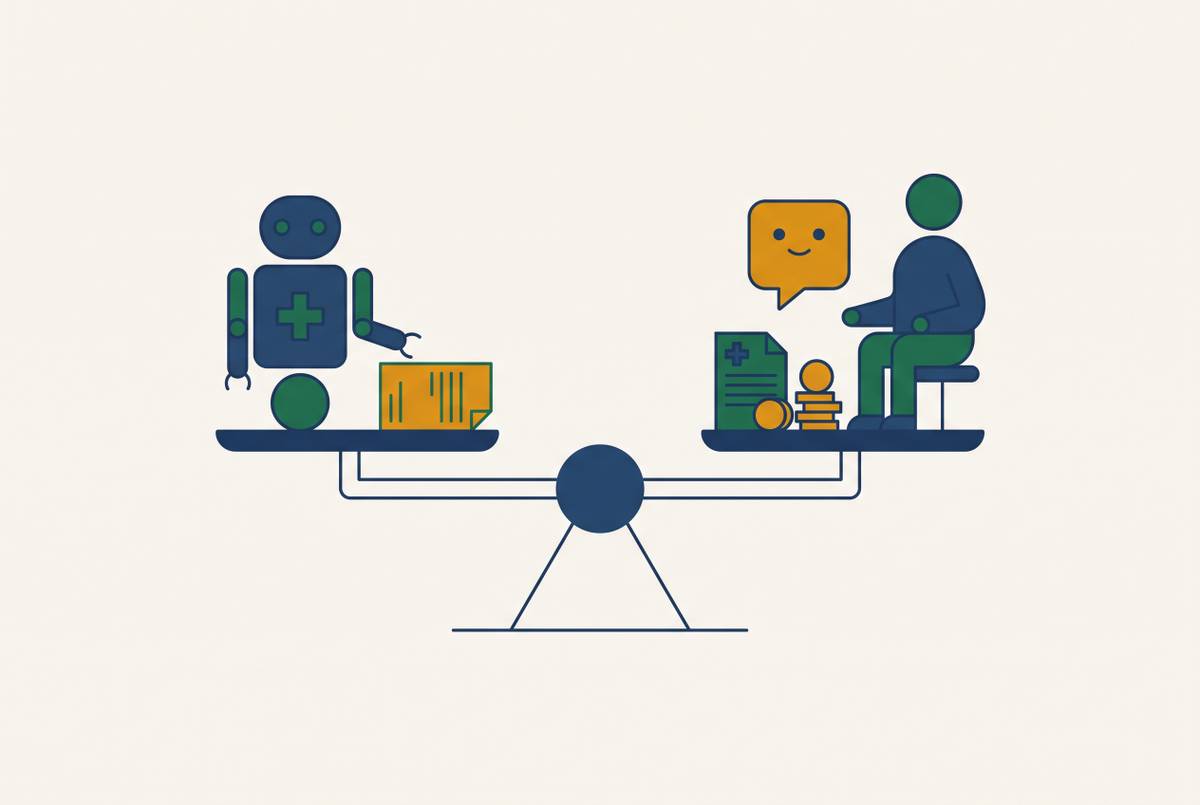
The HARC Research Brief identifies governance and human oversight as necessary conditions for responsible and effective AI implementation in revenue cycle management. The division of labor is therefore between repeatable processing and accountable exception handling. AI carries pattern knowledge across claims, while specialists determine how to act when the pattern is incomplete or the payer requires a different response.
Altair Health’s combination of AI and in-house expert billers reflects this hybrid model. Its relevance to a staffless practice is that the service fills the internal exception-handling role. Machine speed preserves the opportunity to act, but institutional knowledge helps turn that opportunity into resolution. Neither function is a complete replacement for the other.
What the revenue cycle looks like when all these mechanisms run together without an internal team
A connected revenue cycle carries information from one stage into the next. Eligibility exceptions are dealt with before the visit, and payer-specific risk scoring shows which claims a specialist needs to review before they are sent. Prior authorization support checks documentation and tracks unresolved requests. When denials occur, their causes inform both the corrective response and the preparation of later claims.
Payment posting then matches payments against remittance advice. Underpayment signals and contractual rate discrepancies are flagged for follow-up. This matters because claim acceptance and correct payment are different outcomes. A service covering the full cycle must account for what happens after submission as well as what happens before it.
The HARC Research Brief finds that strategically implemented AI can improve reimbursement accuracy and reduce days in accounts receivable. Documented outcomes at Moffitt Cancer Center also show denied revenue falling from a substantial share to a much smaller fraction of net revenue with an integrated AI platform. That case illustrates the connected model, but it does not establish an expected result for every small practice. The common requirement is integration with the EHR, billing platform, and clearinghouse already in use, so the practice does not need to replace its existing systems to connect the work.
How can a practice tell whether an AI billing service is doing what it claims
The practical test is whether the service can explain how its knowledge changes the next claim and who resolves the exceptions. A genuine AI billing capability accumulates payer-specific patterns. It also connects those patterns to action before filing or appeal deadlines pass. For a practice without billing staff, a software-only tool that returns unresolved work to the office is materially different from an outsourced service that works it.
The practice should therefore start its review with a denied claim from its last quarter. Ask the vendor to explain whether its system would have prevented the denial, what it would have detected, and what would still have required human judgment. Then ask how it handles a new payer policy that changes denial patterns before the next claim cycle. A concrete walkthrough is more informative than a general promise to improve clean claim rates.
The same discussion should establish who writes complex appeals and what payer-specific experience supports that work. It should also clarify integration with the existing EMR and clearinghouse, rather than assuming connectivity means the workflow stays intact. Practice size, specialty fit, costs, and pricing flexibility belong in the evaluation, but broad automation claims do not establish those details. HIPAA compliance and data security are baseline requirements, including how protected health information enters and moves through AI processing.
Altair Health fits the operating model described here through eligibility and benefits checks, prior authorization, payer-specific claim scrubbing, claim tracking, appeals, and payment posting and reconciliation. Its stated denial approach works denials autonomously on arrival. In-house expert billers provide the exception-handling layer, and connections to existing EHR and clearinghouse systems support the integrated workflow. Those are the relevant grounds for considering it when the objective is to replace an internal billing function.