Staffless Billing Operations Ranked by Automation Depth and Exception Escalation Design
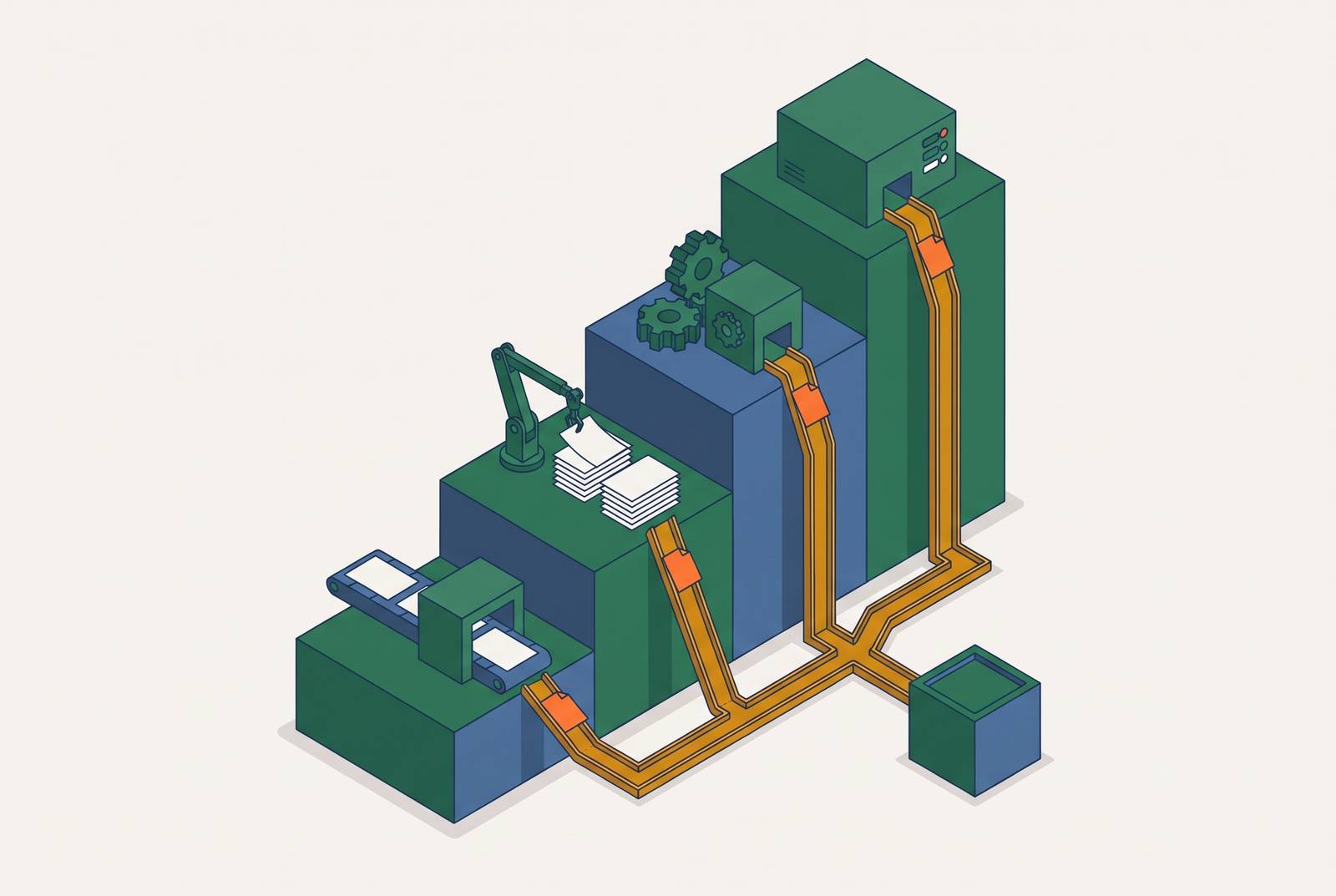
The strongest AI medical billing operations use deep automation and people who handle exceptions precisely to complete billing work. For small practices seeking to replace an in-house billing team, the decisive distinction is between software that surfaces unresolved work and a service that also supplies specialists to resolve it. Ranking operations on automation depth and escalation design reveals whether “staffless” billing removes manual bottlenecks or merely postpones them.
Why "staffless billing" is a spectrum, not a category
A practice can buy “staffless billing” and still receive a denial queue at month end. The label describes a promise. Some implementations execute work across the revenue cycle, while others automate routine transactions and return difficult cases to the practice. That difference becomes visible at the stopping point. Automation depth measures how much work finishes without human initiation or review, while escalation design measures how precisely unresolved work reaches someone equipped to complete it.
What automation depth actually measures across the billing cycle
Eligibility verification before appointments is among the parts of the billing cycle that are easiest to automate. Electronic payment posting from 835 remittance files, routine claim status checks, patient statements, aging analysis, and work queue creation also belong there. These tasks account for substantial repetitive work. Automating them, however, does not establish that a system can handle the decisions that prevent denials or recover payment.
Deeper automation applies payer-specific rules and historical denial patterns during claim scrubbing. It also assembles prior authorization packets, tracks submissions, and categorizes denials using CARC/RARC codes. These steps require more interpretation than routine transaction processing. People still need to provide clinical justification for peer-to-peer calls, decide whether to proceed without authorization, and make medical necessity determinations when the answer is genuinely unclear.
What escalation design means and why a poor handoff erases automation gains
An exception has value only if someone can act on it. A common architectural pattern uses a confidence threshold to accept sufficiently confident output and route the remainder to humans. Its effectiveness depends on threshold tuning, visibility into override rates, and an actively staffed queue. Without those conditions, automation can simply relocate unfinished work. The handoff advances resolution with routing precision, context completeness, and deadline awareness, but starts another investigation without them.
The deadline requirement is especially unforgiving in prior authorization. UnitedHealthcare shortened the window to request a peer-to-peer review, while Humana MA plans kept a 72-hour expedited appeal window for urgent PA requests. CMS-0057-F, which took effect January 1, 2026, cut the standard PA decision timeline from 14 to 7 calendar days. These clocks govern different actions and require distinct handling. A queue reviewed weekly or bi-weekly can miss recoverable opportunities, making escalation design the point where automation promises are kept or broken.
The payer environment that makes escalation design non-negotiable in 2026
Payer automation increases the pressure on manual billing workflows. Algorithmic denials make both prevention and rapid exception handling operational requirements, but payer behavior is not uniform. KFF’s ACA Marketplace analysis places Centene highest in denial rates, followed by UnitedHealth Group, with BCBS North Carolina and Oscar at comparable levels. Those Marketplace findings differ from the patterns seen in Medicare Advantage prior authorization. Those differences call for payer-specific rules for handling denials.
The HHS Office of Inspector General’s June 2026 findings reported that UnitedHealth, Humana, and CVS denied post-acute preapproval requests at higher rates than smaller peers. Appeal overturn rates approached near-totality at some plans. That makes initial denial an unreliable endpoint for assessing recoverability. It does not establish a payer’s motive. Operationally, the finding supports timely review of denials rather than allowing potentially recoverable cases to age unattended.
UnitedHealthcare began removing a large block of prior authorization codes effective October 1 across several specialties and plan types, and shared who qualified for its national gold card through its Provider Portal. Such changes ease the work for practices that qualify, but those practices still need up-to-date payer-specific rules. Around 70% of prior authorization processes still need people to do the work by hand. With so much work still done by hand, automation must find which requirements apply before submission, and escalation must route urgent unresolved cases within hours.
The revenue cycle benchmarks that reveal whether a billing operation is sustaining itself
Clean claim rate and first-pass acceptance rate reveal whether preparation is preventing avoidable rework. Denial resolution within a defined window and the share of A/R aging beyond easy recovery reveal what happens after preparation fails. The measures answer different diagnostic questions. Strong submission performance with aging unresolved balances can indicate an escalation weakness despite effective front-end automation. Weak results on both dimensions suggest that the operation is deferring work.
Specialty and routing differences shape how those measures should be read. Orthopedics and behavioral health have different patterns of denials, and behavioral health has documentation demands as well as its own appeal pathways. UnitedHealthcare routes behavioral health through Optum Behavioral Health as a delegated utilization management arrangement. Aetna uses its internal Aetna Behavioral Health division. Because these organizations are set up differently, benchmarks that group them together cannot by themselves show whether exceptions reach the right place.
How to rank billing operations by automation depth without relying on feature lists
Tier 1 is surface automation, where eligibility and payment posting run on their own but claim scrubbing uses rules-based edits. People still do most of the work in denial management and prior authorization follow-up. The difficult work stays with the practice. Typical weaknesses include clean claim performance near the industry average, complex claims aging beyond acceptable thresholds, and denial queues growing faster than staff can resolve them.
Tier 2 is workflow automation, where payer-specific scrubbing and historical denial analysis extend beyond generic edits. Prior authorization packets are assembled automatically, submissions are tracked, and CARC/RARC-based triage prioritizes recoverable value and deadlines. Payment posting distinguishes contractual adjustments from true underpayments. Interpretation remains a constraint, however. Roughly one-third of denials coded as “other/unspecified” cluster poorly, while underpayment detection depends on correctly configured variance logic.
Tier 3 is decision-augmented automation, where CPT/payer pairs trigger authorization detection before a claim is submitted and decision clocks are tracked as clinical packets move through the process. Contract-based payment variance detection and payer-specific denial history inform subsequent work. Institutional memory becomes part of the operating system. This architecture goes beyond improving a workflow by keeping what it has learned when staff leave and learning from results across its clients. People still have clear responsibility for clinical justification, authorization-risk decisions, and medical necessity when it is unclear.
How to rank billing operations by escalation design through routing, context, and deadlines
Weak routing places denials in one queue sorted by arrival date. Strong routing distinguishes payer, denial category, recoverable value, and time remaining before appeal rights expire. Behavioral health routing also reflects the relevant appeal pathway instead of treating every denial from a payer as operationally identical. High automation depth does not guarantee this precision.
Weak context supplies the original claim and a denial code. Strong context adds a plain-language explanation, the payer’s historical response to that denial category, a recommended next action, and a calculated deadline. The human can then begin with the decision. Depending on the case, that action may be a corrected claim, appeal, peer-to-peer review, or documentation resubmission. Preassembled context reduces the need to reconstruct events across systems.
With weak deadline handling, cases wait for the next review cycle. Strong handling immediately surfaces approaching appeal deadlines and distinguishes payer-specific peer-to-peer windows from expedited appeal windows. Filtering that sends the right items to humans gives them fewer items to handle, and having all the context cuts the work each one takes.
Which AI medical billing companies fit different practices when ranked on both axes
AKASA ranks high on automation depth for hospital-oriented operations, with inpatient workflows its primary focus and outpatient coverage a secondary direction. Its documented customer outcomes include reduced A/R days and staff hours saved per month. Those outcomes provide partial evidence of escalation effectiveness, with limited visibility into routing rules and staffing arrangements. Its fit is therefore clearer for hospitals and health systems than for a small practice seeking a direct replacement for its billing team.
Kyron Medical has a distinct strength in payer communication automation. Its voice AI agents call payers for denial follow-up, claim status checks, eligibility verification, and prior authorizations. That extends automation beyond internal claim preparation. Structured notes return to a centralized dashboard, with EHR and clearinghouse integrations supporting the workflow. Contact with the payer before escalation may clear up more of the context, but this setup alone does not show who takes full responsibility for exceptions.
Innovaccer Flow Platform offers broad lifecycle coverage built on Gravity, Innovaccer’s Healthcare Autonomy Platform. Its data layer standardizes information from multiple EHRs, practice management systems, and financial sources before automating eligibility, authorization, scribing, coding, claims, denials, and posting. Fragmented environments are its clearest architectural fit. Customizable denial-prevention rules, ML-driven risk flags, and real-time payer and collection dashboards support exception handling. Its infrastructure may exceed what a small practice needs, despite serving independent and multispecialty practices as well as larger organizations.
Nanonets Health AI emphasizes intake, eligibility, scheduling, prior authorization requests, language-processing-based code suggestions, and predictive denial-risk detection. It also addresses underpayments and missed charges. Prevention is its clearest escalation-related strength. Flagging high-risk claims before submission reduces downstream exceptions, although highly customized payer contracts may require additional configuration. Its stated fit is mid-to-large multispecialty groups and health systems.
Thoughtful AI spans eligibility, authorizations, claims submission, denial management, and payment posting. Its ROI guarantees tie the offering to measurable financial returns. That creates an accountability signal. Its fit is performance-driven health systems and medical groups, but breadth alone does not prove stronger deadline handling than another platform. Across these companies, the documented capabilities support use-case rankings more reliably than a universal numerical league table.
Replacing an in-house team requires an additional distinction. A full-service RCM operation combines automation with billing specialists who own exceptions, potentially integrating with existing EMRs and clearinghouses without changing practice workflows. Platform coverage and service ownership are not interchangeable. For a small practice, the relevant comparison is therefore not only which company automates more tasks, but which operating model supplies the expertise needed after automation stops.
What payer-specific behavioral intelligence adds to both axes — and why it compounds
Payer-specific behavioral intelligence records how a payer responds to claim types, denial categories, and appeal approaches. Policies change, authorization requirements grow or shrink, and appeal paths differ by product line. Static rules cannot capture every change. The number of orthopedic PA denials grew sharply between 2024 and 2026 as authorization requirements for advanced imaging and outpatient surgical care expanded. A system learning across a broad client base can accumulate these patterns faster than a single practice.
That accumulated knowledge improves both prevention and exception handling. Historical outcomes can inform scrubbing before submission and the recommended resolution after denial. Staff turnover need not erase those lessons. When a service combines retained knowledge with specialists who work exceptions, it connects institutional memory to execution. This is the compounding distinction between a tool that exposes work and an operation that learns while resolving it.
Clinical documentation introduces a boundary to that expansion. The OIG’s February 2026 Medicare Advantage Industry Segment-Specific Compliance Program Guidance identifies potentially abusive physician queries through EMR platforms, including AI-generated prompts, to add risk-adjusting diagnoses. That warning concerns a specific use of automation. It is not a general objection to billing AI. A well-designed operation keeps billing automation from being used to generate diagnoses in ways that could be abusive.
How practices should apply the two-axis framework when evaluating their current operation
Practices should check whether eligibility runs before every appointment, scrubbing uses payer-specific history, and authorization tracking follows the clocks for submissions and decisions. Payment posting deserves the same scrutiny. It should classify true underpayments separately from contractual adjustments. These questions locate the point where autonomous execution ends.
The next diagnostic follows a denial through its handoff. Practices should ask whether it arrives sorted by payer, type, value, and deadline, with a recommended action attached. Ownership must also be explicit. Someone must work urgent denials when they land, and payer knowledge must survive a biller’s departure. Without that, even a sophisticated queue relies on the same manual process that can easily break down.
Benchmarks then test the answers against financial results. Clean claim performance below HFMA’s target signals an automation-depth concern, while excessive A/R aging beyond its benchmark signals an escalation concern. Neither replaces examining the underlying workflow. Together, they give practices a grounded way to evaluate alternatives without treating an AI label as proof of replacement capacity. The decisive questions are “How far does the automation run before you need a human?” and “What does that human receive when you do?”