What a Fully Managed RCM Service Actually Does When a Claim Gets Denied or Ignored
Fast denial response requires payer expertise and operational discipline, not just billing staff.

Outsourcing medical billing is an option when a practice cannot reliably capture denials, meet payer deadlines, build targeted appeals, and track outcomes with its own staff. A fully managed RCM service handles all those steps as well as taking on more billing work. Its value depends on combining fast processing with payer-specific judgment and a durable record of what works, because denial response is as important as prevention.
Why denials are structurally harder to manage in 2026 than they were five years ago
Payers can screen claims with AI at machine speed, while many practices still look into denials one at a time after they arrive. That asymmetry changes the demands on billing operations. A practice must identify the reason for each denial, establish the response deadline, and assemble the right evidence while new denials continue entering the queue. Faster adjudication does not give the practice more time. Shortened response windows instead compress the period available for that work.
Prior authorization adds pressure because the lists of requirements have grown and payer policies keep changing, which affects which claims need supporting documentation before they can be paid. Code inaccuracies and coverage disputes create different problems, even when they arrive together in the same remittance. The appropriate response therefore depends on more than recognizing an unpaid balance. It requires distinguishing a correction from a clinical appeal and identifying whether an immediate review opportunity applies. Denial management in 2026 is a time-sensitive specialty that requires attention alongside other billing work.
What practices lose when denial response is slow or ad hoc
A denied claim may still be paid. The money can be lost later, when the deadline for a recoverable claim passes without an adequate response. A clinically supported service may remain unpaid simply because no one filed the appeal in time, an operational failure. Fragmented responsibility makes the exposure harder to see because the denial, supporting records, and deadline may sit in different places.
HFMA/Guidehouse’s 2026 survey of provider executives found that medical group executives reported the highest final denial rates, with well over a third reporting rates above five percent. Medical groups have less room to take on repeated claim work than health systems that have teams set aside for it. For a small practice, that work competes with the rest of the revenue cycle rather than entering a separate, fully staffed operation. The cost includes both unpaid claims and time spent reconstructing their histories. A final denial rate also measures a different outcome from an initial denial rate, so the two cannot serve as interchangeable performance benchmarks.
Weekly or bi-weekly review creates a further mismatch when a response window is measured in days. Review cadence is a financial decision because time elapsed before a denial is noticed reduces the response time available even to a capable biller. The relevant comparison is not simply the cost of an outside service against the salary of an employee, but whether either arrangement can protect recoverable revenue before deadlines expire.
How payer denial rates vary and why that variation changes the response required
CMS’s ACA marketplace data shows roughly one in five in-network claims denied across tens of millions of submissions in HealthCare.gov states. Denial rates vary by nearly twenty percentage points across major national insurers. Employer-sponsored plans and publicly funded managed care plans report their results in different ways, so marketplace results cannot show what denial rate a practice should expect across its whole payer mix.
In that marketplace data, Oscar and Molina deny shares of claims that are above average, while another insurer’s rate is low because it has an integrated payer-provider structure. Integration removes much of the documentation friction found when independent practices bill separate insurers. That architectural advantage is not available merely by improving an appeal letter. A payer with a higher denial rate may still have published guidance. Oscar publishes medical and pharmacy clinical guidelines, and Molina publishes clinical policies that it uses to decide what to cover.
The operational consequence is that an appeal must address the relevant payer’s rules rather than a generalized idea of what insurers require. Published policies, authorization requirements, and available review routes supply different parts of that response. Payer identity is therefore an input to the work. A denial rate helps describe the environment, but it does not tell the billing team which evidence will resolve an individual claim.
Stage one of the managed RCM denial response: capture and triage within 24 to 48 hours
A managed denial workflow begins with scheduled capture from electronic remittance advice files, payer portals, and clearinghouse reports into a single system of record. Automated ingestion avoids the delay of manually re-entering information or discovering a notice during a later balance review. The capture standard is one to two business days after remittance. Every record includes the CARC and RARC codes, dollar amount, payer, denial date, and appeal deadline. Without those fields, a queue cannot be prioritized reliably.
Triage then separates eligibility, authorization, coding, clinical, and timely filing denials because each category has a different resolution path. Dollar value and days remaining before appeal determine the order of work. A high-value claim with ample time remaining presents a different scheduling problem from one approaching its final opportunity for review.
The capture target is not permission to wait. UnitedHealthcare’s provider appeals guidance says most peer-to-peer reviews need to be requested within 24 hours of coverage denial, with inpatient cases allowed 3 business days and outpatient cases 21 calendar days. Those review windows apply specifically to peer-to-peer reviews and need close attention. Checking once a week can leave no time to request a review. Triage must therefore check whether a claim can get an urgent review as well as when its appeal is due.
Stage two: root-cause analysis and payer-specific appeal construction
Once a denial is categorized, root-cause analysis identifies the appropriate response: correction, resubmission, authorization work, or a substantive appeal. An eligibility denial may need the subscriber information to be corrected, while a timely filing denial may need proof that the claim was submitted. A prior authorization denial may call for retroactive authorization or a clinical appeal with supporting records. Medical necessity requires a different argument. Physician documentation must address the language in the payer’s clinical policy and go beyond saying again that the service was ordered.
Payer knowledge shapes how that evidence reaches the reviewer. Some appeals can cite published clinical policy bulletins, while others go through utilization management vendors that have their own appeal portals. Gold card programs may also establish that an authorization requirement should not have applied. These are not interchangeable routes. Selecting the wrong one can turn an otherwise adequate response into another round of work.
AI fits this stage when its role follows the complexity of the denial. It can draft denial-specific letters and assemble evidence packets, with minimal human intervention for suitable lower-complexity work such as duplicate claims, eligibility issues, and timely filing. Machine speed supports documentation assembly, while billing specialists apply payer-specific judgment to the argument and decide whether peer-to-peer review is appropriate.
The manufacturer’s reimbursement guidance states that S0013 was discontinued and replaced by J0013 for esketamine, or Spravato, effective January 1, 2026. Commercial payers adopted the change at different speeds, creating automated denials when a correct new code reached a system that had not updated. The remedy depended on the payer’s timeline. Preserving that information prevents each biller from having to rediscover the same mismatch.
Stage three: escalation, peer-to-peer coordination, and external review
When a clinical denial survives the first appeal, a managed service evaluates the next available route rather than treating the letter as the end of its responsibility. Peer-to-peer review brings the treating physician into discussion with the payer’s medical reviewer. The service identifies eligible denials and coordinates physician scheduling before the applicable window closes. Clinical participation still belongs to the physician. Outsourcing the coordination places deadline tracking and preparation within a defined workflow.
External independent review may be available after an unsuccessful internal appeal, depending on the plan type and state. Independent reviewers assess whether the payer applied appropriate clinical standards, and overturns at that stage are binding on the payer. Availability is not universal. The service must work out which claims can go to external review and which need another route, including a regulatory complaint where appropriate. Escalation depends on knowing both the denial and the rules governing the plan.
The proposed Doctors Not AI Act would prevent AI from making or dictating coverage decisions involving medical judgment while allowing it to assist with claims processing. A proposed bill is not an operative appeal right. Existing state and payer requirements determine the grounds available in a particular case. Repeated requests for documentation, explanations that conflict, or missed appeal timelines may also need a closer look, but finding a pattern requires examining the claim history.
Stage four: tracked follow-through and the prevention loop it closes
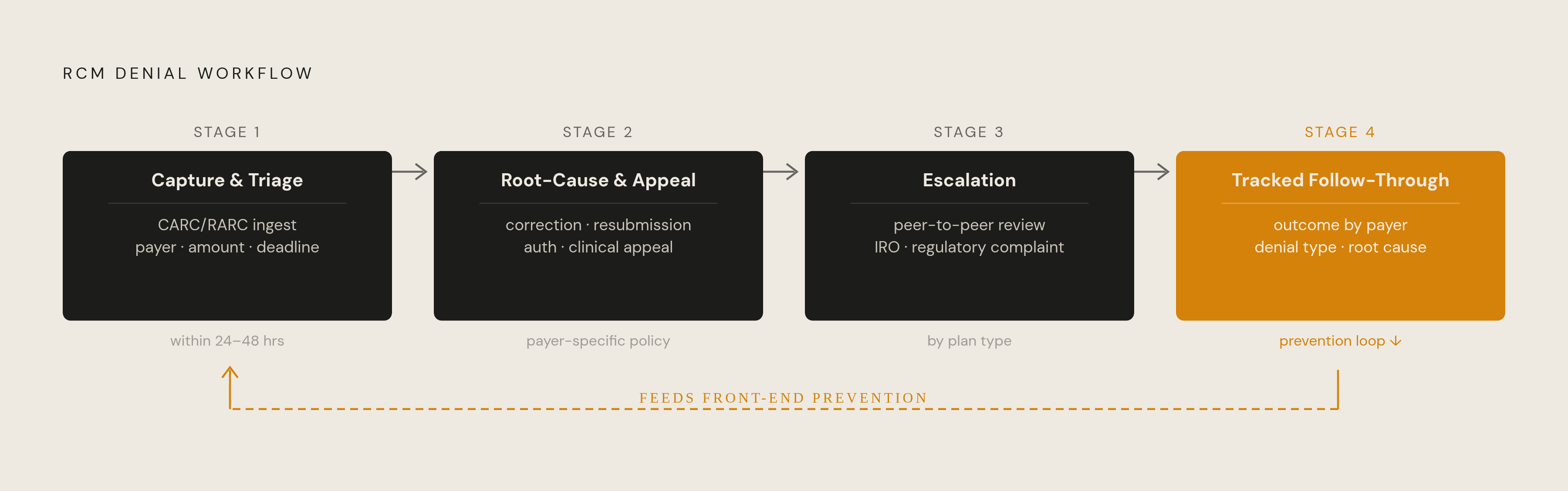
Appeal submission is an intermediate event in recovery. A managed service follows the claim through its outcome and records results by payer, denial type, and root cause. That makes appeal overturn rate a usable performance measure. The stated target is above half, with a rate below roughly a third signaling a need for review. Those thresholds must be interpreted against the claims being appealed rather than treated as a promise that every denial category will perform alike.
Outcome tracking also separates a weak appeal strategy from an upstream problem. If a payer begins denying a CPT code that previously passed cleanly, a recorded pattern can flag a policy change before the affected inventory grows. Eligibility-related results point to a different intervention. Verification at scheduling, registration, and day of service addresses errors before submission. Recovery data shows the front end and appeals team where to work together to prevent denials.
Black Book Research found that nearly three-quarters of revenue cycle leaders prioritized denial prevention over post-denial recovery. The same survey found that a large majority linked front-end data quality directly to denials or cash timing. These priorities reinforce one another when outcomes feed back into workflow changes. Community Medical Centers in Fresno applied AI to prior authorization workflows and reported fewer prior authorization denials and substantial weekly time saved on appeals.
A documented payer-specific correction, appeal result, or policy change becomes part of a record available for the next claim. Staff turnover need not erase it. As that record develops, the service has more evidence for selecting an effective response and recognizing recurring causes before they generate further denials.
Should a practice outsource billing when its in-house team cannot sustain the full sequence?
The decision turns on operating capacity: an in-house team can remain appropriate when it can sustain timely capture, payer-specific analysis, escalation coordination, and outcome tracking while covering its other responsibilities. Keeping billing in-house is no guarantee that the team can do all that. Equally, hiring an outside service does not guarantee them. The comparison should center on who owns each stage and whether the practice’s actual workflow supports the deadlines involved.
A fully managed service’s advantage is concentrated infrastructure and expertise. Its limitation is that clinical judgment and necessary physician participation cannot simply be transferred away from the practice. AI alone does not resolve that boundary. HFMA/Guidehouse found that a substantial share of executives had not implemented revenue cycle AI or automation, while fragmented adoption remained a problem among those using it. Fast drafting without informed review can accelerate the wrong response.
The right service combines machine pattern recognition for ingestion, categorization, and drafting with billing specialists who handle payer-specific exceptions. Integration with the practice’s existing EMR and clearinghouse allows that sequence to operate without requiring a rebuilt front desk or retrained clinical staff. A small practice can use those capabilities to compare outsourcing with hiring another person in-house. A service that records what each denial teaches can improve its response over time rather than restarting the learning curve whenever staffing changes.